Friday, August 24, 2007
Kismet
About 13 minutes into Astrogeny on John Blum Astrogeny Quartet, Eeremite, William Parker and Denis Charles, who would die a month later, achieve perfect bass-drums symmetry and create the exact base needed for pianist Blum and reedist Antonio Grippi to wrap up the improvisation. Should be taught in free jazz school, assuming free jazz school existed.


Wednesday, August 22, 2007
Lee Konitz, Jazz Nocturne, Evidence
On Misty I started thinking "what an unusual rendering of an old standard," abstract, albeit it recognizable in a Picasso Don Quixote kind of way. Some Monkian cliff hanging and the concomitant tension and release also characterize the effort. Par for the program, which includes similar recastings of Body and Soul and My Funny Valentine, among other standards. A good illustration of what makes Konitz a special player.
Sunday, August 19, 2007
The Big Horn, Proper Records
Subtitle: The History of the Honkin' & Screamin' Saxophone. The thing amusing me right now is how much I hear Albert Ayler, who started out playing R&B in Cleveland and did a stint with Little Walter, in somebody like Wild Bill Moore. Albert would later bend that big tone and those high- and low-register effects to his own purposes, but the roots are the same and I think that's why I frequently discern an underlying sense of hand-clapping, foot-stomping swing in Albert's stuff.
The four CD-box covers proto-rock boogie-woogie, jump, R&B saxophonists only a few of which I know much about (Illinois Jacquet, Arnett Cobb, Willis "Gator Jackson, Buddy Tate) and while the music may not be serious art it is serious fun and guys like Wild Bill, Big Jay McNeely and Earl Bostic could flat blow. Not a boring cut in the lot. Great stuff.
The four CD-box covers proto-rock boogie-woogie, jump, R&B saxophonists only a few of which I know much about (Illinois Jacquet, Arnett Cobb, Willis "Gator Jackson, Buddy Tate) and while the music may not be serious art it is serious fun and guys like Wild Bill, Big Jay McNeely and Earl Bostic could flat blow. Not a boring cut in the lot. Great stuff.
Saturday, August 18, 2007
Waverly Seven, Yo! Bobby, Anzic
Bought it because Anat Cohen is a key member of the group, plus Joel Frahm, a saxophonist I like. (Anat does some perfectly placed bass clarinet soloing on I Guess I'm Good For Nothing But The Blues, besides playing her usual array of other reeds).
Overall, it makes me think of Gerry Mulligan's Concert Jazz Band. The arranging (of songs associated with Bobby Darin) and the execution are stellar. No real curve balls, but a lot of exciting, pristine music where the plethora of nifty solos is like the icing (and, heck, ice cream) on the luscious super-cohesive cake of the ensemble playing. (I think all the more of Mulligan when guest baritonist Scott Robinson weighs in, as on The More I See You and Work song.)
They take A Nightingale Sang In Berkeley Square upbeat and apace, a contrast to the Sonny Rollins' version on This Is What I Do, which I revere but which always makes me feel a little sad when I hear it. Anat's sprightly clarinet work on I Can't Give You Anything But Love had me grinning on the other hand, but she can make it pull you the other way, too, and does on All The Way. Frahm on tenor and her brother Avishai on trumpet have nice solos on the latter as well.
Nature Boy is the only thing that tops six minutes (barely) and it's impressive how much they're able to work into mostly four- and five-minute pieces. Skill in buckets. A New Orleans-style treatment of Some Of These Days and a bluesy Black Coffee with Frahm's tenor and Vic Juris on electric guitar anchoring it are two other things I liked a lot. And I'd have to say nobody's made jazz this good of Mack The Knife ( again, with a distinct air of Congo Square) since Mr. Rollins and Moritat on Saxophone Colossus.
Overall, it makes me think of Gerry Mulligan's Concert Jazz Band. The arranging (of songs associated with Bobby Darin) and the execution are stellar. No real curve balls, but a lot of exciting, pristine music where the plethora of nifty solos is like the icing (and, heck, ice cream) on the luscious super-cohesive cake of the ensemble playing. (I think all the more of Mulligan when guest baritonist Scott Robinson weighs in, as on The More I See You and Work song.)
They take A Nightingale Sang In Berkeley Square upbeat and apace, a contrast to the Sonny Rollins' version on This Is What I Do, which I revere but which always makes me feel a little sad when I hear it. Anat's sprightly clarinet work on I Can't Give You Anything But Love had me grinning on the other hand, but she can make it pull you the other way, too, and does on All The Way. Frahm on tenor and her brother Avishai on trumpet have nice solos on the latter as well.
Nature Boy is the only thing that tops six minutes (barely) and it's impressive how much they're able to work into mostly four- and five-minute pieces. Skill in buckets. A New Orleans-style treatment of Some Of These Days and a bluesy Black Coffee with Frahm's tenor and Vic Juris on electric guitar anchoring it are two other things I liked a lot. And I'd have to say nobody's made jazz this good of Mack The Knife ( again, with a distinct air of Congo Square) since Mr. Rollins and Moritat on Saxophone Colossus.
Friday, August 17, 2007
Anat Cohen, Poetica, Anzic
OK, I'll admit it, I am madly in love with Anat Cohen, or rather her playing, her clarinet playing in particular, not that I don't love her playing on the multiple saxophones she plays as well. But this is her clarinet CD and I don't frigging get how somebody once told her to play something else, unless the point was to expand her horizons and make her clarinet playing even better.
I'm saying Sidney Bechet and Benny Goodman, maybe even irascible Artie Shaw, would have been standing in the back of the room thinking, well hell, she is kicking my butt.
Stuff like Hofim (Beaches) and The Purple Piece (Cohen's composition) threaten to make the clarinet more than a novelty in jazz again. In between, she trots out her classical and Latin interests (sometimes with strategic strings) and as interest goes there's nothing here that isn't interesting. The with-strings recasting of Coltrane's Lonnie's Lament makes me appreciate Coltrane even more, not to mention Anat and the band playing it. Scintillating.
Must mention pianist Jason Lindner and bassist Omer Avital, who are perfect accompanists.
I'm saying Sidney Bechet and Benny Goodman, maybe even irascible Artie Shaw, would have been standing in the back of the room thinking, well hell, she is kicking my butt.
Stuff like Hofim (Beaches) and The Purple Piece (Cohen's composition) threaten to make the clarinet more than a novelty in jazz again. In between, she trots out her classical and Latin interests (sometimes with strategic strings) and as interest goes there's nothing here that isn't interesting. The with-strings recasting of Coltrane's Lonnie's Lament makes me appreciate Coltrane even more, not to mention Anat and the band playing it. Scintillating.
Must mention pianist Jason Lindner and bassist Omer Avital, who are perfect accompanists.
Max + Dizzy (Roach and Gillespie) Paris 1989, A&M Records
On Salt Peanuts, I imagine them as a street duo, drummer and trumpeter, working the crowds outside a train station somewhere (I like the Paris Metro, Denfert-Rochereau stop) and sounding too good to be doing it because they aren't really there for the spare change, rather for the amusement, two old pals just messing around (and messing with the heads of the people passing by).
Could have happened. Dizzy Gillespie was a noted joker after all, although Max Roach strikes me as having been a tad too serious for it. Still, he seems to be having a lot of fun on Max + Dizzy Paris 1989, a duet set with two guys who obviously had no problem playing together.
Salt Peanuts always gets my attention in particular when I listen to this because Dizzy takes it almost as an avant-garde piece and Max, not a youngster even in 1989, is amazing in the number of things he can accomplish on his kit at the same time, which I guess gets to the center of why everybody is writing about him today as a guy who made the drums a frontline instrument. One interlude where he's creating thunderous complexity on the drums and maintaining the pulse with the hi-hat, too, is especially nifty. On The Underground, they're basically symbiotic, creating a two-man improvisation that more or less unfolds simultaneously. They either read minds or knew each other, and their business, very well.
Could have happened. Dizzy Gillespie was a noted joker after all, although Max Roach strikes me as having been a tad too serious for it. Still, he seems to be having a lot of fun on Max + Dizzy Paris 1989, a duet set with two guys who obviously had no problem playing together.
Salt Peanuts always gets my attention in particular when I listen to this because Dizzy takes it almost as an avant-garde piece and Max, not a youngster even in 1989, is amazing in the number of things he can accomplish on his kit at the same time, which I guess gets to the center of why everybody is writing about him today as a guy who made the drums a frontline instrument. One interlude where he's creating thunderous complexity on the drums and maintaining the pulse with the hi-hat, too, is especially nifty. On The Underground, they're basically symbiotic, creating a two-man improvisation that more or less unfolds simultaneously. They either read minds or knew each other, and their business, very well.
Thursday, August 16, 2007
Anat Cohen, Place & Time, Anzic
On saxes, I hear Cannonball Adderley early and on Say It I hear Coltrane distinctly, but mostly Anat Cohen has a voice all her own on whatever reed instrument she's playing. She's marvelous on the clarinet, dexterity like a hummingbird yet with the presence of an eagle at the same time.
Six of the nine songs are her compositions and she's marvelous at that, too, with some post bop (Homeland, with Middle Eastern/traditional Jewish touches worked in, something of a motif in her stuff here) that reminds me of Wayne Shorter's more advanced material and Latin-inflected pieces that use the Latin influence as precision coloring rather than overtly. Pour Toi is a ballad impressive in both its melancholy and complexity. Gotta think Gerry Mulligan would have dug her sprightly tenor rendition of his As Catch Can.
Six of the nine songs are her compositions and she's marvelous at that, too, with some post bop (Homeland, with Middle Eastern/traditional Jewish touches worked in, something of a motif in her stuff here) that reminds me of Wayne Shorter's more advanced material and Latin-inflected pieces that use the Latin influence as precision coloring rather than overtly. Pour Toi is a ballad impressive in both its melancholy and complexity. Gotta think Gerry Mulligan would have dug her sprightly tenor rendition of his As Catch Can.
Wednesday, August 15, 2007
Carr's theory of jazz in Europe
Reading Ian Carr's Miles Davis: The Definitive Biography (good mix of personal and music bio, albeit it a little too gushing at times) last night I was struck by his notion that jazz, representative of the American Lincolnesque ideal of freedom and individual liberty and equality within a unified, cooperative society and republic, became big in many parts of Europe, in part, as a form of resistance against oppressive governments, first the Nazis and then the Soviets, that tended to ban the music.
He has it most readily adopted by republican France and then, for example, by the Scandinavian countries (Nazi occupied in World War II) and Eastern block nations like Poland. After the war, he posits that the way people in Germany and Japan latched onto the music was symbolic of the post-war change in their societies. Meanwhile, Britain, stratified socially, was slower to appreciate it (and still lags in the extent and quality of its jazz offerings in my experience).
Personally, I think factors such as European traditions in avant-garde music, and art, have a lot to do with it as well. But I want to see if I can find more writing along the lines of Carr's thesis.
He has it most readily adopted by republican France and then, for example, by the Scandinavian countries (Nazi occupied in World War II) and Eastern block nations like Poland. After the war, he posits that the way people in Germany and Japan latched onto the music was symbolic of the post-war change in their societies. Meanwhile, Britain, stratified socially, was slower to appreciate it (and still lags in the extent and quality of its jazz offerings in my experience).
Personally, I think factors such as European traditions in avant-garde music, and art, have a lot to do with it as well. But I want to see if I can find more writing along the lines of Carr's thesis.
Saturday, August 11, 2007
Thoughts on the Revenant Albert Ayler Holy Ghost box
1) I have to be in the right frame of mind for Albert. I found the first six disks of this a little disappointing on my initial pass. But my second listen of the first three today has me excited. Maybe because I came to them rested (and sober).
2) Albert takes repeated listening to "get," appreciate. As visceral as this music is, it's also highly intellectual. Your mind has to be engaged to reap the full benefit.
3) Anybody who thnks Albert just couldn't play is A) not listening, B) didactic, or C) stupid. He does things with his horn that wouldn't seem to be possible. And every once in awhile he lets loose with a snatch Coleman Hawkins, Ben Webster or any other "inside" player would have been proud to issue.
4) I'm regularly amazed with the size of the sound these guys put out. You would think he had the Marine Corps band working with him on F# Tune (a favorite), not a quintet.
I was worried about the sound quality when I bought this. It's mostly amateur or broadcast tapes of live sets. But the quality is actually pretty good for the most part. The Coltrane funeral cut isn't good, but it's acceptable given the historic nature.
2) Albert takes repeated listening to "get," appreciate. As visceral as this music is, it's also highly intellectual. Your mind has to be engaged to reap the full benefit.
3) Anybody who thnks Albert just couldn't play is A) not listening, B) didactic, or C) stupid. He does things with his horn that wouldn't seem to be possible. And every once in awhile he lets loose with a snatch Coleman Hawkins, Ben Webster or any other "inside" player would have been proud to issue.
4) I'm regularly amazed with the size of the sound these guys put out. You would think he had the Marine Corps band working with him on F# Tune (a favorite), not a quintet.
I was worried about the sound quality when I bought this. It's mostly amateur or broadcast tapes of live sets. But the quality is actually pretty good for the most part. The Coltrane funeral cut isn't good, but it's acceptable given the historic nature.
Saturday, August 04, 2007
Kahil El'zabar, Renaissance of the Resistance, Delmark
My man Kahil El'zabar can sing. See Save Your Love for Me. He percusses even better, of course. The late Malachi Favors rules on this, both as a pivot point for the group's explorations and a soloist (same role he served in the Art Ensemble). But saxophonist Ari Brown is the revelation for me. Dude can blow, from Benny Carter sophisticated to late Coltrane visceral, which is a good description of the CD's range as well.
Friday, August 03, 2007
Gebhard Ullmann, Die Blaue Nixe, Between the Lines
Might be the quietest avante-garde, heavily improvised jazz album I own; certainly not your father's Pharoah Sanders. I notice the bass, Chris Dahlgren, and often barely notice the piano, Art Lande, in a trio session with Ullmann on saxes and bass clarinet as the central player. In spots he makes me think of Lester Young if Pres had been around, and down with, the post-Ornette stuff of the '60s, or maybe of Marzette Watts by way of Ike Quebec. Now that's an interesting mix. Will need more listens before I decide how I really feel about it, and that's a good thing.
Saturday, July 28, 2007
Louis Sclavis, Napoli's Walls, ECM
Classical in nature and, yet, I have been listening to a lot of Albert Ayler lately and thinking that a big element in what made him memorable was his ability to make his instrument remind at whiles of the human voice; ditto this, but on a group rather than individual level. They also employ real voices in some spots, filtered through electronics, and hard to separate from the instrument-created voices.
I don't remember why I didn't like this much when I bought it. There's a diversity of music, avant-garde jazz and classical, Italian folk, Spanish-like quitar, fusion; it's even operatic in places, all from a quartet, albeit one that plays a heck of a lot of instruments. Some interludes remind me of (much bigger) Pink Martini. Sclavis is consistently memorable on his clarinets.
If someone asked me for an example of modern third stream jazz, this would be a good one.
I don't remember why I didn't like this much when I bought it. There's a diversity of music, avant-garde jazz and classical, Italian folk, Spanish-like quitar, fusion; it's even operatic in places, all from a quartet, albeit one that plays a heck of a lot of instruments. Some interludes remind me of (much bigger) Pink Martini. Sclavis is consistently memorable on his clarinets.
If someone asked me for an example of modern third stream jazz, this would be a good one.
Wednesday, July 25, 2007
Art Farmer Quintet, The Time and the Place, Mosaic
Subtitle The Lost Concert. Live 1966 set from unearthed master tapes on par with the Miles 1965 Plugged Nickel box I bought on eBay earlier this year and adore. Same base in standards treated in a modernist and extended fashion, maybe not quite as advanced as Davis' second great quintet (Who in conventional jazz was?) but darn close. Jimmy Heath on tenor is in the zone (heck of a solo on his own Far Away Lands) and I think Albert Dailey is every bit of Herbie Hancock, by way of Wynton Kelly.
I say standards, but a lot of these probably weren't at the time, like Heath's On the Trail and Kenny Dorham's Blue Bossa, so another advantage to this is hearing them fresh, before they've been worked over by all kinds of players for a few decades. Mosaic did wonders with the sound, again. What the band does with the popper The Shadow of Your Smile is classic jazz. Farmer's solo in particular is just pristine and Dailey's comes near matching it.
I say standards, but a lot of these probably weren't at the time, like Heath's On the Trail and Kenny Dorham's Blue Bossa, so another advantage to this is hearing them fresh, before they've been worked over by all kinds of players for a few decades. Mosaic did wonders with the sound, again. What the band does with the popper The Shadow of Your Smile is classic jazz. Farmer's solo in particular is just pristine and Dailey's comes near matching it.
Tuesday, July 24, 2007
Bud Freeman, Chicago/Austin High School Jazz in Hi-Fi, Mosaic
This is marvelous small group (nothing bigger than an septet) traditional jazz rooted in swing with a heavy nod to New Orleans. The musicianship's flawless, to my ear, and outstanding, in particular Freeman on tenor, Pee Wee Russell and Peanuts Hucko on clarinet and Jack Teagarden and Tyree Glenn on trombones (the latter four trade off over three sets, no redundant instrumentation).
The guys who really struck me, however, are George Wettling on drums, who anchors everything perfectly, pianist Jimmy McPartland, excellent comping, and trumpeter Billy Butterfield, with some great solos. Generally joyous music and pristine sound from Mosaic's remastering. Their rendering of Chicago is an improvisational feast even a free jazz lover can appreciate.
The guys who really struck me, however, are George Wettling on drums, who anchors everything perfectly, pianist Jimmy McPartland, excellent comping, and trumpeter Billy Butterfield, with some great solos. Generally joyous music and pristine sound from Mosaic's remastering. Their rendering of Chicago is an improvisational feast even a free jazz lover can appreciate.
Sunday, July 22, 2007
Roy (Eldridge) and Diz(zy Gillespie), Verve
I need to get this out more often. I find a lot of these Norman Granz all-star sessions lacking in real rapport between the musicians and disappointing. This isn't, probably because Little Jazz was Dizzy's guy and, like Coleman Hawkins, rooted but not stuck in the big band and swing era. They compliment each other very well, whether it's working the mute or trading high notes. Oscar Peterson reins in his tendency toward notational verbosity and does a great job comping. Ray Brown always does a great job comping.
Anat Cohen, Noir, Anzic
With the Anzic Orchestra, I make it 18 pieces plus Cohen. I hear music I'd expect to hear from a Mexican cantina band, modern big band swing ala Gerald Wilson's In My Time or Charles Tolliver's With Love, Jobim on a clarinet if Jobim played the clarinet, hard bop (great play from Cohen on tenor and the Anzic sax section on Do It, a Johnny Griffin tune), and bluesy balladeering, among other things. At one point, they make a smile-inducing, seamless trip from a samba into Struttin' With Some Barbecue. I gotta think Julian Adderley would have been impressed with Cohen's cheescake-rich alto tone on Cry. On tenor, she's skilled and powerful enough to sound a lot like James Carter on You Never Told Me That You Care.
Pristine musicianship all around often with a Latin tinge in balanced not overpowering measure. Cohen plays tenor, alto and soprano saxes and clarinet, is accomplished on all of them, but really stands out on the latter, which could use a torch bearer these days having been largely relegated to second string (or third, or the bench) in jazz from its swing heyday. She could be as Pee Wee Russell was in late career to clarinet and bop, only young enough to drive the instrument for a long time.
Pristine musicianship all around often with a Latin tinge in balanced not overpowering measure. Cohen plays tenor, alto and soprano saxes and clarinet, is accomplished on all of them, but really stands out on the latter, which could use a torch bearer these days having been largely relegated to second string (or third, or the bench) in jazz from its swing heyday. She could be as Pee Wee Russell was in late career to clarinet and bop, only young enough to drive the instrument for a long time.
Saturday, July 21, 2007
John Coltrane Live in Seattle, Impulse
I'm rating it with Live at the Village Vanguard and wondering why it seems to get overlooked. The classic quartet plus Pharoah Sanders and Donald Rafael Garrett. I like all of the two-disk set, but two cuts in particular fascinate me.
One is Body and Soul on the first disk, in which they barely refer to the original and yet, on close listening, are obviously working from it as a base. An incredible piece of in situ improvising.
The other is Afro Blue on the second disk. I love Coltrane playing this on every CD I own where he does (four now), but he's secondary here (in part because the tape runs out on his closing run). He hands off to Sanders for the first extended solo and Pharoah treats things about as gently as a horde of Visigoths sacking Rome, which his sax eventually ends up sounding like, leading into a pained, moaning vocal that's hard to separate from the sound of the horn. Just what he intended, I suspect. A long interlude of Garrett and Jimmy Garrison weaving a wonderful bass duet follows.
Too bad about the tape problem. Coltrane sounds like he might have been inspired by what came before, but we don't get to hear all of that inspiration come out.
One is Body and Soul on the first disk, in which they barely refer to the original and yet, on close listening, are obviously working from it as a base. An incredible piece of in situ improvising.
The other is Afro Blue on the second disk. I love Coltrane playing this on every CD I own where he does (four now), but he's secondary here (in part because the tape runs out on his closing run). He hands off to Sanders for the first extended solo and Pharoah treats things about as gently as a horde of Visigoths sacking Rome, which his sax eventually ends up sounding like, leading into a pained, moaning vocal that's hard to separate from the sound of the horn. Just what he intended, I suspect. A long interlude of Garrett and Jimmy Garrison weaving a wonderful bass duet follows.
Too bad about the tape problem. Coltrane sounds like he might have been inspired by what came before, but we don't get to hear all of that inspiration come out.
Friday, July 20, 2007
Bennie Wallace, Disorder at the Border, Justin Time
Coleman Hawkins songs and songs associated with Hawkins. Captures that bluesy Kansas City sound John Hammond heard, notably in Count Basie's band, as an antidote to the stagnation of swing, but in a thoroughly modern way.
Wallace's sax accommodates the advances of Rollins, Coltrane, Shorter, et al, (not to mention Hawk, Ben Webster and Ike Quebec) but in a voice of his own. Some memorable trumpet soloing from Terell Stafford and nice ensemble playing overall. The program progresses like a wonderful narrative story, with the tendency to captivate, right down to a great ending in Joshua Fit the Battle of Jericho.
Wallace's sax accommodates the advances of Rollins, Coltrane, Shorter, et al, (not to mention Hawk, Ben Webster and Ike Quebec) but in a voice of his own. Some memorable trumpet soloing from Terell Stafford and nice ensemble playing overall. The program progresses like a wonderful narrative story, with the tendency to captivate, right down to a great ending in Joshua Fit the Battle of Jericho.
Thursday, July 19, 2007
Jerome Richardson, Jazz Station Runaway, TCB
One of the nicest and most melancholy renderings of In a Sentimental Mood I know of, and on the soprano sax no less. Kind of a travesty that he only got to lead about a half dozen sessions in 40-year career, although he played for a ton of people. Groove Merchant, Richardson's composition, is a great strollin' tune of a closer with some nice licks from a young Russell Malone.
Harry Potter Deathly Hallows surprise ending
I have a source at one of the places they're printing it (can't say more or the guy's job might be on the line) and the ending turns out to be a real shocker.
Harry, despondent over his inability to defeat the prince of darkness, what's-his-nameless, goes on a tequila bender and chokes to death on his own vomit.
Wow, I didn't see that coming. Nifty though.
Harry, despondent over his inability to defeat the prince of darkness, what's-his-nameless, goes on a tequila bender and chokes to death on his own vomit.
Wow, I didn't see that coming. Nifty though.
Things I came across...
...looking at other things.
I had no idea the governor of Massachusetts is the son of Sun Ra saxophonist (especially baritone and alto) Pat Patrick, who also played with Coltrane and Duke Ellington. I wonder if the guv plays?
I had no idea the governor of Massachusetts is the son of Sun Ra saxophonist (especially baritone and alto) Pat Patrick, who also played with Coltrane and Duke Ellington. I wonder if the guv plays?
Friday, July 13, 2007
Archie Shepp, First Take, ArchieBall
Can't say what the liner notes tell me; they're in French. Merci. I do know Archie and a pianist dueting usually are worth the price of admission (see Duet with Dollar Brand and Trouble in Mind with Horace Parlan). This, with German avant-garde pianist Siegfried Kessler, is no exception. Nifty reworking of Misterioso. Plus, Archie sings the blues, well. Like Kindred Spirits, has some of the fire of Shepp's old Fire Music.
Screwing with traditional haiku
Kiss my ass now mother
In Macy's front window dude
Do it right now, punk
In Macy's front window dude
Do it right now, punk
John Coltrane's Ascension, Rova's 1995 Live Recording, Black Saint
Bought Coltrane's Ascension, what, years and years ago. Didn't like it. Was annoyed. Gradually came to appreciate it. Then came to revere it, not as much as A Love Supreme, maybe, but in the same neighborhood. Same depth of expression, different context, same kind of emotional impact on me.
What's important about this? 1) Shows the underlying beauty of the music to start. 2) Recasts, but travels along the same path as, the freely improvised elements of the piece, graphically illustrating that none of it was just randomly issued sound.
A great tool for understanding a great piece of music, and some excellent musicianship displayed in the process to boot. Don't forget the original.
What's important about this? 1) Shows the underlying beauty of the music to start. 2) Recasts, but travels along the same path as, the freely improvised elements of the piece, graphically illustrating that none of it was just randomly issued sound.
A great tool for understanding a great piece of music, and some excellent musicianship displayed in the process to boot. Don't forget the original.
Wednesday, July 11, 2007
The Oscar Pettiford Orchestra, Deep Passion, Impulse
Located on the same street as Duke Ellington and Benny Carter with a somewhat more modern construction (recorded in 1956-57) than either, which is to say its foundation rests in the hard bop rather than the swing era. About a million good solos and that's not surprising. Heck of a band, Benny Golson, Gigi Gryce (whose arranging magic is all over this), Jerome Richardson, Lucky Thompson, Kenny Dorham, Art Farmer, Julius Watkins and Tommy Flanagan, among others.
Tuesday, July 10, 2007
That's a big clarinet you have there
In addition to David Murray, the bass clarinet player I've been listening to lately is Peter Fuglsang, who also works the relative beast of a horn like an alto saxophone, or at least a tenor, on a program ranging from "Cherokee" and Monk to Franz Schubert and several interesting originals. The CD is File Under Purple, which I bought on a lark at the Jazz Record Mart after being intrigued by the bass clarinet player (and contrabass clarinet, which is just huge) in a performance of Mingus' Epitaph.
Coltrane's quest
Nisenson's theme is that Coltrane had epiphany in the '50s driving him to shake heroin and booze (although never sweets, which is why he battled weight and rarely smiled, because his teeth were bad; pre-fluoride) and to devote his life to understanding the nature of the universe, himself and their creation using the tools he had at hand, his horn(s) and his music, requiring a constant striving to perfect his art (why he was an inveterate practicer).
Makes some sense to me. I do know I've always found Coltrane's music, at least from Cresecent on, almost painfully spiritual. A Love Supreme is like a sacred work, to me and a lot of other people, and I think Ascension, which Nisenson doesn't feel worked very well, preferring Meditations as the height of later Coltrane, can be almost scary in the boundaries it probes depending on your state of mind when listening.
Other thing I learned: Coltrane (and band) did LSD with some regularity in making his later music, according to Nisensen, who appears to have valid sources. Interesting, but not surprising, I think, given LSD's place in the '60s, a searching decade spiritually and in a lot of other ways. Beyond just getting high, acid was considered a tool for consciousness expanding after all.
Good read, nice bare-bones personal biography, excellent music biography.
Makes some sense to me. I do know I've always found Coltrane's music, at least from Cresecent on, almost painfully spiritual. A Love Supreme is like a sacred work, to me and a lot of other people, and I think Ascension, which Nisenson doesn't feel worked very well, preferring Meditations as the height of later Coltrane, can be almost scary in the boundaries it probes depending on your state of mind when listening.
Other thing I learned: Coltrane (and band) did LSD with some regularity in making his later music, according to Nisensen, who appears to have valid sources. Interesting, but not surprising, I think, given LSD's place in the '60s, a searching decade spiritually and in a lot of other ways. Beyond just getting high, acid was considered a tool for consciousness expanding after all.
Good read, nice bare-bones personal biography, excellent music biography.
Monday, July 09, 2007
Serenity song
Eric Nisenson in Ascension: John Coltrane and His Quest, says he thinks Coltrane, a student of world religions as well as music, not to mention Einstein's theories, deliberately used a chant form common in the East on a Love Supreme, so now I know why, when I started trying to clear my mind for a few minutes every morning, what passes for meditation at my place, I naturally used a love supreme, a love supreme, a love supreme to push away my tendency to plan, worry, et al instead of not thinking. Bring in the music, in my mind, behind the chant and I can pretty much take my mind off anything else.
Nisenson points out as well that Coltrane later repeats the chant on his tenor in a human voice-like fashion, which I'd noticed before, of course, but never really thought about. In New Orleans, and before, jazz and proto-jazz musicians worked to capture vocal qualities on their instruments (Morton, Bechet and Armstrong, among others). However, I think it is, in a more abstracted form, an integral quality of free, avant-garde jazz, a step on the way to the pure sound experiments that eventually resulted. Meaning A Love Supreme really does point the way to what Coltrane would be doing next, kind of like Miles and In a Silent Way.
Nisenson points out as well that Coltrane later repeats the chant on his tenor in a human voice-like fashion, which I'd noticed before, of course, but never really thought about. In New Orleans, and before, jazz and proto-jazz musicians worked to capture vocal qualities on their instruments (Morton, Bechet and Armstrong, among others). However, I think it is, in a more abstracted form, an integral quality of free, avant-garde jazz, a step on the way to the pure sound experiments that eventually resulted. Meaning A Love Supreme really does point the way to what Coltrane would be doing next, kind of like Miles and In a Silent Way.
Sunday, July 08, 2007
Two Bands and A Legend, Smalltown Superjazz
Swedish garage rockers Cato Salsa Experience meet Swedish extremely avant-garde jazz group The Thing (Mats Gustafsson leader) and free jazz legend Joe McPhee (tenor, pocket trumpet) and produce one hell of a version of Louie Louie, among other things.
I have to think the jack-booted thugs at the NSA make it point to keep an eye on you if you buy this. Radical, subversive and as energetic as a triple espresso. Note to self: don't ever listen to it just before bedtime.
I have to think the jack-booted thugs at the NSA make it point to keep an eye on you if you buy this. Radical, subversive and as energetic as a triple espresso. Note to self: don't ever listen to it just before bedtime.
Shout out
Note to self: Next time you're in the mood for a blues shoutin' New Orleans-style jam fest put on Chicago the Living Legends: Alberta Hunter with Lovie Austin's Blues Serenaders. Makes me glad for the City of New Orleans, Amtrak and the Illinois Central, not to mention the dudes who set out to record these folks before they disappeared.
Saturday, July 07, 2007
Sincerest form of flattery
Tolliver on Our Second Father, third disk of the Mosaic set, is positively Trane-esque on a song dedicated to the memory of Coltrane. The sax-like diversity he gets out of his trumpet in these sessions is just ear-catching.
Mosaic Select: Charles Tolliver
If I was independently wealthy I'd buy everything Mosaic puts out. This makes me giddy because 1) Tolliver is a wonderful trumpet player and composer who's playing seems to me to marry Woody Shaw and Miles; 2) you don't hear a lot of quartets with the trumpet as the only horn and Tolliver hauls these live sessions on his shoulders like he was a saxophonist: impressive; 3) it's another exhibit for my contention that jazz wasn't dead in the '70s, music companies just haven't bothered to release a lot of it on CD, probably because it didn't sell that well back when. Thank the gods for emusic, as well as Mosaic.
Archie Shepp, Kindred Spirits Vol. 1, ArchieBall
Seemed like Archie lost the fire in his Fire Music as he got older. I think he kind of found it again playing with Dar Gnawa, traditional musicians from Tanger (think a chorus of clackety thumb cymbals and a guitar-lute thingy). He's elemental in places on this. Makes me think of the first time I ever went to see live jazz at a jazz club, at New Morning in Paris, these very guys playing. So happy I bought this.
David Murray, Sacred Ground, Justin Time
I've been attracted to David Murray since the first CD of his I bought, Ming as I recall, and a reason strikes me here. He plays his tenor, and the unwieldy bass clarinet, with the dexterity of an alto.
Pairing his horn, whatever horn, and Cassandra Wilson's bluesy, boozy voice is genius.
Pairing his horn, whatever horn, and Cassandra Wilson's bluesy, boozy voice is genius.
Sunday, April 15, 2007
Good line
"Jazz is sometimes seen as a history of great individual voices, instrumental soloists whose sound has the indelible singularity of a fingerprint."
From "It's About That Time: Miles Davis On and Off Record," by Richard Cook, who gets around having written yet-another Miles' biography by viewing Davis' life through the prism of Cook's picks for his seminal albums. I'm early into it at this point and not certain how well that works.
I think great jazz groups can have a fingerprint-like sound as well, whether driven by their leaders or the players in the ensemble, for instance Miles Davis' two great quintets, the Modern Jazz Quartet, Coltrane's classic quartet, any group Mingus led and the orchestras of Ellington and Basie.
From "It's About That Time: Miles Davis On and Off Record," by Richard Cook, who gets around having written yet-another Miles' biography by viewing Davis' life through the prism of Cook's picks for his seminal albums. I'm early into it at this point and not certain how well that works.
I think great jazz groups can have a fingerprint-like sound as well, whether driven by their leaders or the players in the ensemble, for instance Miles Davis' two great quintets, the Modern Jazz Quartet, Coltrane's classic quartet, any group Mingus led and the orchestras of Ellington and Basie.
Saturday, April 14, 2007
George Coleman, At Yoshi's, Evidence
I've read that Tony Williams didn't think, in essence, that he played beyond his obvious technical proficiency enough. I think Tony should have stuck to drums. He's as explorative as Coltrane on this (at least before 1964). Good Morning Heartache reminds me of a Sonny Rollins exploration, same kind of probing the boundaries at the same kind of length, albeit with a different voice. Miles did fine with Wayne Shorter, but he should have kept George Coleman around longer.
Friday, April 13, 2007
Charlie Mariano, Savannah Samuari, Jazzline
What Kenny G could have been if he hadn't gone bad. Mariano's Boston All Stars, OJC, which I already owned, is a great bunch of bop from the '50s. This, from the late '90s, shows he wasn't just sitting around for 48 years. He makes me think Lee Konitz in places, Kenny Garrett, with Miles in Miles' electric period no less, in others, with a healthy nod to freely improvised jazz. Ranges from an extension of post-Miles acoustic (the Shorter-Hancock-Carter-Williams era) to an extension of fusion. Vic Juris guitar, Deter Ilg bass stand out, too.
Friday, March 16, 2007
Joey Defrancesco, Where Were You?, Columbia
Hey, don't get, me wrong, I like Joey D. But it always pisses me off when he claims to have brought the B-3 back from the dead, which I doubt Jimmy Smith or Dr. Lonnie Smith or any number of other Hammond gods not named Smith who were making the beast hum when J.D. came along would agree.
Then there's this excellent CD from 1990. First, a young Joey D. benefits greatly from side dudes like Illinois Jacquet, Jerome Richardson, Milton Hinton and John Scofield. Second, this might be as good as he's ever played on a recording. So let's not get carried away, my friend.
The big surprise on this: smooth saxman Kirk Whalum, who wails. I don't know, maybe it was being on a session with a sax legend like Jacquet.
Then there's this excellent CD from 1990. First, a young Joey D. benefits greatly from side dudes like Illinois Jacquet, Jerome Richardson, Milton Hinton and John Scofield. Second, this might be as good as he's ever played on a recording. So let's not get carried away, my friend.
The big surprise on this: smooth saxman Kirk Whalum, who wails. I don't know, maybe it was being on a session with a sax legend like Jacquet.
Monday, March 12, 2007
Saturday, March 10, 2007
Thelonious Monk Trio Complete 1951-54 Recordings, Definitive Records
Monk said he just played (and composed) what he heard in his head. Given the way he recasts Sweet and Lovely and These Foolish Things there must have been some interesting stuff going on in there. The latter comes out sounding dangerous; the word that came into my head listening to it.
What a great format to hear Monk in, not as sparse a soundscape as his solo recordings, although I like them as well, but with his piano as the only "lead" instrument you get an unobstructed view, so to speak, of his playing. I kept waiting for Charlie Rouse to come in at first, a feeling which passed about halfway through Nutty, the first cut. Excellent versions of Blue Monk and Trinkle Tinkle.
I still think of Monk and his quartets with Rouse as the heights, but I am really glad I read about this Spanish import and bought it. Doesn't lack for commodious sidemen either, Art Blakey, Max Roach and Percy Heath among them.
I'm in no hurry to set a date, but I think I'd like someone to spin up Monk playing Just a Gigolo at the end of my funeral.
What a great format to hear Monk in, not as sparse a soundscape as his solo recordings, although I like them as well, but with his piano as the only "lead" instrument you get an unobstructed view, so to speak, of his playing. I kept waiting for Charlie Rouse to come in at first, a feeling which passed about halfway through Nutty, the first cut. Excellent versions of Blue Monk and Trinkle Tinkle.
I still think of Monk and his quartets with Rouse as the heights, but I am really glad I read about this Spanish import and bought it. Doesn't lack for commodious sidemen either, Art Blakey, Max Roach and Percy Heath among them.
I'm in no hurry to set a date, but I think I'd like someone to spin up Monk playing Just a Gigolo at the end of my funeral.
Friday, March 09, 2007
Joe McPhee, Underground Railroad, Atavistic (Unheard Music Series)
If he ever hears this, Kenny G wakes up screaming. I wonder whatever happened to Ernest Bostic, Tyrone Crabb and Reggie Marks? Crabb and Bostic are central to making this work. Bostic's drums are frequently a front-line instrument. You ride Underground Railroad for a dang long time and wonder where the idea train pulls into the station. But it just keeps rolling along. Harriet winds its way through snippets from a film noir score, the blues, a dirge from an African or Middle Eastern flute and more. Crabb's bowing on the song sounds almost orchestral.
Joe McPhee should be on the front line in any discussion of freely improvised jazz from the late '60s on. He's like Ron Carter in his ubiquity on great sessions. Great saxophonist, too, in the manner of Pharoah Sanders, albeit with a sound all McPhee. But I get giddy when he pulls out his pocket trumpet, which I hear him using as a nifty tool for adding different colors to his pieces, like Message from Demark here.
A second CD in the package (and two cuts on the first CD) adds a professional quality concert recording by the core group plus two other horns. The music also is excellent and has an Art Ensemble of Chicago feel. This was a great purchase.
Joe McPhee should be on the front line in any discussion of freely improvised jazz from the late '60s on. He's like Ron Carter in his ubiquity on great sessions. Great saxophonist, too, in the manner of Pharoah Sanders, albeit with a sound all McPhee. But I get giddy when he pulls out his pocket trumpet, which I hear him using as a nifty tool for adding different colors to his pieces, like Message from Demark here.
A second CD in the package (and two cuts on the first CD) adds a professional quality concert recording by the core group plus two other horns. The music also is excellent and has an Art Ensemble of Chicago feel. This was a great purchase.
Kenny G, Greatest Hits, Arista
I frigging love Albert Ayler and Archie Shepp, and Sonny Rollins is my deity; why in the flip am I listening to this cowflop? Well, I wanted to see how the other half lives and I have to say the dude can blow; which he does on this, in that limited sense of his. I'd like to hear him in a real jazz combo, say Tain Watts, Christian McBride and Robert Glasper. Pisses me off mostly. The waste of talent does. Songbird probably rates right up there with Chuck Mangione's Feels So Good from a crossover pop hit standpoint, but it ain't nearly so good from an adventure standpoint. And what should jazz be if not adventurous? Havana, a Latin beat thing, is the best of the lot and there's a fairly fascinating duet with an old, croaky Sinatra. Want to own one Kenny G CD? Pervert! But you could do worse.
Wednesday, March 07, 2007
Cannonball Adderley, Know What I Mean?, Riverside
Julian does not make his alto sound like a tenor and I have no problem with that. His high tone is lovely (and very Benny Carter-like in snatches) and I'd like to know how he got all the speed and dexterity in his fingering. This might be my favorite Cannonball Adderley CD. Was he inspired or challenged by playing with Evans, or just really good at it since they'd played together for years when this date came along, notably in the creation maelstrom that was working for Miles Davis. Percy Heath and Connie Kay, in a break from the Modern Jazz Quartet, can back anybody well. They're perfect compliments here.
Sunday, March 04, 2007
Fantastic Frank Strozier, Koch Jazz
Must have been Woody Shaw's Little Red's Fantasy that perked my ears up and made me look at the credits to see who was playing that alto saxophone. Allmusic compares Strozier to Jackie McLean. I'm thinking more of a hotter Lee Konitz, or of Bobby Watson. He often gets an almost tenor-like sound out of his horn on this. (Struck me on Off Shore, where he sounds kind of like Clifford Jordan.) Enjoyably complex hard-bop songs, mostly Strozier's, that you don't hear played constantly, too, which is refreshing.
Booker Little has some memorable trumpet solos and the rhythm section is Wynton Kelly, Paul Chambers and Jimmy Cobb, who all sound like they enjoyed playing with this guy. I wanna get some more Frank Strozier.
Booker Little has some memorable trumpet solos and the rhythm section is Wynton Kelly, Paul Chambers and Jimmy Cobb, who all sound like they enjoyed playing with this guy. I wanna get some more Frank Strozier.
Frank Foster, Leo Rising, Arabesque
I certainly can't tell from this that Frank Foster made his bones playing (and composing) for Basie and later led the Basie Orchestra after Basie's death. More like a Jazz Messengers' date with elements of late '60s Miles Davis. Here, Foster reminds me more of Coltrane, Wayne Shorter and even Sam Rivers than Lester Young.
I liked Stephen Scott playing with Sonny Rollins and he does a nice job for Foster as well. Tasty Christian McBride arco interlude on When April Comes.
I liked Stephen Scott playing with Sonny Rollins and he does a nice job for Foster as well. Tasty Christian McBride arco interlude on When April Comes.
Saturday, March 03, 2007
Listening to Monk's Misterioso...
... on Monk Big Band and Quartet in Concert, Columbia, and it made me think of this little fear of heights thing I have. I have no problem going up or looking down, whether it's the Grand Canyon, Eiffel Tower, whatever. But after awhile I always start thinking what it would be like to fall and my heart gets racy and the hairs on my arms stand up.
Waiting on the edge to see if Monk is gong to hit that next note sometimes affects me in the same way, even though I know he is. He's scary, man.
But I've always liked horror movies and Stephen King novels, too.
Great Butch Warren bass solo on Light Blue.
Waiting on the edge to see if Monk is gong to hit that next note sometimes affects me in the same way, even though I know he is. He's scary, man.
But I've always liked horror movies and Stephen King novels, too.
Great Butch Warren bass solo on Light Blue.
Friday, March 02, 2007
Cover this...
Jimmy Buffett cover band blows through town and does a passable Margaritaville. I don't have a problem with that.
Don't see any Sun Ra cover bands. I don't have a problem with that either.
Would like to see somebody try it.
Maybe James Carter.
Don't see any Sun Ra cover bands. I don't have a problem with that either.
Would like to see somebody try it.
Maybe James Carter.
Horace Sliver, You Gotta Take a Little Love, Blue Note
So almost anything by Horace Silver makes me happy, and what's wrong with that? This and United States of Mind drag me back to the heydays of my youth in the '70s, however, which makes them special from my perspective. Yeah, so, the '70s don't mean dick to you. The playing of Randy Brecker on trumpet and flugelhorn and Bennie Maupin on tenor sax and flute (note to self, and anybody reading this, incredible Maupin solos on It's Time and Lovely's Daughter) probably will. And then there's Silver, tickling the ivories in his always bluesy fashion and his compositional skill and his musical leadership in general. Ah crap, just buy the damn thing.
Lou Donaldson, Lush Life, Blue Note
Interesting, I think Sweet Lou sometimes gets kind of lost in his notable organ jazz sessions but here, while in a nonet, the Stitt-like beauty of his horn really stands out (see Star Dust and What Will I Tell My Heart). I think this and Blues Walk are the essential Lou Donaldson CDs.
Oh, and this one has Wayne Shorter, Pepper Adams, Freddie Hubbard, McCoy Tyner (god-like on It Might As Well Be Spring) and Ron Carter in the band. 'Nuff said.
Oh, and this one has Wayne Shorter, Pepper Adams, Freddie Hubbard, McCoy Tyner (god-like on It Might As Well Be Spring) and Ron Carter in the band. 'Nuff said.
Sun Ra, The Magic City, Evidence
Do I think there's a quintessential Arketstra CD? No. To understand Sun Ra, I think you have to listen to and contemplate his music over the course of his career, right up until his death. But the title track on this probably covers it about as well as anything in a single blow. It ranges from funereal music and traditional jazz to Art Ensemble of Chicago-like, African-influenced sections and free jazz reminiscent of Albert Ayler or Pharoah Sanders with not an unimpressive interlude from a compositional, conductorial, or musical skill perspective. If you think about it in terms of what it is, a song about Birmingham, Alabama, by a black man born in 1914 who grew up there, it is absolutely illuminating, which I think is the attraction of Sun Ra's music in general. I only wish I'd known about it when I was smoking pot lo those many years ago. (Note to Bush administration 'Net monitors, it's been, like, 25 years. So eat me!)
Junior Parker, Junior's Blues: The Duke Recordings, Vol. 1, MCA
I could easily make Jivin' Woman or Cryin' for My Baby my ramblin' songs. Lotso good horns on this, too.
Thinking about the Modern Jazz Quartet's Pyramid
I'm listening to this very sophisticated, finely wrought, almost classical music (as nearly anything in the hands of the Modern Jazz Quartet is) and it strikes me: the song is just an old blues. Still with all of its ability to tweak you in a gutbucket way, too. Masterful musicianship.
Thursday, March 01, 2007
Ralph Peterson's Fo'tet, Ornettology, Blue Note
Don Byron does a great job capturing the essence of Ornette Coleman's playing, on the clarinet and bass clarinet no less. The whole group, led by drummer Peterson, gets the Coleman thing right, in fact. Even though they play only one Coleman song and Ornettize, so to speak, tunes by Monk and Wayne Shorter. The quartet consisting of Byron, Bryan Carrott on vibraphone, Peterson and bassist Melissa Slocum is an unusual instrumental mix for music in the Coleman vein that offers a different vantage point on Coleman's techniques and makes me appreciate his genius even more.
Tuesday, February 06, 2007
Art Ensemble of Chicago, Live, Delmark
A one-song performance from the University of Chicago in 1972 that lasts 70-plus minutes and does about everything I can think of a quintet doing with sound exploration in a jazz context heavy on the African flavor. (Don Moye's percussion is almost dominant.)
I don't know of anybody who gets more out of a penny whistle. I realize not everyone likes this stuff. To me, it is the sound of joy and ingenious.
I don't know of anybody who gets more out of a penny whistle. I realize not everyone likes this stuff. To me, it is the sound of joy and ingenious.
Dimitri Vassilakis on MySpace
MySpace site for the excellent Greek saxophonist Dimitri Vassilakis (and excellent saxophonist in general), whose Candid CD "Parallel Lines" I like a lot.
Hentoff on Balliett
"Jazz has never been defined with more instant clarity than in Whitney Balliett's four-word overture: 'The sound of surprise.'"
A line I want to remember from Nat Hentoff, remembering the late jazz critic and historian in a column in today's Wall Street Journal.
A line I want to remember from Nat Hentoff, remembering the late jazz critic and historian in a column in today's Wall Street Journal.
Oops
Track listing references concerning Wynton Marsalis' "From the Plantation to the Penitentiary" may be askew. Some of the titles were mixed up on the label of the demo CD to which I listened. I lost the note I got about it. The point is, it's a good CD, maybe the most risky Marsalis has done since "Black Codes (from the Underground)" or "Live at Blues Alley."
Saturday, January 13, 2007
Wynton Marsalis, From the Plantation to the Penitentiary, Blue Note
The title track on this begins with periodically discordant, almost avant-garde instrumentation (from pianist Dan Nimmer and drummer Ali Jackson Jr. especially) and singing (from Jennifer Sanon) and I think Marsalis' first trumpet solo has kind of a Lester Bowie thing going. (He switches to Don Cherry later.) I still hear the blues, New Orleans and Duke Ellington in sections. It is a Wynton Marsalis CD, after all. But it's got hard edges I haven't heard a lot from him since "Black Codes (From the Underground)" or "Live at Blues Alley" or maybe his Jazz Messengers days.
Also reminds me of his Pulitzer-winning opus on slavery, segregation and racism "Blood on the Fields," and the songs with lyrics generally have a political or social message; the disproportionate number of black men in prison, the homeless, the unfulfilling nature of consumerism (in the form of a frenetic Sanon scat on "Doin' (Y)Our Thing"). I think he's going to get some flak for "These Are Those Soulful Days," which takes a poke at the gangster end of hip-hop. But the message is worth considering and the music the message is wrapped around is wonderful. It's followed by "Where Y'all At?," on which Marsalis bends rap, second line style, to his own purposes.
Not every song is overtly message driven. "Find Me" is a pretty, bluesy ballad. "Supercapitalism" had me thinking of children's songs, Freddie Hubbard's '70s stuff and Gershwin. Go figure?
Some nice sax playing by Walter Blanding (tenor and soprano, where I can hear some Coltrane in his playing) as well, both solo and in the ensemble.
Maybe a tad too much singing for my tastes, but very interesting all the way through. Music writer at work loaned me a review copy of this. (Comes out in March.) I will buy it.
Also reminds me of his Pulitzer-winning opus on slavery, segregation and racism "Blood on the Fields," and the songs with lyrics generally have a political or social message; the disproportionate number of black men in prison, the homeless, the unfulfilling nature of consumerism (in the form of a frenetic Sanon scat on "Doin' (Y)Our Thing"). I think he's going to get some flak for "These Are Those Soulful Days," which takes a poke at the gangster end of hip-hop. But the message is worth considering and the music the message is wrapped around is wonderful. It's followed by "Where Y'all At?," on which Marsalis bends rap, second line style, to his own purposes.
Not every song is overtly message driven. "Find Me" is a pretty, bluesy ballad. "Supercapitalism" had me thinking of children's songs, Freddie Hubbard's '70s stuff and Gershwin. Go figure?
Some nice sax playing by Walter Blanding (tenor and soprano, where I can hear some Coltrane in his playing) as well, both solo and in the ensemble.
Maybe a tad too much singing for my tastes, but very interesting all the way through. Music writer at work loaned me a review copy of this. (Comes out in March.) I will buy it.
Thursday, January 04, 2007
William Parker Bass Quartet, Requiem, Splasc(H) Records
Over the weekend a strange late-December thunderstorm rolled through and that's what "Requiem" from the William Parker Bass Quartet (Parker, Henry Grimes. Alan Silva and Sirone) makes me think of; the basses are the rumbling thunder, punctuated by cracks (screeches) of lightning, and Charles Gayle's alto saxophone is the howling wind. Moody, but excellent freely improvised jazz and a bass-lover's feast.
Tuesday, January 02, 2007
Thinking about Take Five
Why is this song so infectious? There's Desmond's silk-and-satin saxophone playing, which ranges from strolling on a sunny day to sipping old scotch in a smokey barroom around midnight, and Brubeck's neoclassical piano playing, which essentially morphs into a percussive part of an expanded rhythm section under the soloists in the course of the tune.
But I think the actual "rhythm" section has a whole lot to do with it, especially drummer Joe Morello, whose soling is as front line as Desmond's on the alto.
But I think the actual "rhythm" section has a whole lot to do with it, especially drummer Joe Morello, whose soling is as front line as Desmond's on the alto.
Saturday, December 30, 2006
Fred Anderson, Blue Winter, Eremite
Two disks, four long, two very long, bouts of freely improvised trio jazz. Avant-garde, yes, but not too far outside to put off those who are skeptical of this kind of music I think, and sometimes pretty much inside in a conventional, if advanced, hard bop way.
Velvet Lounge owner Mr. Anderson is every bit of Ornette Coleman on tenor if you ask me, an insult to neither of them, with measures of Coltrane and Rollins. He also struck me as a real gentleman when he took my money at his club last month before playing with Henry Grimes.
I do believe William Parker and Hamid Drake could make anybody sound good and playing with someone like Anderson, a high-quality session is probably assured. This set proves my point.
Velvet Lounge owner Mr. Anderson is every bit of Ornette Coleman on tenor if you ask me, an insult to neither of them, with measures of Coltrane and Rollins. He also struck me as a real gentleman when he took my money at his club last month before playing with Henry Grimes.
I do believe William Parker and Hamid Drake could make anybody sound good and playing with someone like Anderson, a high-quality session is probably assured. This set proves my point.
Friday, December 29, 2006
Fela Kuti, Coffin for the Head of State/Unknown Soldier, Wrasse Records
Listen to all those horns and that wailing saxophone, which reminds me of both J.T. Brown and Manu Dibango. Jazzy and bluesy, but it satisfies the funk and reggae things I have going on the side as well. Mesmerizing bass and percussion beat behind the horns and singing with some sparkling keyboards that bring to my mind Horace Silver's "United States of Mind."
Unless you listen to the words, you'd hardly know it's about Nigerian government troops killing his mother and burning down his home.
Unless you listen to the words, you'd hardly know it's about Nigerian government troops killing his mother and burning down his home.
Wednesday, December 27, 2006
Steven Bernstein's Millennial Territory Orchestra, MTO Vol. 1, Sunnyside
Steven Bernstein always seems to be doing something interesting, whether it's covering (kind of) James Bond movie tunes with Sex Mob or woking as an arranger and trumpeter for modernists like Mario Pavone or Bobby Previte.
I like his Steven Bernstein's Millennial Territory Orchestra idea and "MTO, Vol. 1" so much that I gave it to a couple people as a holiday present. The concept (and execution) is a modern updating of the pre-World War II proto-swing territory band sound, think Andy Kirk and his Clouds of Joy or Bennie Moten, which makes for an upbeat and fun session since territorty bands existed to get people's feet moving on the dance floor.
Nonetheless, some of this borders on the avant-garde, but not so much that I thought my friends who wouldn't touch avant-garde jazz with a 10-foot pole wouldn't like it. I hope for more from this group.
I like his Steven Bernstein's Millennial Territory Orchestra idea and "MTO, Vol. 1" so much that I gave it to a couple people as a holiday present. The concept (and execution) is a modern updating of the pre-World War II proto-swing territory band sound, think Andy Kirk and his Clouds of Joy or Bennie Moten, which makes for an upbeat and fun session since territorty bands existed to get people's feet moving on the dance floor.
Nonetheless, some of this borders on the avant-garde, but not so much that I thought my friends who wouldn't touch avant-garde jazz with a 10-foot pole wouldn't like it. I hope for more from this group.
Friday, December 22, 2006
James Carter's Strange Fruit
When I listen to Billie Holiday sing "Strange Fruit," I concentrate on the words and, of course, her voice. Although Miche Braden does a credible job singing in James Carter's version on the CD "Gardenias for Lady Day," listening to it this week the importance of the music underlying what is one of the most gripping songs I know stood out.
In part that's because of what Carter and his mates do with it in a reading I think of as operatic, but I think it's powerful music in any event and integral to the song's impact.
This really is an excellent Carter CD overall. Even though it's maybe his most "conventional" disk, it gives a great feel for his amazing command of the saxophone, or saxophones since he plays four different types, plus bass and contrabass clarinets, over the course of the program.
In part that's because of what Carter and his mates do with it in a reading I think of as operatic, but I think it's powerful music in any event and integral to the song's impact.
This really is an excellent Carter CD overall. Even though it's maybe his most "conventional" disk, it gives a great feel for his amazing command of the saxophone, or saxophones since he plays four different types, plus bass and contrabass clarinets, over the course of the program.
Thursday, December 21, 2006
Holiday greetings from Henry Grimes
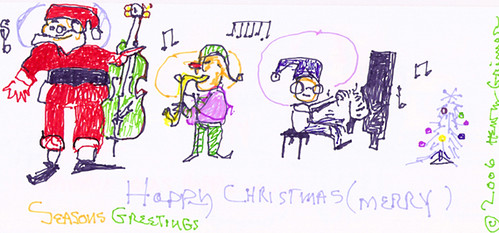
Xmas e-card I received this morning from the great Henry Grimes and his friend Magaret Davis.
The CD "Henry Grimes Trio Live at the Kerava Jazz Festival," Ayler Records, with David Murray and Hamid Drake, is a great gift for your favorite jazz fan. I gave it to myself.
Wednesday, December 20, 2006
Thoughts on listening to Albert Ayler's Spiritual Unity
Music, I've decided, tends to affect me on either an emotional or an intellectual level. The blues, Louis Armstrong, Jimmy Smith, stuff by Harry Chapin, Springsteen, "Ride of the Valkyries", Beethoven's Ninth, even, let's face it, crap like Meat Loaf's "Bat Out of Hell," stir something in my gut ... joy, sadness, anger, outrage. They bring tears to my eyes, make me laugh, or something between.
Jazz, freely improvised jazz especially but also things like a great Sony Rollins solo, get my brain working. I'm captivated by the way a Mr. Rollins can generate idea after idea off a simple base or familiar melody ("Autumn Nocturne" on "Don't Stop the Carnival" is a classic example) and I thrill in the mental hunt for the logic inside the process.
What occurred to me in listening to Albert Ayler's "Spiritual Unity" this week is that it works on both levels for me, as does a lot of the music I've come to consider essential (including "Autumn Nocturne" on "Don't Stop the Carnival"). Ayler's use of devices such as march forms make his music as emotive as Sousa tunes while the labyrinthal path he treads from there makes for a cognitive feast.
Jazz, freely improvised jazz especially but also things like a great Sony Rollins solo, get my brain working. I'm captivated by the way a Mr. Rollins can generate idea after idea off a simple base or familiar melody ("Autumn Nocturne" on "Don't Stop the Carnival" is a classic example) and I thrill in the mental hunt for the logic inside the process.
What occurred to me in listening to Albert Ayler's "Spiritual Unity" this week is that it works on both levels for me, as does a lot of the music I've come to consider essential (including "Autumn Nocturne" on "Don't Stop the Carnival"). Ayler's use of devices such as march forms make his music as emotive as Sousa tunes while the labyrinthal path he treads from there makes for a cognitive feast.
Tuesday, December 19, 2006
Monk's Casino, Alexander von Schlippenbach, Intakt
I have to think Thelonious Monk would have been pleased by this rendering of his entire compositional output by pianist Alexander von Schlippenbach in an unusual group with a trumpet and bass clarinet added to the standard piano trio.
You can't fail to recognize the oft-played songs (say, "Ruby My Dear" or "In Walked Bud") if you're familiar with Monk, but the group, as might be expected from one led by von Schlippenbach, often puts its own spin on the music.
If the places where the avant-garde touches are pretty heavy don't sound too out of place, that's because Monk himself wasn't ever very far from the edge, if not a little over it, in his music. These three CDs can't help but deepen an appreciation for his genius. I get giddy when I listen to them.
You can't fail to recognize the oft-played songs (say, "Ruby My Dear" or "In Walked Bud") if you're familiar with Monk, but the group, as might be expected from one led by von Schlippenbach, often puts its own spin on the music.
If the places where the avant-garde touches are pretty heavy don't sound too out of place, that's because Monk himself wasn't ever very far from the edge, if not a little over it, in his music. These three CDs can't help but deepen an appreciation for his genius. I get giddy when I listen to them.
Monday, December 18, 2006
New Kingdom, Roy Campbell, Delmark
Roy Campbell reminds me more of Freddie Hubbard on this than Lee Morgan (he plays with a modernist sensibility underneath as opposed to a traditional blues base), but I think he blows the trumpet about as well as either. Most of the CD is strong hard bop, which is to say Jazz Messengers-like fare, with the updated '70s sound of Hubbard disks like "Red Clay" and "Straight Life," building on the foundation laid down by Miles Davis' last great acoustic quintet.
There are avant-garde interludes as well, particularly when Campbell plays in a drums and bass trio with William Parker (great as always), as he does on three of the eight cuts. In the sextet for the rest of the program, Zane Massey and Ricardo Strobert do some memorable sax playing. A nice way to be introduced to Roy Campbell if you haven't been already. It left me wanting more.
There are avant-garde interludes as well, particularly when Campbell plays in a drums and bass trio with William Parker (great as always), as he does on three of the eight cuts. In the sextet for the rest of the program, Zane Massey and Ricardo Strobert do some memorable sax playing. A nice way to be introduced to Roy Campbell if you haven't been already. It left me wanting more.
Saturday, December 02, 2006
Dr. Lonnie Smith...
plays joy
from the tip of his toes
to the top of his turban
(At the Jazz Showcase, Chicago)
Friday, December 01, 2006
Monday, September 25, 2006
Tuesday, September 12, 2006
Up front side man
With all the saxophones playing (Johnny Griffin, Hank Mobley and Coltrane) it's funny that Wynton Kelly really caught my ear on Griffin's "A Blowin' Session," Blue Note, yesterday. Not that the saxes aren't great, they are. Could be the pianist knew he had to push it to avoid getting lost amid all those horns. (Lee Morgan on trumpet, too. Not to mention a pretty strong dummer name of Blakey.) Kelly uses about every kind of trick he likely had in his book, blues and stride, bebop and hard hard bop, and more than holds his own. Classic.
Monday, September 11, 2006
That other Sonny
My heart is pounding, I kid you not. I am shaking my head. I smile. Then laugh. I am listening to Sonny Stitt solo on "Love Walked In" from disk one of "The Complete Roost Sonny Stitt Studio Sessions," Mosaic, which arrived today.
The purest sound this side of Charlie Parker, with whom he was often compared, to his annoyance. The ballad following, "If You Could See Me Now," drenched in flawless soul, does nothing to quell my excitement. In command of the horn and flood of ideas, "Come Rain or Come Shine" could, in fact, be Bird. He might not have liked the comparison, but it was, at least at this juncture, 1955, an apt one, and no insult.
However, while he may have played like Bird, even used some of Bird's phrasing, he sounds like himself, some Parker in there, yes, and Coleman Hawkins, Johnny Hodges and Lester Young, but mostly Sonny Stitt.
And then there are the people playing with him, J.J. Johnson and Kai Winding, Joe Newman, Hank Jones, Oscar Pettiford and Charles Mingus, Papa Jo Jones ... and that's just on disk one. If all nine disks are like this I'll be one happy dude for the rest of the month. (I'm not eating this in one sitting, this is for savoring.)
The purest sound this side of Charlie Parker, with whom he was often compared, to his annoyance. The ballad following, "If You Could See Me Now," drenched in flawless soul, does nothing to quell my excitement. In command of the horn and flood of ideas, "Come Rain or Come Shine" could, in fact, be Bird. He might not have liked the comparison, but it was, at least at this juncture, 1955, an apt one, and no insult.
However, while he may have played like Bird, even used some of Bird's phrasing, he sounds like himself, some Parker in there, yes, and Coleman Hawkins, Johnny Hodges and Lester Young, but mostly Sonny Stitt.
And then there are the people playing with him, J.J. Johnson and Kai Winding, Joe Newman, Hank Jones, Oscar Pettiford and Charles Mingus, Papa Jo Jones ... and that's just on disk one. If all nine disks are like this I'll be one happy dude for the rest of the month. (I'm not eating this in one sitting, this is for savoring.)
Teamwork
They're as coordinated as synchronized swimmers when playing as an ensemble and on solos they hand off to each other like a finely honed championship relay team. My thoughts on Harold Land, sax, Jack Sheldon, trumpet, and Carl Perkins, piano, on the ballad "Counceltation" from "You Get More Bounce with Curtis Counce!"
The Contemporary/OJC disk culled from five 1956-57 sessions is one of those lesser-known gems from lesser-known artists that I think pervade '50s and '60s jazz.
The Contemporary/OJC disk culled from five 1956-57 sessions is one of those lesser-known gems from lesser-known artists that I think pervade '50s and '60s jazz.
Friday, September 08, 2006
Trane ride, Elvin Jones conducting
Walking home from work last night listening to the Nano, "India" from "Impressions," Impulse, came up and the greatness of Elvin Jones hit me like an epiphany. Here's Coltrane, plus Eric Dolphy, McCoy Tyner and two bassists, Reggie Workman in addition to Jimmy Garrison, making music without a script and Jones, to my ear, never issues an out-of-place beat.
The near-perfect way he melds his drumming with Coltrane's playing actually kind of shocked me, even though I must have played the disk a dozen times before. Most of the song's 14 minutes are just Coltrane, Jones and the basses, which also are uncannily in step with the saxophonist. Amazing stuff.
The near-perfect way he melds his drumming with Coltrane's playing actually kind of shocked me, even though I must have played the disk a dozen times before. Most of the song's 14 minutes are just Coltrane, Jones and the basses, which also are uncannily in step with the saxophonist. Amazing stuff.
Thursday, September 07, 2006
Birthday greetings
Happy birthday to Mr. Sonny Rollins, 76 years young today.
Celebrate by picking up "Our Man in Jazz," an RCA Victor/BMG CD of 1962-63 recordings, including a 25-minute remake of Mr. Rollins' "Oleo" by the saxophonist and trumpeter Don Cherry that could be used as a textbook example of how to play in the avant-garde vein but remain accessible.
Cool to hear Bob Cranshaw, who seems like he's been playing electric bass forever, playing an acoustic bass on three of the tracks as well. The great Henry Grimes handles the bass on the other three tracks and Billy Higgins drums throughout. This was a marvelous Sonny Rollins group.
Celebrate by picking up "Our Man in Jazz," an RCA Victor/BMG CD of 1962-63 recordings, including a 25-minute remake of Mr. Rollins' "Oleo" by the saxophonist and trumpeter Don Cherry that could be used as a textbook example of how to play in the avant-garde vein but remain accessible.
Cool to hear Bob Cranshaw, who seems like he's been playing electric bass forever, playing an acoustic bass on three of the tracks as well. The great Henry Grimes handles the bass on the other three tracks and Billy Higgins drums throughout. This was a marvelous Sonny Rollins group.
Thursday, August 31, 2006
Legends on the side
Art Blakey and the Jazz Messengers have been on my mind, and my CD player, the last couple weeks as I've been reading Alan Goldsher's "Hard Bop Academy," which I finished this week. Goldsher didn't write a book about Blakey, although there's plenty about the legendary drummer and band leader in it. He focused instead on the Messengers' sidemen over the decades, a list which, of course, reads like a who's who of jazz luminaries. (On trumpet, take your pick of Lee Morgan, Freddie Hubbard, Woody Shaw, Wynton Marsalis or Terence Blanchard, among others. Sax Jackie McLean, Hank Mobley, Benny Golson, Wayne Shorter, Branford Marsalis, Donald Harrison and more. Piano, Horace Silver, Keith Jarrett, Bobby Timmons, Mulgrew Miller, Cedar Walton ... you get the idea.)
Goldsher basically acted as a facilitator to get these guys to talk about each other, the Messengers legacy and playing for Blakey. It makes for a quick, enjoyable read that reminds me of "Loose Balls," Terry Pluto's fun book about the wild and crazy days of the American Basketball Association.
Among the things I found interesting, Blakey wanted talented guys young, or at least not yet big names, and when they got old enough or big enough, he booted them out, sometimes even if they wanted to stay, and brought in somebody new. Part of it was to keep salaries in line, sure, but part of it was his conception of the Messengers as a training ground for great jazz musicians, composer-arrangers and band leaders. Part of it also was that a steady infusion of new guys (and for awhile a gal, Joanne Brackeen on piano, which in my mind says a lot about Art Blakey) kept him challenged and kept the band constantly fresh.
I was listening to a couple prime examples as I wrote this, "Album of the Year," Timeless Records, and "Keystone 3," Concord. These are 1981 and '82 dates with guys like the Marsalis brothers, Blanchard, Harrison and Bobby Watson and I swear the music is just as vibrant as a classic like "Moanin'" with Morgan, Golson and Timmons in 1958. "Duck Soup" and "Soulful Mr. Timmons" on "Album of the Year" are, like so much Messenger stuff, loaded with incredible ensemble play and memorable solos and I think "In Walked Bud" and "In a Sentimental Mood" on "Keystone 3" rate with any version of either standard that I've heard. "In a Sentimental Mood," in fact, is an extremely clever recasting of the song, no less so than Archie Shepp's avant-garde version on "Live in San Francisco," Impulse, a favorite of mine. "Waterfalls" on Keystone 3 makes you understand why Wynton Marsalis created such a stir when he came on the scene.
My buddy Carl Abernathy will tell you there's no such thing as a bad Jazz Messengers album and I'm inclined to agree. Art Blakey, Abdullah Ibn Buhaina to his friends, made sure of that.
Goldsher basically acted as a facilitator to get these guys to talk about each other, the Messengers legacy and playing for Blakey. It makes for a quick, enjoyable read that reminds me of "Loose Balls," Terry Pluto's fun book about the wild and crazy days of the American Basketball Association.
Among the things I found interesting, Blakey wanted talented guys young, or at least not yet big names, and when they got old enough or big enough, he booted them out, sometimes even if they wanted to stay, and brought in somebody new. Part of it was to keep salaries in line, sure, but part of it was his conception of the Messengers as a training ground for great jazz musicians, composer-arrangers and band leaders. Part of it also was that a steady infusion of new guys (and for awhile a gal, Joanne Brackeen on piano, which in my mind says a lot about Art Blakey) kept him challenged and kept the band constantly fresh.
I was listening to a couple prime examples as I wrote this, "Album of the Year," Timeless Records, and "Keystone 3," Concord. These are 1981 and '82 dates with guys like the Marsalis brothers, Blanchard, Harrison and Bobby Watson and I swear the music is just as vibrant as a classic like "Moanin'" with Morgan, Golson and Timmons in 1958. "Duck Soup" and "Soulful Mr. Timmons" on "Album of the Year" are, like so much Messenger stuff, loaded with incredible ensemble play and memorable solos and I think "In Walked Bud" and "In a Sentimental Mood" on "Keystone 3" rate with any version of either standard that I've heard. "In a Sentimental Mood," in fact, is an extremely clever recasting of the song, no less so than Archie Shepp's avant-garde version on "Live in San Francisco," Impulse, a favorite of mine. "Waterfalls" on Keystone 3 makes you understand why Wynton Marsalis created such a stir when he came on the scene.
My buddy Carl Abernathy will tell you there's no such thing as a bad Jazz Messengers album and I'm inclined to agree. Art Blakey, Abdullah Ibn Buhaina to his friends, made sure of that.
Wednesday, August 30, 2006
Finding Bill Evans
My buddy Carl Abernathy got me thinking about Bill Evans the other day and why he prompts an almost religious devotion from fans and students of piano (Evans, not Carl, although his fans are certainly devoted as well). Then I spied the newer (2005) "Bill Evans: The Complete Village Vanguard Recordings, 1961," Riverside, at the bookstore and sprung for it, which hasn't made me a convert (I already admired the guy, within reason) but has shifted my perspective on him some.
What strikes me, listening to these three CDs from a very famous trio session, is how cleanly Evans plays, with no hint really of the bawdy house or dance hall, the blues, rag or stride cutting contests, what some folks (not me) might consider "lower" forms of music in the jazz family tree. Now whether this means his music is jazz infused with European classicism, as many people say, I don't know. In my mind, the thing that stands out is his huge technical proficiency. I think he sounds so pristine not because of the classical elements he uses but because he was just that good.
I contrast him with Monk, no slouch as a pianist but not nearly as clean, probably intentionally so at times, and a step or three ahead in at-the-keyboard creativity (and as a composer). Evans, on the other hand, is plenty inventive, more so I'd venture to say than a lot of top-drawer jazz pianists, and that, I think, combined with his Horowitiz-like command of his instrument, is what has focused so much attention on him. I'll take Monk first, Art Tatum and maybe Bud Powell and McCoy Tyner after, but Evans would be the fifth if I were allowed disks from only five pianists on the desert island. (Actually, I would refuse to go if they let me have only five. Like I'm going anywhere without Fats Waller, Herbie Hancock and Chick Corea, or Keith Jarrett for that matter.)
The redone sound on the Evans "Vanguard" set, which has been widely available in various configurations before, including the landmark "Sunday Morning at the Village Vanguard" and "Waltz for Debby" CDs, is spiffy by the way. You hear everything super clearly right down to the occasional glass clink. One thing that does is really bring out the playing of bassist Scott LaFaro and drummer Paul Motian. LaFaro, who died two weeks later in a car crash, in particular is as proficient as Evans and often as stunning. Interesting that the liner notes say they didn't get along personally. They sure did musically.
What strikes me, listening to these three CDs from a very famous trio session, is how cleanly Evans plays, with no hint really of the bawdy house or dance hall, the blues, rag or stride cutting contests, what some folks (not me) might consider "lower" forms of music in the jazz family tree. Now whether this means his music is jazz infused with European classicism, as many people say, I don't know. In my mind, the thing that stands out is his huge technical proficiency. I think he sounds so pristine not because of the classical elements he uses but because he was just that good.
I contrast him with Monk, no slouch as a pianist but not nearly as clean, probably intentionally so at times, and a step or three ahead in at-the-keyboard creativity (and as a composer). Evans, on the other hand, is plenty inventive, more so I'd venture to say than a lot of top-drawer jazz pianists, and that, I think, combined with his Horowitiz-like command of his instrument, is what has focused so much attention on him. I'll take Monk first, Art Tatum and maybe Bud Powell and McCoy Tyner after, but Evans would be the fifth if I were allowed disks from only five pianists on the desert island. (Actually, I would refuse to go if they let me have only five. Like I'm going anywhere without Fats Waller, Herbie Hancock and Chick Corea, or Keith Jarrett for that matter.)
The redone sound on the Evans "Vanguard" set, which has been widely available in various configurations before, including the landmark "Sunday Morning at the Village Vanguard" and "Waltz for Debby" CDs, is spiffy by the way. You hear everything super clearly right down to the occasional glass clink. One thing that does is really bring out the playing of bassist Scott LaFaro and drummer Paul Motian. LaFaro, who died two weeks later in a car crash, in particular is as proficient as Evans and often as stunning. Interesting that the liner notes say they didn't get along personally. They sure did musically.
Monday, August 28, 2006
Who dat?
Say man, is that Miles Davis rollin' with the muted trumpet on "Secret Love" from "Get the Message" on the Drive Archive record label? Nope, the guy with the sound is Chuck Mangione during his short stint with Art Blakey and the Jazz Messengers. He wrote three of the songs on the CD as well. And then there's the pianist, who rips off some lively solos of his own and plays his piano strings like an ersatz harp at one point, which I bet had Art Blakey shaking his head. Keith Jarrett. A nifty disk.
Hard bop defined
Hard bop is one of those "know it when I hear it" kind of things for me. I don't know a good definition for it. I don't know if there even is one. If there is, I haven't seen it, yet. I think it would include bebop phrasing and flourishes (see Benny Golson's soloing on the Blue Note Art Blakey and the Jazz Messengers classic "Moanin'") but feel funkier, more syncopated, with harder edges and heavier aurally, and with more prominent swing and blues elements, among other things. If a good bebop performance can amaze and delight, a good hard bop performance can awe and excite.
Like "Moanin'" the title track on the Blakey and Messengers CD, of which you get two standout versions on recent issues of the disk. Either version of the song, written by pianist Bobby Timmons and refined in this case by Golson, has to be considered a seminal jazz performance and prime example of what hard bop is. "Moanin'" probably explains it better than hanging words on it can.
Like "Moanin'" the title track on the Blakey and Messengers CD, of which you get two standout versions on recent issues of the disk. Either version of the song, written by pianist Bobby Timmons and refined in this case by Golson, has to be considered a seminal jazz performance and prime example of what hard bop is. "Moanin'" probably explains it better than hanging words on it can.
Saturday, August 26, 2006
Perspective would be nice
Maynard Ferguson's death turned up as one of the top stories (from CNN, as I recall) on my Google home page yesterday and it kind of annoyed me for a couple reasons.
Nothing against Maynard Ferguson. I've said in the past he deserves more props for the fine jazz he recorded and less abuse for some of his more commercial ventures. Sad then that in pretty much every obit I saw he was referred to as the guy who covered the theme from "Rocky" and had a big hit with it.
Bugs me as well that Jackie McLean or John Hicks didn't show up on my Google home page when they died earlier this year, which is a measure of the media attention their deaths received. McLean in particular was a far more significant figure in American music than Ferguson (yeah, yeah, I know he was from Canada; he didn't get famous playing in Saskatoon). That's true not only because of McLean's music and his prominent role in jazz history but his educational endeavors and the impact of his many students.
Nothing against Maynard Ferguson. I've said in the past he deserves more props for the fine jazz he recorded and less abuse for some of his more commercial ventures. Sad then that in pretty much every obit I saw he was referred to as the guy who covered the theme from "Rocky" and had a big hit with it.
Bugs me as well that Jackie McLean or John Hicks didn't show up on my Google home page when they died earlier this year, which is a measure of the media attention their deaths received. McLean in particular was a far more significant figure in American music than Ferguson (yeah, yeah, I know he was from Canada; he didn't get famous playing in Saskatoon). That's true not only because of McLean's music and his prominent role in jazz history but his educational endeavors and the impact of his many students.
Thursday, August 24, 2006
As good as sex, really
Interesting Wired interview with a guy who studies music's effect on the brain. He's found, among other things, that music activates the same parts of the brain and the same brain chemical mix as things like having an orgasm, eating chocolate and winning a big poker hand.
Heck, I could have told him that. Happens every time I put on "Root Down: Jimmy Smith Live!" from Verve and listen to Jimmy Smith play "Root Down (and Get It)."
Heck, I could have told him that. Happens every time I put on "Root Down: Jimmy Smith Live!" from Verve and listen to Jimmy Smith play "Root Down (and Get It)."
Wednesday, August 23, 2006
More Sonny in London
I'm liking the "Sonny Rollins Live in London" series from British Harkit Records and covering a month's performances in 1965 by Mr. Rollins at Ronnie Scott's muy famoso jazz club in London, where he performed with pianist Stan Tracey's trio, a pretty much legendary outfit on the island. The sound isn't fantastic (the drums are a little heavy on Volume 2 as I listen to it, for instance) but it isn't terrible and you can make out everything the saxophonist is doing, which is a lot. Nothing on the second disk clocks in under 10 minutes and he goes 20 on a calypso-tinged rendition of "Night and Day."
Mr. Rollins has clearly gotten comfortable with the Tracey unit here, and the Brits with him, more than on the first volume, where they don't seem quite as together. He's particularly inventive on nearly 18 minutes built on Gershwin's "Foggy Day," which also includes a nice run by bassist Rick Laird. Monk's "Nutty" toes closer to the line of the original, but then it was pretty inventive to start with. The version of "Autumn Nocturne" is different than any of the other versions from Sonny Rollins I've heard and a classic example of his on-the-spot creating in concert. There's a third volume "Live in London" and I think it's in my future.
Mr. Rollins has clearly gotten comfortable with the Tracey unit here, and the Brits with him, more than on the first volume, where they don't seem quite as together. He's particularly inventive on nearly 18 minutes built on Gershwin's "Foggy Day," which also includes a nice run by bassist Rick Laird. Monk's "Nutty" toes closer to the line of the original, but then it was pretty inventive to start with. The version of "Autumn Nocturne" is different than any of the other versions from Sonny Rollins I've heard and a classic example of his on-the-spot creating in concert. There's a third volume "Live in London" and I think it's in my future.
Monday, August 21, 2006
Swedish roots music
I bought the disk "Lars-Göran Ulander Trio Live at the Glenn Miller Cafe," on the Swedish Ayler label, after reading that Ulander (on alto here) had been kind of the Coleman Hawkins to Swedish free jazz saxophonist Mats Gustafsson's Sonny Rollins.
Gustafsson, known for his work with Ken Vandermark, has been an interest of mine since I caught him with his group The Thing and guest Joe McPhee last year. He's on the Albert Ayler end of the free jazz spectrum as opposed to early Ornette Coleman, which wasn't all that out there. But I don't think that means he's inaccessible. I might say the same about Ulander, whose trio on the Ayler CD includes drummer Palle Danielsson and bassist Paal Nilssen-Love, the former another legendary Swede and the latter himself a member of The Thing (and one of the most manic, attacking drummers I've ever seen, although he's fairly subdued in this session).
"Tabula Raasa G.M.C." has kind of a Middle Eastern motif, while "Intrinsic Structure I" feels more like European classical music with Coleman-like snatches and great interplay between Ulander and Danielsson. The songs are freely improvised, but to my ear could hardly be considered unstructured, illogical, or slapdash in any way. "What Love" starts out like a conventional ballad before venturing into territory you couldn't have anticipated from that beginning. And this, perhaps, is what I appreciate most about the disk. You never know what's around the corner, making for something of a voyage of musical discovery, which I suspect is how the musicians felt about it as well. Lots of corners to go around and a concomitant number of surprises, too, in something like "Ionizacion-Variaciones E.V.," which last nearly 23 minutes.
Gustafsson, known for his work with Ken Vandermark, has been an interest of mine since I caught him with his group The Thing and guest Joe McPhee last year. He's on the Albert Ayler end of the free jazz spectrum as opposed to early Ornette Coleman, which wasn't all that out there. But I don't think that means he's inaccessible. I might say the same about Ulander, whose trio on the Ayler CD includes drummer Palle Danielsson and bassist Paal Nilssen-Love, the former another legendary Swede and the latter himself a member of The Thing (and one of the most manic, attacking drummers I've ever seen, although he's fairly subdued in this session).
"Tabula Raasa G.M.C." has kind of a Middle Eastern motif, while "Intrinsic Structure I" feels more like European classical music with Coleman-like snatches and great interplay between Ulander and Danielsson. The songs are freely improvised, but to my ear could hardly be considered unstructured, illogical, or slapdash in any way. "What Love" starts out like a conventional ballad before venturing into territory you couldn't have anticipated from that beginning. And this, perhaps, is what I appreciate most about the disk. You never know what's around the corner, making for something of a voyage of musical discovery, which I suspect is how the musicians felt about it as well. Lots of corners to go around and a concomitant number of surprises, too, in something like "Ionizacion-Variaciones E.V.," which last nearly 23 minutes.
Friday, August 18, 2006
Hot stuff
Sonny Rollins wanted to get people thinking about a serious topic on "Global Warming," Milestone, as a read of his poetic liner notes tells you, but the disk also includes two songs by Mr. Rollins that inevitably are great tonic when I'm feeling low. "Island Lady" is another in his line of joyous calypso-style pieces with some creative exploring by the saxophonist. Likewise on the title track, one of my all-time Sonny Rollins favorites. Both feature, in addition, strong solo work by trombonist Clifton Anderson and pianist Stephen Scott.
I put Scott in the same class as Mark Soskin as far as pianists who seem to fit best with Mr. Rollins go, the two just a small step down from Tommy Flanagan at the head of the list. Scott is Monkish on "Echo-side Blue," where Mr. Rollins' playing, it seems to me, is close to being on par with his famous rendering of "Blue 7" on "Saxophone Colossus." Meanwhile, "Mother Nature's Blues" makes me think of those magic Sonny Rollins concert moments when the flow of ideas from his horn drives the guys playing with him to respond in kind. A CD comfortably ensconced in my Sonny Rollins Top 10.
I put Scott in the same class as Mark Soskin as far as pianists who seem to fit best with Mr. Rollins go, the two just a small step down from Tommy Flanagan at the head of the list. Scott is Monkish on "Echo-side Blue," where Mr. Rollins' playing, it seems to me, is close to being on par with his famous rendering of "Blue 7" on "Saxophone Colossus." Meanwhile, "Mother Nature's Blues" makes me think of those magic Sonny Rollins concert moments when the flow of ideas from his horn drives the guys playing with him to respond in kind. A CD comfortably ensconced in my Sonny Rollins Top 10.
Thursday, August 17, 2006
Back for seconds
For another helping of the tasty combination that is tenorman Lin Halliday, multi-instrumentalist Ira Sullivan and pianist Jodie Christian, all three guys I think should be better known, try "Where or When," Delmark. On "My Shining Hour," you get strong solos from Halliday, Sullivan on a muted trumpet and Christian, who strikes me as McCoy Tyner-like in this instance. Ditto with respect to Christian and Tyner on "Dear Old Stockholm," which also features complex playing by Halliday.
He does some bluesy blowing on Ellington's "Sophisticated Lady," giving it a little different spin, and there's wonderful interplay between the saxophonist and Sullivan on "Over the Rainbow" (boffo version) and on Sonny Rollins' "Pent-up House." Excellent bassist Larry Gray worked the date as well, although he stays pretty much in the background. He does stand out a little on the title track, where Sullivan adds a second tenor sax to good effect on top of his trumpet and flugelhorn work elsewhere.
He does some bluesy blowing on Ellington's "Sophisticated Lady," giving it a little different spin, and there's wonderful interplay between the saxophonist and Sullivan on "Over the Rainbow" (boffo version) and on Sonny Rollins' "Pent-up House." Excellent bassist Larry Gray worked the date as well, although he stays pretty much in the background. He does stand out a little on the title track, where Sullivan adds a second tenor sax to good effect on top of his trumpet and flugelhorn work elsewhere.
Wednesday, August 16, 2006
I wouldn't want to live without...
Sonny Rollins playing "Someone to Watch Over Me" on "Here's to the People," Milestone, among other things. Nice version of "Why was I Born," a song Mr. Rollins clearly has an affinity for, as well. A couple cuts with a young Roy Hargrove on trumpet also make this a CD worth having.
Tuesday, August 15, 2006
More Sonny Rollins with pipes
"First Moves," Jazz Door, is another place to hear Sonny Rollins and jazz bagpiper Rufus Harley working together. Better yet, I believe Mr. Rollins was in an exploratory mood for this European concert in 1974 and, as you would expect, that yields some interesting music. The sound on what I think is probably a bootleg recording is adequate, a lot better than most impromptu concert recordings.
Harley checks in with his bagpipes on "Alfie's Theme" and while I don't think it's quite as effective as "Swing Low, Sweet Chariot" on the Milestone disk "The Cutting Edge" it works. If you get "Alfie's Theme" and "Alfie's Theme Differently" on the Impulse CD of the movie score by Mr. Rollins, this is "Alfie's Theme" really differently. Harley also plays some soprano sax (he was a saxophonist before picking up the pipes), as does Mr. Rollins, who waxes avant-garde on "Look for the Silver Lining." The generally rockish electric guitar playing from Yoshiaki Masuo is consistently good. Gene Perla on electric bass and David Lee round out a fusion-oriented ensemble well.
Harley checks in with his bagpipes on "Alfie's Theme" and while I don't think it's quite as effective as "Swing Low, Sweet Chariot" on the Milestone disk "The Cutting Edge" it works. If you get "Alfie's Theme" and "Alfie's Theme Differently" on the Impulse CD of the movie score by Mr. Rollins, this is "Alfie's Theme" really differently. Harley also plays some soprano sax (he was a saxophonist before picking up the pipes), as does Mr. Rollins, who waxes avant-garde on "Look for the Silver Lining." The generally rockish electric guitar playing from Yoshiaki Masuo is consistently good. Gene Perla on electric bass and David Lee round out a fusion-oriented ensemble well.
Monday, August 14, 2006
Easy listening, in a good way
"Easy Living," Milestone, is another Sonny Rollins CD I ought to play more, a modernist session from 1977, kind of Sonny Rollins meets Weather Report, not that it really sounds like the latter and unlike the former, with George Duke on keyboards and Tony Williams drumming, along with electric guitar and bass players.
Aside from the different style of accompaniment for Mr. Rollins, the cool version of Stevie Wonder's "Isn't She Lovely" elevates this disk, as does Mr. Rollins performing "My One and Only Love," as a pretty ballad, in a rare turn on the soprano sax, which he also plays apace to great effect on "Aroz Con Pollo." Back on tenor, the title track sports yet another memorable improvised solo introduction by the master, ala "Autumn Nocturne" on "Don't Stop the Carnival," Milestone.
Aside from the different style of accompaniment for Mr. Rollins, the cool version of Stevie Wonder's "Isn't She Lovely" elevates this disk, as does Mr. Rollins performing "My One and Only Love," as a pretty ballad, in a rare turn on the soprano sax, which he also plays apace to great effect on "Aroz Con Pollo." Back on tenor, the title track sports yet another memorable improvised solo introduction by the master, ala "Autumn Nocturne" on "Don't Stop the Carnival," Milestone.
Friday, August 11, 2006
Saxofonistas passing
I count 21 renditions of "All the Things You Are" in my iTunes music library, which is to say you better be a player if you want to get my attention with the song. Tenorman Lin Halliday, who sometimes reminds me of Sonny Rollins in his flights from melody, and pianist Jodie Christian do on Halliday's "East of the Sun," Delmark, an CD I took a flier on (didn't know a thing about Halliday) after reading about it on the Brazilian jazz Web log jazzseen, kind of.
OK, jazzseen is in Portuguese and I can read a little Spanish and French but no Portuguese. I was attracted by the cover photo, however, Halliday looking like he's seen a lot of bad road and clutching the only thing keeping him going, his horn. And if I don't read Portuguese, I recognized the names Coleman Hawkins and Anthony Braxton in the text; intriguing combination. Then there's the description of Halliday in the rough translation of the text by Google, "one of these saxofonistas strangers who pass incognitos for all, smile to the life and die without ostentation." Good enough for me.
The presence of the severely underexposed Ira Sullivan on this consistently excellent disk also suggests it, whether it's Sullivan playing bass flute (oops, alto flute as Marc Berner points out in an e-mail) on the title track, the trumpet on "I Found a New Baby," the flugelhorn on "Corcovado," or adding a second tenor sax in spots for good measure. What a talent. He, Halliday and Christian, who also should be better known, mesh with near perfection on "Corcovado." Halliday's soloing on "My Foolish Heart" is gripping. I want more.
OK, jazzseen is in Portuguese and I can read a little Spanish and French but no Portuguese. I was attracted by the cover photo, however, Halliday looking like he's seen a lot of bad road and clutching the only thing keeping him going, his horn. And if I don't read Portuguese, I recognized the names Coleman Hawkins and Anthony Braxton in the text; intriguing combination. Then there's the description of Halliday in the rough translation of the text by Google, "one of these saxofonistas strangers who pass incognitos for all, smile to the life and die without ostentation." Good enough for me.
The presence of the severely underexposed Ira Sullivan on this consistently excellent disk also suggests it, whether it's Sullivan playing bass flute (oops, alto flute as Marc Berner points out in an e-mail) on the title track, the trumpet on "I Found a New Baby," the flugelhorn on "Corcovado," or adding a second tenor sax in spots for good measure. What a talent. He, Halliday and Christian, who also should be better known, mesh with near perfection on "Corcovado." Halliday's soloing on "My Foolish Heart" is gripping. I want more.
Thursday, August 10, 2006
Experience counts
A drone, as if from an organ or bagpipes, as the canvas on which to paint music from a flute and other horns, including splashes of brass, music that sounds orchestral and at the same time like a Scottish folk piece and is decorated with bells and chimes, gradually rising in pace and intensity as bass and drums kick in until it's, yes, jazz by the end. Then the band switches to a funk romp with Detroit and New Orleans as anchor points and punctuated by, among other things, a penny whistle and a police siren. Followed by a jazz waltz punched up using the judicious insertion of free jazz elements.
"Prayer for Jimbo Kwesi," "Funky Aeco" and "Walking in the Moonlight" from "The Third Decade," ECM, by the Art Ensemble of Chicago. I figure they must have decided to employ everything they learned in the first two decades because the fascinating music just keeps coming. A rare gem even for this group of diamond merchants.
"Prayer for Jimbo Kwesi," "Funky Aeco" and "Walking in the Moonlight" from "The Third Decade," ECM, by the Art Ensemble of Chicago. I figure they must have decided to employ everything they learned in the first two decades because the fascinating music just keeps coming. A rare gem even for this group of diamond merchants.
Wednesday, August 09, 2006
Hank Williams it's not
The crew on Hank Garland's "Jazz Winds from a New Direction" is as elegantly proficient as the Modern Jazz Quartet, Garland and his guitar replacing John Lewis and the piano, and Gary Burton (all of 17 here) on vibes, bassist Joe Benjamin and Joe Morello, Dave Brubeck's drummer of choice, matching the troika of Jackson, Heath and Kay. I really get an MJQ feeling on "All the Things You Are" and the Burton-Garland song "Three-Four, the Blues."
I wish Garland had taken more solo space throughout, as he does on "Move," where his nimble fingers suggest Charlie Parker playing guitar, and the jazzy-bluesy rendering of Irving Berlin's "Always." I also wish he'd made more jazz recordings. A country music and Nashville stalwart, he was crippled in a near-fatal car accident in 1961, the same year "Jazz Winds" came out, struggled to return to form and never recorded a jazz session again.
I wish Garland had taken more solo space throughout, as he does on "Move," where his nimble fingers suggest Charlie Parker playing guitar, and the jazzy-bluesy rendering of Irving Berlin's "Always." I also wish he'd made more jazz recordings. A country music and Nashville stalwart, he was crippled in a near-fatal car accident in 1961, the same year "Jazz Winds" came out, struggled to return to form and never recorded a jazz session again.
Tuesday, August 08, 2006
Lindberg puts out a spread
Tenorman Allan Lunsdtröm, one of the saxophonists with Swedish pianist Nils Lindberg on "Curbits," the first cut from Lindberg's "Sax Appeal & Trisection," Dragon, plays with the sweetness of Stan Getz and it isn't the only thing that makes the cut interesting. There are solos from Lars Gullin, the Swedish baritonist who rates with Pepper Adams in my book, and the great Swedish alto saxman Rolf Billberg. Moreover, the song is based on a Swedish folk tune undoubtedly familiar to many a jazz fan. It provided the structure for "Dear Old Stockholm."
Wonderful stuff and the CD never lets up from there, presenting Swedish legend Lindberg and his music in settings ranging from a quintet to a big band, mostly with standout Swedish musicians, although Idrees Sulieman slips in on trumpet. Largely swinging bop and hard bop that shows off the technical prowess (the "Birth of the Cool" band didn't have anything over on these guys) of the Swedes and makes for a Swedish jazz smörgåsbord.
Wonderful stuff and the CD never lets up from there, presenting Swedish legend Lindberg and his music in settings ranging from a quintet to a big band, mostly with standout Swedish musicians, although Idrees Sulieman slips in on trumpet. Largely swinging bop and hard bop that shows off the technical prowess (the "Birth of the Cool" band didn't have anything over on these guys) of the Swedes and makes for a Swedish jazz smörgåsbord.
Monday, August 07, 2006
I should exit as graciously
"Yeah, but it's been a great gig."
What Dizzy Gillespie said when the 4-year-old daughter of a friend asked him if he was dying about 10 days before he did.
I love that story from "Dizzy: The Life and Times of John Birks Gillespie" by Donald Maggin, a book I can recommend, although it could have used a discography.
What Dizzy Gillespie said when the 4-year-old daughter of a friend asked him if he was dying about 10 days before he did.
I love that story from "Dizzy: The Life and Times of John Birks Gillespie" by Donald Maggin, a book I can recommend, although it could have used a discography.
Friday, August 04, 2006
Lament for Rufus of Philly
I'm listening to my entire Sonny Rollins collection ahead of his Sept. 19 concert here. (Hey, it's going to take awhile to cover all of it.) Wednesday, it was "The Cutting Edge," Milestone, a live performance recording from Montreux in 1974 that's good, but not one of his best in my view. What strongly suggests it nonetheless is "Swing Low, Sweet Chariot" featuring Mr. Rollins dueting with jazz bagpiper Rufus Harley. It's amazing how well the pairing worked and a tribute to the skill of both guys.
Sadly, I read yesterday that Rufus Harley passed away this week. I know some traditional bagpipers didn't like the attention he got at bagpipe competitions, Scottish festivals and the like. Some jazz snots didn't much like him either. But he was a legitimate musician, whether piping or playing jazz, and by all accounts a good soul.
Over lunch yesterday, I listened to "Dancing in the Dark," Milestone, a 1987 session with Mark Soskin on electric keyboards and one of those CDs I should listen to more often. Mr. Rollins is powerful on this and his improvisations, while fairly short for the most part, are quite creative. I've got a major thing for his version of the pop tune "Just Once." If you consider Tommy Flanagan the gold standard for pianists accompanying Sonny Rollins, Soskin isn't far off.
Sadly, I read yesterday that Rufus Harley passed away this week. I know some traditional bagpipers didn't like the attention he got at bagpipe competitions, Scottish festivals and the like. Some jazz snots didn't much like him either. But he was a legitimate musician, whether piping or playing jazz, and by all accounts a good soul.
Over lunch yesterday, I listened to "Dancing in the Dark," Milestone, a 1987 session with Mark Soskin on electric keyboards and one of those CDs I should listen to more often. Mr. Rollins is powerful on this and his improvisations, while fairly short for the most part, are quite creative. I've got a major thing for his version of the pop tune "Just Once." If you consider Tommy Flanagan the gold standard for pianists accompanying Sonny Rollins, Soskin isn't far off.
Thursday, August 03, 2006
Bop lives
Dizzy Gillespie biographer Donald Maggin did an unscientific survey and decided that more than 50 percent of jazz artists playing today still use predominantly bebop forms, which seems about right to me. Modal music is harder to play and less accessible on its face, the popularity of "Kind of Blue" aside. Avant-garde, freely improvised jazz is an even tougher nut to crack on both counts. Likewise the fusion sprung from Miles Davis' electric music.
I thought about Maggin's contention listening to "Night Owls," from an octet led by tenorman (also flute and clarinet) Chris Byars and Smalls Records. "All or Nothing at All" is done as bop, Latin-tinged, complete with saxophonists quoting Charlie Parker, or Leo Parker in the case of baritonist Mark Lopeman. The group's version of Tadd Dameron's "Gnid" also is straight line from the original boppers. Byars kind of reminds me of Sonny Stitt. I swear trombonist John Mosca is channeling J.J. Johnson.
That said, parts of this ("Village Beauty" for one, "The Way You Look Tonight" for another) make me think of "Birth of the Cool" and Gerry Mulligan's concert jazz band, which were more or less modal, albeit with bop roots sunk in swing soil. These guys aren't imitating in any event. They're using traditional tools to build their own state-of-the-art house, and a nice pad to hang out in for awhile it is. Proof bebop lives on.
I thought about Maggin's contention listening to "Night Owls," from an octet led by tenorman (also flute and clarinet) Chris Byars and Smalls Records. "All or Nothing at All" is done as bop, Latin-tinged, complete with saxophonists quoting Charlie Parker, or Leo Parker in the case of baritonist Mark Lopeman. The group's version of Tadd Dameron's "Gnid" also is straight line from the original boppers. Byars kind of reminds me of Sonny Stitt. I swear trombonist John Mosca is channeling J.J. Johnson.
That said, parts of this ("Village Beauty" for one, "The Way You Look Tonight" for another) make me think of "Birth of the Cool" and Gerry Mulligan's concert jazz band, which were more or less modal, albeit with bop roots sunk in swing soil. These guys aren't imitating in any event. They're using traditional tools to build their own state-of-the-art house, and a nice pad to hang out in for awhile it is. Proof bebop lives on.
Wednesday, August 02, 2006
Greek getting his props
I was listening to "Parallel Lines," Candid, from Greek saxophonist Dimitri Vassilakis in the car yesterday and thinking again what an excellent CD it is. I'm not the only one. E-mail from Vassilakis this morning points out positive All About Jazz reviews here and here.
I caught the guy in London in March and really enjoyed it, and then had the opportunity to see him again in Chicago in April on his first trip to the U.S. Looks like he's building a following and he should be; he's good.
I caught the guy in London in March and really enjoyed it, and then had the opportunity to see him again in Chicago in April on his first trip to the U.S. Looks like he's building a following and he should be; he's good.
Tuesday, August 01, 2006
Free jazz, for now
Interesting new(er) Web log for discussing free jazz and posting MP3s of out-of-print and unreleased recordings. I don't know how they do it and I'm sure some music industry thug will shut them down soon, but it's fun while it lasts.
I continue to be royally honked that "licensing issues" killed Swing is in the Air, a favorite jazz podcast of mine that I'm willing to bet did nothing but create new jazz fans and generate jazz recording sales to those of us who already have religion. (You can still get a live stream of the ongoing radio show from whence Swing stemmed.)
I continue to be royally honked that "licensing issues" killed Swing is in the Air, a favorite jazz podcast of mine that I'm willing to bet did nothing but create new jazz fans and generate jazz recording sales to those of us who already have religion. (You can still get a live stream of the ongoing radio show from whence Swing stemmed.)
Smalls is big
Smalls, the New York Club, has been a launching pad for some wonderful jazz musicians, as recounted in a June Downbeat piece, and Smalls Records is, thankfully, making a bunch of their music available. The article prompted me to buy the Omer Avital Group's "Asking No Permission," just one of the Smalls titles I had my eye on after experiencing the stunning Frank Hewitt CDs "We Loved You" and "Four Hundred Saturdays" from the label.
Subscribe to:
Posts (Atom)