"Easy Living," Milestone, is another Sonny Rollins CD I ought to play more, a modernist session from 1977, kind of Sonny Rollins meets Weather Report, not that it really sounds like the latter and unlike the former, with George Duke on keyboards and Tony Williams drumming, along with electric guitar and bass players.
Aside from the different style of accompaniment for Mr. Rollins, the cool version of Stevie Wonder's "Isn't She Lovely" elevates this disk, as does Mr. Rollins performing "My One and Only Love," as a pretty ballad, in a rare turn on the soprano sax, which he also plays apace to great effect on "Aroz Con Pollo." Back on tenor, the title track sports yet another memorable improvised solo introduction by the master, ala "Autumn Nocturne" on "Don't Stop the Carnival," Milestone.
Monday, August 14, 2006


Friday, August 11, 2006
Saxofonistas passing
I count 21 renditions of "All the Things You Are" in my iTunes music library, which is to say you better be a player if you want to get my attention with the song. Tenorman Lin Halliday, who sometimes reminds me of Sonny Rollins in his flights from melody, and pianist Jodie Christian do on Halliday's "East of the Sun," Delmark, an CD I took a flier on (didn't know a thing about Halliday) after reading about it on the Brazilian jazz Web log jazzseen, kind of.
OK, jazzseen is in Portuguese and I can read a little Spanish and French but no Portuguese. I was attracted by the cover photo, however, Halliday looking like he's seen a lot of bad road and clutching the only thing keeping him going, his horn. And if I don't read Portuguese, I recognized the names Coleman Hawkins and Anthony Braxton in the text; intriguing combination. Then there's the description of Halliday in the rough translation of the text by Google, "one of these saxofonistas strangers who pass incognitos for all, smile to the life and die without ostentation." Good enough for me.
The presence of the severely underexposed Ira Sullivan on this consistently excellent disk also suggests it, whether it's Sullivan playing bass flute (oops, alto flute as Marc Berner points out in an e-mail) on the title track, the trumpet on "I Found a New Baby," the flugelhorn on "Corcovado," or adding a second tenor sax in spots for good measure. What a talent. He, Halliday and Christian, who also should be better known, mesh with near perfection on "Corcovado." Halliday's soloing on "My Foolish Heart" is gripping. I want more.
Thursday, August 10, 2006
Experience counts
A drone, as if from an organ or bagpipes, as the canvas on which to paint music from a flute and other horns, including splashes of brass, music that sounds orchestral and at the same time like a Scottish folk piece and is decorated with bells and chimes, gradually rising in pace and intensity as bass and drums kick in until it's, yes, jazz by the end. Then the band switches to a funk romp with Detroit and New Orleans as anchor points and punctuated by, among other things, a penny whistle and a police siren. Followed by a jazz waltz punched up using the judicious insertion of free jazz elements.
"Prayer for Jimbo Kwesi," "Funky Aeco" and "Walking in the Moonlight" from "The Third Decade," ECM, by the Art Ensemble of Chicago. I figure they must have decided to employ everything they learned in the first two decades because the fascinating music just keeps coming. A rare gem even for this group of diamond merchants.
"Prayer for Jimbo Kwesi," "Funky Aeco" and "Walking in the Moonlight" from "The Third Decade," ECM, by the Art Ensemble of Chicago. I figure they must have decided to employ everything they learned in the first two decades because the fascinating music just keeps coming. A rare gem even for this group of diamond merchants.
Wednesday, August 09, 2006
Hank Williams it's not
The crew on Hank Garland's "Jazz Winds from a New Direction" is as elegantly proficient as the Modern Jazz Quartet, Garland and his guitar replacing John Lewis and the piano, and Gary Burton (all of 17 here) on vibes, bassist Joe Benjamin and Joe Morello, Dave Brubeck's drummer of choice, matching the troika of Jackson, Heath and Kay. I really get an MJQ feeling on "All the Things You Are" and the Burton-Garland song "Three-Four, the Blues."
I wish Garland had taken more solo space throughout, as he does on "Move," where his nimble fingers suggest Charlie Parker playing guitar, and the jazzy-bluesy rendering of Irving Berlin's "Always." I also wish he'd made more jazz recordings. A country music and Nashville stalwart, he was crippled in a near-fatal car accident in 1961, the same year "Jazz Winds" came out, struggled to return to form and never recorded a jazz session again.
I wish Garland had taken more solo space throughout, as he does on "Move," where his nimble fingers suggest Charlie Parker playing guitar, and the jazzy-bluesy rendering of Irving Berlin's "Always." I also wish he'd made more jazz recordings. A country music and Nashville stalwart, he was crippled in a near-fatal car accident in 1961, the same year "Jazz Winds" came out, struggled to return to form and never recorded a jazz session again.
Tuesday, August 08, 2006
Lindberg puts out a spread
Tenorman Allan Lunsdtröm, one of the saxophonists with Swedish pianist Nils Lindberg on "Curbits," the first cut from Lindberg's "Sax Appeal & Trisection," Dragon, plays with the sweetness of Stan Getz and it isn't the only thing that makes the cut interesting. There are solos from Lars Gullin, the Swedish baritonist who rates with Pepper Adams in my book, and the great Swedish alto saxman Rolf Billberg. Moreover, the song is based on a Swedish folk tune undoubtedly familiar to many a jazz fan. It provided the structure for "Dear Old Stockholm."
Wonderful stuff and the CD never lets up from there, presenting Swedish legend Lindberg and his music in settings ranging from a quintet to a big band, mostly with standout Swedish musicians, although Idrees Sulieman slips in on trumpet. Largely swinging bop and hard bop that shows off the technical prowess (the "Birth of the Cool" band didn't have anything over on these guys) of the Swedes and makes for a Swedish jazz smörgåsbord.
Wonderful stuff and the CD never lets up from there, presenting Swedish legend Lindberg and his music in settings ranging from a quintet to a big band, mostly with standout Swedish musicians, although Idrees Sulieman slips in on trumpet. Largely swinging bop and hard bop that shows off the technical prowess (the "Birth of the Cool" band didn't have anything over on these guys) of the Swedes and makes for a Swedish jazz smörgåsbord.
Monday, August 07, 2006
I should exit as graciously
"Yeah, but it's been a great gig."
What Dizzy Gillespie said when the 4-year-old daughter of a friend asked him if he was dying about 10 days before he did.
I love that story from "Dizzy: The Life and Times of John Birks Gillespie" by Donald Maggin, a book I can recommend, although it could have used a discography.
What Dizzy Gillespie said when the 4-year-old daughter of a friend asked him if he was dying about 10 days before he did.
I love that story from "Dizzy: The Life and Times of John Birks Gillespie" by Donald Maggin, a book I can recommend, although it could have used a discography.
Friday, August 04, 2006
Lament for Rufus of Philly
I'm listening to my entire Sonny Rollins collection ahead of his Sept. 19 concert here. (Hey, it's going to take awhile to cover all of it.) Wednesday, it was "The Cutting Edge," Milestone, a live performance recording from Montreux in 1974 that's good, but not one of his best in my view. What strongly suggests it nonetheless is "Swing Low, Sweet Chariot" featuring Mr. Rollins dueting with jazz bagpiper Rufus Harley. It's amazing how well the pairing worked and a tribute to the skill of both guys.
Sadly, I read yesterday that Rufus Harley passed away this week. I know some traditional bagpipers didn't like the attention he got at bagpipe competitions, Scottish festivals and the like. Some jazz snots didn't much like him either. But he was a legitimate musician, whether piping or playing jazz, and by all accounts a good soul.
Over lunch yesterday, I listened to "Dancing in the Dark," Milestone, a 1987 session with Mark Soskin on electric keyboards and one of those CDs I should listen to more often. Mr. Rollins is powerful on this and his improvisations, while fairly short for the most part, are quite creative. I've got a major thing for his version of the pop tune "Just Once." If you consider Tommy Flanagan the gold standard for pianists accompanying Sonny Rollins, Soskin isn't far off.
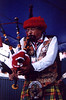
Sadly, I read yesterday that Rufus Harley passed away this week. I know some traditional bagpipers didn't like the attention he got at bagpipe competitions, Scottish festivals and the like. Some jazz snots didn't much like him either. But he was a legitimate musician, whether piping or playing jazz, and by all accounts a good soul.
Over lunch yesterday, I listened to "Dancing in the Dark," Milestone, a 1987 session with Mark Soskin on electric keyboards and one of those CDs I should listen to more often. Mr. Rollins is powerful on this and his improvisations, while fairly short for the most part, are quite creative. I've got a major thing for his version of the pop tune "Just Once." If you consider Tommy Flanagan the gold standard for pianists accompanying Sonny Rollins, Soskin isn't far off.
Thursday, August 03, 2006
Bop lives
Dizzy Gillespie biographer Donald Maggin did an unscientific survey and decided that more than 50 percent of jazz artists playing today still use predominantly bebop forms, which seems about right to me. Modal music is harder to play and less accessible on its face, the popularity of "Kind of Blue" aside. Avant-garde, freely improvised jazz is an even tougher nut to crack on both counts. Likewise the fusion sprung from Miles Davis' electric music.
I thought about Maggin's contention listening to "Night Owls," from an octet led by tenorman (also flute and clarinet) Chris Byars and Smalls Records. "All or Nothing at All" is done as bop, Latin-tinged, complete with saxophonists quoting Charlie Parker, or Leo Parker in the case of baritonist Mark Lopeman. The group's version of Tadd Dameron's "Gnid" also is straight line from the original boppers. Byars kind of reminds me of Sonny Stitt. I swear trombonist John Mosca is channeling J.J. Johnson.
That said, parts of this ("Village Beauty" for one, "The Way You Look Tonight" for another) make me think of "Birth of the Cool" and Gerry Mulligan's concert jazz band, which were more or less modal, albeit with bop roots sunk in swing soil. These guys aren't imitating in any event. They're using traditional tools to build their own state-of-the-art house, and a nice pad to hang out in for awhile it is. Proof bebop lives on.
Wednesday, August 02, 2006
Greek getting his props
I was listening to "Parallel Lines," Candid, from Greek saxophonist Dimitri Vassilakis in the car yesterday and thinking again what an excellent CD it is. I'm not the only one. E-mail from Vassilakis this morning points out positive All About Jazz reviews here and here.
I caught the guy in London in March and really enjoyed it, and then had the opportunity to see him again in Chicago in April on his first trip to the U.S. Looks like he's building a following and he should be; he's good.
I caught the guy in London in March and really enjoyed it, and then had the opportunity to see him again in Chicago in April on his first trip to the U.S. Looks like he's building a following and he should be; he's good.
Tuesday, August 01, 2006
Free jazz, for now
Interesting new(er) Web log for discussing free jazz and posting MP3s of out-of-print and unreleased recordings. I don't know how they do it and I'm sure some music industry thug will shut them down soon, but it's fun while it lasts.
I continue to be royally honked that "licensing issues" killed Swing is in the Air, a favorite jazz podcast of mine that I'm willing to bet did nothing but create new jazz fans and generate jazz recording sales to those of us who already have religion. (You can still get a live stream of the ongoing radio show from whence Swing stemmed.)
I continue to be royally honked that "licensing issues" killed Swing is in the Air, a favorite jazz podcast of mine that I'm willing to bet did nothing but create new jazz fans and generate jazz recording sales to those of us who already have religion. (You can still get a live stream of the ongoing radio show from whence Swing stemmed.)
Smalls is big
Smalls, the New York Club, has been a launching pad for some wonderful jazz musicians, as recounted in a June Downbeat piece, and Smalls Records is, thankfully, making a bunch of their music available. The article prompted me to buy the Omer Avital Group's "Asking No Permission," just one of the Smalls titles I had my eye on after experiencing the stunning Frank Hewitt CDs "We Loved You" and "Four Hundred Saturdays" from the label.
Monday, July 31, 2006
Tenor trio plus
I like pianoless saxophone trios, from Sonny Rollins at the Village Vanguard in 1957 to Donald Harrison's 2004 "Heroes." Then there's "Asking No Permission," from Smalls Records and the Omer Avital Group, with bassist Avital leading and holding things together sans piano, but not one sax, no, a veritable phalanx of saxes as the centerpiece. (Charles Owens, Gregory Tardy and Mark Turner on tenors and Myron Walden on alto. Ali Jackson drums, pretty much perfectly I might add, to round out the sextet.)
The music strikes me as hard bop with free elements and lots of clever touches that make it interesting over multiple listens. Take the nice coloring from Tardy playing flute, on which he doubles, on "Know What I Mean?!" The saxophones often sound like a choir during the ensemble interludes, not unlike the World Saxophone Quartet, but not quite as heavy or imposing either. It's more like Odean Pope's Saxophone Choir on "Locked & Loaded: Live at the Blue Note," Halfnote, a good disk my friend Carl Abernathy gave me recently, although Pope uses a piano.
"Lullaby of Leaves" is like something out of a "Pink Panther" score meets the deep blues, while "Devil Head" makes me think of classical chamber music in some places and Mingus in others. Avital, who gives himself some solo space, makes me think of Mingus as well, not in his sound necessarily but in his ability to make the bass seem not at all out of place when used as a front-line instrument. Plenty of fine solos from the saxes, too, including a series of them in "12 Tribes." Thanks Smalls, again.
Sunday, July 30, 2006
All-star stars
Put a bunch of stars together and you usually don't get a disaster, but it's been my experience that often you don't get anything particularly special either.
I thought about that this afternoon listening to Charlie Parker's "Au Privave" on the Jimmy Smith Blue Note CD "House Party." The B-3 master, Lee Morgan, Lou Donaldson, Tina Brooks, Kenny Burrell and Art Blakey turn in one of the most perfect pieces of jazz music I know. (Jimmy, how I miss him, lets lose with some brilliant solo improvisation on "Just Friends" as well.)
I thought about that this afternoon listening to Charlie Parker's "Au Privave" on the Jimmy Smith Blue Note CD "House Party." The B-3 master, Lee Morgan, Lou Donaldson, Tina Brooks, Kenny Burrell and Art Blakey turn in one of the most perfect pieces of jazz music I know. (Jimmy, how I miss him, lets lose with some brilliant solo improvisation on "Just Friends" as well.)
Friday, July 28, 2006
Murderers row
You can have your '27 Yankees, make my "Murderers Row" the lineup on "Benny Carter, Dizzy Gillespie, Inc.," Pablo/OJC, which besides the saxophone and trumpet giants includes Joe Pass on guitar and pianist Tommy Flanagan, giants in their own right. Al McKibbon and Mickey Roker on bass and drums aren't Old Milwaukee Light either.
Cool call and response from Gillespie and Carter on "Sweet and Lovely" and Pass, Carter, Flanagan and Dizzy all take standout solos on "Constantinople." John Birks even raises the roof a bit with high notes during "Nobody Knows the Trouble I've Seen," showing he could still do it even in his 60s. Roker ends the cut by singing the words to the song in a way that makes you feel the blues and the church at the same time. This is rated 2.5 stars (of 5) on allmusic, which I generally like, but that rating's stupid.
Cool call and response from Gillespie and Carter on "Sweet and Lovely" and Pass, Carter, Flanagan and Dizzy all take standout solos on "Constantinople." John Birks even raises the roof a bit with high notes during "Nobody Knows the Trouble I've Seen," showing he could still do it even in his 60s. Roker ends the cut by singing the words to the song in a way that makes you feel the blues and the church at the same time. This is rated 2.5 stars (of 5) on allmusic, which I generally like, but that rating's stupid.
Thursday, July 27, 2006
Dizzy muted
Miles Davis may have owned the thing, or seemed like it, but Dizzy Gillespie could work the mute, too, as is plain on "Dizzy's Big 4," Pablo/OJC, his spiffy 1974 no-piano quartet date with Joe Pass, Ray Brown and Mickey Roker. Pass is a copacetic partner for Dizzy and the two play off each other especially well on "Birks Works." The version of Fats Waller's "Jitterbug Waltz" is one of my most beloved jazz cuts.
Wednesday, July 26, 2006
Dizzy later
Other than the obvious, his small groups with Charlie Parker, Dizzy Gillespie does some of my favorite non-big band work on "Something Old, Something New," Verve, in a quintet with James Moody (who's super on this) and Kenny Barron.
As the title implies, they do a mix of bebop standards, including a wonderful medley of "I Can't Get Started" and "Round Midnight," and new (for 1963 when this was recorded) stuff. In the latter, I hear Dizzy, minus the mute, telling Miles Davis (and his second great quintet) that he ain't got nothin' over on old John Birks where sophisticated post-bop jazz is concerned. Barron cooks on "Cup Bearers." I might make "Early Mornin' Blues" my theme song for walking to work.
As the title implies, they do a mix of bebop standards, including a wonderful medley of "I Can't Get Started" and "Round Midnight," and new (for 1963 when this was recorded) stuff. In the latter, I hear Dizzy, minus the mute, telling Miles Davis (and his second great quintet) that he ain't got nothin' over on old John Birks where sophisticated post-bop jazz is concerned. Barron cooks on "Cup Bearers." I might make "Early Mornin' Blues" my theme song for walking to work.
Tuesday, July 25, 2006
Dizzy early
Besides "Dizzy Gillespie at Newport" and "Birks Works: The Verve Big-Band Sessions," covering Dizzy Gillespie's stellar 1956-57 "State Department" big bands, I wouldn't be without "Dizzy Gillespie: The Complete RCA Victor Recordings," Bluebird. The two-disk set starts with four tracks (including a version of the "King Porter Stomp" like you've never heard the "King Porter Stomp") of Gillespie in Teddy Hills' and Lionel Hampton's orchestras in 1937 and '39 and then covers Dizzy's own '46 to '49 groups, before economics forced him to fold up the big band tent.
A host of bop standards, such as "52nd Street Theme" and "Anthropology," get large-group treatment and you hear him go full-bore into incorporating Afro-Cuban forms into his music, after dabbling previously, by adding legendary congero Chano Pozo for "Manteca," "Cubana Be," "Cubana Bop" and other Latin-laced tunes. The recasting of "St. Louis Blues," which author Donald Maggin says honked off W.C. Handy, is priceless, the learned Professor Handy notwithstanding. Nifty Latinized version of "That Old Black Magic" with Johnny Hartman singing. Dizzy throws down in soling on "Jumpin' with Symphony Sid," which almost skirts the avant-garde in places.
A host of bop standards, such as "52nd Street Theme" and "Anthropology," get large-group treatment and you hear him go full-bore into incorporating Afro-Cuban forms into his music, after dabbling previously, by adding legendary congero Chano Pozo for "Manteca," "Cubana Be," "Cubana Bop" and other Latin-laced tunes. The recasting of "St. Louis Blues," which author Donald Maggin says honked off W.C. Handy, is priceless, the learned Professor Handy notwithstanding. Nifty Latinized version of "That Old Black Magic" with Johnny Hartman singing. Dizzy throws down in soling on "Jumpin' with Symphony Sid," which almost skirts the avant-garde in places.
Monday, July 24, 2006
Art period
Giving a second listen this morning to Tom Harrell's "Art of Rhythm," a 1998 RCA CD I picked up through La La (it had been on my to-buy list for quite awhile) and I'm thinking this has to be one of the best jazz disks of the last decade at least.
The music, all Harrell's, is diverse, from classically tinged to hard boppy and semi bossa nova to borderline free. But what really strikes me is the diversity of musicians he employed, from Dewey Redman and David Sanchez to Regina Carter and Mike Stern, and how well they work together despite generally having what I would call very different musical personalities. Stern and Redman turn in some memorable solos.
There's a Latin feeling to many of the cuts and, besides the bigger names, an interesting collection of instrumentation under the music, including strings, bassoon, marimba, bass clarinet and a variety of percussion devices. Enjoyable from first to last.
Saturday, July 22, 2006
Birks working
The two-disk "Birks Works: The Verve Big-Band Sessions" is a great companion to "Dizzy Gillespie at Newport" where Gillespie's boffo 1956-57 big bands are concerned. You get one bout of kick-butt ensemble play after another with "Whisper Not," "Tour de Force" and "Jordu" prime examples.
Dizzy raises the roof solo on the latter as well, and does some powerful soloing that I dig in particular on ballads such as "Stella by Starlight" and "I Remember Clifford." He lets loose with fine muted blues playing on "Joogie Boogie." Check out "School Days," which rocks and rolls, in large part thanks to the rhythm and blues-style sax runs by Billy Mitchell.
"Groovin' High" on this set captures the essence of Gillespie's conception of a bebop big band. A tad too many alternate takes of "Left Hand Corner" (four) on the second disk for my taste, but overall it's still plenty of unique tunes for the money.
Thursday, July 20, 2006
Birks works in a big band
Dizzy Gillespie is on my mind because I'm making my way through "Dizzy: The Life and Times of John Birks Gillespie" by Donald Maggin (which my friend Carl Abernathy loaned to me) as part of my study of bebop this summer.
As I said, I have a thing for Dizzy's mid-1950s big bands and one of the points I find interesting in the book is that he had a strong preference for leading and playing in big bands in general, albeit bop and Latin jazz arrangements not traditional swing. Unlike Charlie Parker, who preferred small groups, small-group play was more of an economic necessity for Dizzy than a vocation.
We can thank the U.S. Government, which wanted a jazz big band for a State Department good-will tour and was willing to subsidize it, and Norman Granz, who just wanted to hear great music, for the existence of Gillespie's '56-57 groups, which the man himself classed as his best ever.
Tuesday, July 18, 2006
Dizzy in the sky
If you want to hear Dizzy Gillespie work the high notes, you can do a lot worse than "Cool Breeze" on "Dizzy Gillespie at Newport," Verve, recorded 49 years ago this month. Memorable sax playing from Benny Golson and Billy Mitchell, too.
John Birks sure should have been famous for his small-group bebop recordings with Charlie Parker, but I think I like him best leading his mid-1950s big bands. Besides Golson and Mitchell (on my all-underrated sax team), this one includes Lee Morgan and Wynton Kelly, among others, along with a guest turn by Mary Lou Williams, who does wonderful Latin-inflected soloing on "Carioca." Standout version of "A Night in Tunisia" as well, with some cool Dizzy improvising. Classic.
John Birks sure should have been famous for his small-group bebop recordings with Charlie Parker, but I think I like him best leading his mid-1950s big bands. Besides Golson and Mitchell (on my all-underrated sax team), this one includes Lee Morgan and Wynton Kelly, among others, along with a guest turn by Mary Lou Williams, who does wonderful Latin-inflected soloing on "Carioca." Standout version of "A Night in Tunisia" as well, with some cool Dizzy improvising. Classic.
Monday, July 17, 2006
Sugar doesn't have to be sweet
I've seen Burnt Sugar classed as an extension of the kind of stuff Miles Davis did with his electric music, but "More than Posthuman: The Rise of the Mojosexual Cotillion" makes me think of Horace Silver's wonderful '70s set piece "The United States of Mind," for a new more angry and less hopeful millennium (so far) with an updated, harsher funk groove, interludes of hip-hop, sound theater using both instruments and voices and spiced by free jazz. Intricate and powerful and, heck, you could even dance to some of it. Maybe what this group really represents is a 21st Century big band that sounds like it. I am turned on by its music in any event.
Thursday, July 13, 2006
Miles unplugged
Disk 19 of "The Complete Miles Davis at Montreux," Columbia, which I reached over the weekend, is the same as the single CD "Miles & Quincy Live at Montreux," wherein Quincy Jones assembled two big bands, including the Gil Evans Orchestra, for the occasion and convinced Miles to do what he said he wouldn't ... revisit his old stuff, from "Birth of the Cool" to "Sketches of Spain."
Less than three months from death, Miles Davis still had it, even figuring that the power trumpet parts I hear are carried by Benny Bailey and Wallace Roney, who were there to help out. The big bands conducted by Jones and playing Evans' classic arrangements for Davis are outstanding. But the guy who really stands out is saxophonist Kenny Garrett, a regular in Davis' electric groups at the time, where he also excels based on the "Montreux" disks I've listened to previously.
Miles Davis always resented the excess of attention Chet Baker received. At least he could take comfort, if cold, that he was playing a heck of a lot better than Chet at the end.
I bought the box set for the breadth of coverage it offers of live performances of Davis' constantly changing electric music over more than 20 years, but I'm happy to have this nod to his past as part of the package. In fact, I haven't been less than happy with any of the disks in the set. Songs are repeated from disk to disk, as is natural in any "complete" box. Generally, I don't think that's as big a drawback in jazz, where versions tend to differ with some significance from one to another. But in the "Montreux" box, the repeats are more or less in title only. They're like whole new songs from performance to performance. One disk to go .. then I'm listening again.
Tuesday, July 11, 2006
More Sonny, please
Weird, the first thing that struck me on the title track of the new Sonny Rollins' CD "Sonny, Please" was the playing of trombonist Clifton Anderson (who's got a good solo on "Remembering Tommy" as well) and Kimati Dinizulu on percussion.
Mr. Rollins gets his by the time it's over, however, on his first studio release in six years and the first release ever on his own record label Doxy. I thought his last two studio CDs, "Sonny Rollins +3" and "This is What I Do," both Milestone, were among his best. They also were his last new disks of any kind before the outstanding, Grammy-winning and live "Without a Song," also Milestone, released last year.
I think "Sonny, Please" rates with any of the three and will probably get even more interesting over time because there's a lot going on in the course of the program.
Mr. Rollins is at his lyrical best on "Someday I'll Find You" and "Stairway to the Stars," which I place up there with two of my favorites, "A Nightingale Sang in Berkeley Square" on "This is What I Do" and "What a Difference a Day Made" on "+3." (Nice supporting work from Dinizulu on "Someday I'll Find You" and Anderson and guitarist Bobby Broom on "Stairway.")
The great tenor saxophonist is on the avant-garde edge on "Nishi," with some very complex blowing, and he makes another wonderful tribute to an old friend on "Remembering Tommy" (pianist Flanagan, who played with Mr. Rollins on his masterwork "Saxophone Colossus.") He seems to get especially inspired when he pens tunes in honor of former musical mates, as he did with "Have You Seen Harold Vick?" and "Charles M." on "This is What I Do."
The highlight: Probably "Serenade," on which he engages in the kind of ultra-creative improvisational odyssey from a simple melody for which he's justly famous. He closes with another in a line of smile-creating calypso-influenced tunes, "Park Place Parade."
Here's to many more new Sonny Rollins' CDs.
Monday, July 10, 2006
Found on the road
I met Eddie Fisher and his wife Christina over the weekend while working on a story in East St. Louis. Christina was showing me the community theater (complete with computer lab and video studio) she and her husband use to give kids in particular something constructive and educational to do, when she mentioned that her husband is a jazz guitarist. I'm a big jazz fan, I say. Let me show you something, she says. She takes me into Eddie's office and there's a picture of Eddie and ... Herbie Hancock, she says, and another of Eddie with ... Wayne Shorter, I say. You are a jazz person, she says. Yes mam, I say.
Meanwhile, Eddie's outside fixing up some junkyard furniture for the garden patio he's building in front of the theater, even though he's played with Booker T. & the MG's, Isaac Hayes, Solomon Burke and Albert King and toured Europe 10 times and is in the Arkansas Jazz Hall of Fame (he was born in Little Rock) with Herb Ellis, Louis Jordan and Pharoah Sanders, among others, pretty good company.
When I got home, I downloaded "42nd Street," his last CD, cut in 2001, from iTunes. In his playing style, Eddie Fisher makes me think of ... Eddie Fisher. If he sounds comparable to anybody, it's George Benson or maybe Jimmy Ponder and there's a little Grant Green and Wes Montgomery in his playing, too. The music moves my feet from the opener, "Who Loves You," and has a funk, Motown, soul thing going along with the blues in the mix, as on "Ah Blues Thang." All the songs are Fisher's. "Mr. Smooth" is as driving and powerful as any jazz guitar performance I can recall and it gets balanced nicely by "For You Babe," the pretty ballad that follows. Good musician and a good guy.
Saturday, July 08, 2006
Miles in the Forrest
Off to East St. Louis, which is in Illinois not Missouri, and where
Miles Davis grew up and started earning his props playing with local
guys like Jimmy Forrest, whose CD "Forrest Fire," OJC, is one blues
drenched, soulful romp.
Friday, July 07, 2006
Candy's dandy
I thought about Clifford Brown again yesterday when I received Lee Morgan's "Candy" in the mail for a buck through La La, a new Web-based used CD trading service I've been trying. (Works good so far.)
I thought about Brown because Morgan sounds like Lee Morgan playing Clifford Brown, maybe in "The Clifford Brown Story," if there had been such a movie. Which is not to say Morgan's playing isn't good, because it's downright amazing for a 19-year-old kid who's obviously on the way to finding his own voice, soon to be considerable, on this disk from early in his career.
You get to hear it plainly. Morgan is leading a quartet session and he's the only horn, although Sonny Clark on piano certainly helps carry the load. Spiffy.
Thursday, July 06, 2006
When the cat's away...
"African Cowboy", which opens "Wessell 'Warmdaddy' Anderson Live at the Village Vanguard," Leaning House, starts out making me think of Sonny Rollins' "Way Out West," by way of a New Orleans dance hall, and then segues into Ornette Coleman or Archie Shepp territory. "Now's the Time" gets similar treatment, with Anderson, mostly on alto saxophone, and trumpeter Irvin Mayfield opening pseudo Bird and Diz before giving it a more avant-garde flavor. Anderson's stint with the sopranino sax, a step higher than the soprano, on his own "Snake Charmer" begins like he plans to mesmerize a cobra and turns into a heck of a jazz burner. He also flashes a bit of Cannonball Adderley on "I'll Remember April" and a touch of Johnny Hodges on "Star-crossed Lovers."
I'm thinking Anderson, a mainstay of Wynton Marsalis' Lincoln Center Jazz Orchestra, enjoyed playing outside the necon confines of the big group and he took full advantage. I picked this up on a flier last week while poking around in my local used CD store, and I'm glad I did.
I'm thinking Anderson, a mainstay of Wynton Marsalis' Lincoln Center Jazz Orchestra, enjoyed playing outside the necon confines of the big group and he took full advantage. I picked this up on a flier last week while poking around in my local used CD store, and I'm glad I did.
Wednesday, July 05, 2006
Big Banding, part 10
Here's another in my hunt for good one-disk samplers covering a selection of classic big bands from the '20s, '30s and '40s with decent sound, representative material and a reasonable price.
Cab Calloway, "Are You Hep to Jive?" OK, the songs on this Columbia compilation, 22 recordings by the Calloway band from 1939-47, are generally goofy. But hey, the Cabster could sing, even on novelties like "Minnie the Moocher," and the band he had behind him plain ruled. Little wonder with dudes such as Dizzy Gillespie (before he and Calloway came to blows), Chu Berry and Milt "the Judge" Hinton in it. "The Calloway Boogie" might, in fact, keep you groovy 24 hours a day. Everybody ate when they came to Cab's house. And that's all reet, hep cat.
Follow the links to my suggestions for disks featuring the bands of Jay McShann or Glenn Miller or Claude Thornhill or Chick Webb or Benny Goodman or Fletcher Henderson or Billy Eckstine or Earl Hines or Andy Kirk.
Monday, July 03, 2006
Harold in jazz land
"Harold in the Land of Jazz," Contemporary/OJC, is an enjoyable Harold Land CD that has the tenorman in a quintet with the great Swedish trumpeter Rolf Ericson and bass god Leroy Vinnegar. Land and Ericson make me think of Miles Davis and Coltrane in Davis' first great quintet, especially on the quiet song "Lydia's Lament" but also on hoppin' tunes like "Speak Low" and "Smack Up." A very high level of musicianship on this disk.
Sunday, July 02, 2006
Slide's in the barn
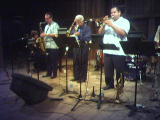
So I've been in a Jazz Showcase, a Jazz Bakery, a Jazz Kitchen and a
Jazz Cafe. Tonight, I added a jazz barn, officially the new Music Barn
at the University of Illinois-run Allerton Park. I have to say the loft
of an old timber barn makes a pretty nice concert venue. Of course it
helped that the UI jazz profs who broke it in had trombone legend Slide
Hampton along as a guest artist for a wonderful program of their
compositions, plus one from Mr. H., who still cooks, baby. I wonder if
he's ever played a real barn before?
Friday, June 30, 2006
I Remember Clifford
The death of Clifford Brown in a car accident 50 years ago this this week prompted Benny Golson to write one of the saddest songs I know, "I Remember Clifford." For a version of it from the wellspring, check out "Meet the Jazztet," Chess/MCA, a disk by Golson's group with trumpeter Art Farmer, which also includes trombonist Curtis Fuller and a young McCoy Tyner on piano. There's a soulful in extremis rendition on "People Time," Verve, the Stan Getz and Kenny Barron duet CD set, which I happen to think presents Getz at his best, especially on ballads.
Thursday, June 29, 2006
Studying Brown
"Study in Brown" and "More Study in Brown," both from EmArcy, are two nice disks for hearing Clifford Brown in his justly famous combos with Max Roach. The solos are fairly brief and emphasis is placed on ensemble playing, but it's a tight ensemble and you can understand why the Brown-Roach grouping is notable despite being short lived as a result of Brown's tragic death in a car accident 50 years ago this week.
On "Study," Brown produces memorable soling on "Cherokee" and he and saxophonist Harold Land function as if one on an unusual version of Billy Strayhorn's Duke Ellington anthem "Take the A Train." (Everybody does it on "A Train," but if you wanna hear somebody really make his cymbals sound like a steam engine chugging, listen to Roach.)
I didn't put a stopwatch to it, but the solo space feels more expansive to me on "More Study." Plus, half the tracks have Sonny Rollins, who joined the group in Chicago after Land went back to California as I recall, on tenor sax. He and Brown are practically symbiotic, which is not to bad rap Harold Land, a guy I think should be remembered more prominently than he is. Kickin' Brown solo on "Jordu" and some spiffy bass work by George Morrow on "These Foolish Things."
Wednesday, June 28, 2006
Two-man sound theater
On "Critical Mass," PSI, I swear I hear guitars, a bass, a Chinese lute, congas, steel drums and drums in general, along with sheet metal being shaken in the wings to simulate thunder for a stage play.
I even hear a piano and a saxophone (tenor and baritone) and those are the only sounds that I don't find surprising because a piano and saxophones are all Spanish pianist Agusti Fernández and Swedish reedist Mats Gustafsson, the only musicians on the duet CD, played for this recording. One amazing work of improvised jazz and a disk I am going to find mind bending over and over again.
I even hear a piano and a saxophone (tenor and baritone) and those are the only sounds that I don't find surprising because a piano and saxophones are all Spanish pianist Agusti Fernández and Swedish reedist Mats Gustafsson, the only musicians on the duet CD, played for this recording. One amazing work of improvised jazz and a disk I am going to find mind bending over and over again.
Monday, June 26, 2006
Brown blues
"There may be no sadder tale in modern music than that of Clifford Brown." The beginning of a Washington Post piece today on the 50th anniversary of the trumpeter's death in a tragic car accident.
He was 25, meaning he'd be 75, same age as his good friend Sonny Rollins, whom jazz journalists named artist of the year just last week. I have to think Brown, like Rollins and 85-year-old Clark Terry, would still be making music, maybe even with Mr. Rollins, and wouldn't that be something to hear and see?
Tonight, I gave a listen to "The Beginning and the End," Columbia, two cuts recorded near the beginning of Brown's career and three likely from the final night of his life, recorded live in Philadelphia. His soloing on "A Night in Tunisia" is the best I've heard on that song, and among the best on any song, and the version of Charlie Parker's "Donna Lee" is fabulous.
"Thank you. You've made me feel so wonderful." What Clifford Brown says to his audience at the recording's end.
Not bad, plus
Why the Swedes in E.S.T. are not like the Bad Plus, a lot of bad comparisons by bad music writers notwithstanding.
Bad Plus: jazz with a rock sensibility and a nod to the classical, group improvisation. E.S.T. (short for Esbjörn Svensson Trio, kind of): jazz with a classical sensibility and a nod to rock. Heavier on the electronica, not as heavy on the avant-garde flavoring, discrete solos as per traditional jazz. The Bad Plus often sounds like a much bigger band from sheer volume. E.S.T. sounds like a much bigger band because of the diversity in what it does with its instruments. Svensson sometimes makes like two pianists, and Dan Berglund like a bassist and guitarist at the same time. These guys, along with drummer Magnus Ostrom, are good.
On their latest, "Viaticum", 215, stick with "What Though the Way May Be Long," the last track, which doesn't actually end until long after 6:20.
Sunday, June 25, 2006
Test of mobile blogging

With pictures, this one of the Blue Room jazz club at the American Jazz Museum in Kansas City, where I saw Joe Chambers play last month.
Hawk bops
"Half Step Down Please" has bebop written all over it, and why not? Fats Navarro, J.J. Johnson, Hank Jones and Max Roach are in the house. The tenorman ... a warhorse named Coleman Hawkins.
From "Coleman Hawkins 1947-50," Classics. That and Classics' Hawkins 1945 disk have really filled out my Hawk collection nicely. This was a strong period for him, mostly in small group settings where he shoulders the load. The sound on the CD is great and the music is flat-out essential.
The solo tune "Picasso" is in a category with "Body and Soul" and "Rainbow Mist," but there are fabulous Hawkins solos one after another throughout the program. The set with baritonist Cecil Payne seems to have really inspired him, on "The Big Head" for one, "There's a Small Hotel for Another." Some of the best, and most boppy, stuff is with a French band in Paris, including a kickin' version of "It's Only a Paper Moon."
Saturday, June 24, 2006
Funny, but I don't play the clarinet
“What’s the difference between a jazz guitarist and a pepperoni pizza? A pizza can feed a family of four."
"What’s the definition of optimism? A jazz clarinetist with a pager.”
Jazz humor from comedian, and sometimes clarinetist, Emo Philips.
"What’s the definition of optimism? A jazz clarinetist with a pager.”
Jazz humor from comedian, and sometimes clarinetist, Emo Philips.
Friday, June 23, 2006
Son of a Trane
Revelation this evening: What Jonas Kullhammar's "Son of a Drummer" makes me think of most is "Blue Train." If the Swedish soccer team played like these guys, it'd be a stone lock in the World Cup.
Blues that don't give them to me
If guy Davis is anything like his music and his liner notes, I figure he must be a pretty good dude. I like him for that, and for his voice, which I think of in terms of gravel smoothed by a river of whiskey; for his guitar, banjo and harmonica playing; and for the stories his songs tell.
He's a blues singer in the Piedmont, Blind Willie McTell vein with bluegrass sensibilities whose latest CD, "Skunkmello" from Red House Records, also uses elements of gospel, R&B, rock and, on one amusing cut, hip-hop. As a musical story teller, I rate him with a couple of my old favorites, Harry Chapin and John Prine. "Legacy" from Red House is a good compilation of his stuff up to "Skunkmello." The song "We All Need More Kindness in This World" makes me want to be a better dude whenever I hear it.
He's a blues singer in the Piedmont, Blind Willie McTell vein with bluegrass sensibilities whose latest CD, "Skunkmello" from Red House Records, also uses elements of gospel, R&B, rock and, on one amusing cut, hip-hop. As a musical story teller, I rate him with a couple of my old favorites, Harry Chapin and John Prine. "Legacy" from Red House is a good compilation of his stuff up to "Skunkmello." The song "We All Need More Kindness in This World" makes me want to be a better dude whenever I hear it.
Wednesday, June 21, 2006
Billie moves to the background
I think Madeleine Peyroux sounds quite a bit like Billie Holiday on her first disk, "Dreamland," Atlantic, but the material is not like a Billie Holiday set, Patsy Cline-associated "Walkin' After Midnight" for one, plus some Peyroux originals. On her second, "Careless Love," Rounder, she sounds a whole lot less like Billie Holiday. I enjoy pretty much every tune on it, "Dance Me to the End of Love" and her own song "Don't Wait Too Long" especially.
"Dreamland" had James Carter, Cyrus Chestnut, Regina Carter and other big hitters behind her as a selling point. "Careless Love" has musicians maybe less well known but more tight as a group. Larry Goldings on keyboards and Scott Amendola on drums stand out.
I just like Peyroux's voice. She hasn't the commanding pipes of an Ella Fitzgerald or the pristine presentation of a Sarah Vaughan, but I think she does interesting and surprising things with accent and inflection that make her singing fetching and emotive, as did Billie Holiday, although, as I said, on "Careless Love" Peyroux sings much more in a Madeleine Peyroux way than a Holiday way.
I put the CDs on this week because I caught her in concert Saturday night (my only complaint being that for $40 it should have run longer than a little over an hour). She has a new disk due out this fall and it could be interesting if the show was an indication. She did some new stuff and it struck me as being a further advance toward her own sound. Couple it with her intelligent song writing and the combination should be formidable.
Monday, June 19, 2006
Shuffling my feet in the heat
If somebody put a gun to my dog's head and told me to pick a favorite jazz single or the pooch gets it, I wouldn't do it. Then again, I don't have a dog.
But if I made a list of potential choices in case I'm ever faced with such a decision, I'd probably put "Blueport" from Gerry Mulligan and his concert jazz band on it. (Verve one-disk version at the Village Vanguard, two renditions in the Mosaic box set.)
Came up on the Shuffle coming back from lunch and had my feet moving, 90-degree heat and like 90 percent humidity aside. In other words, catchy tune and, in this case, legendary musicianship. The speed at which Mulligan could manipulate his baritone is really evident, and amazing.
Friday, June 16, 2006
Make a masterpiece by midnight...
... as Ken Burns put what jazz musicians like Charlie Parker did (and do) up there on stage.
Or as trombonist Jimmy Knepper put it in the liner notes for "Bird at St. Nicks."
"It has sometimes been remarked that 'it's too bad Charlie Parker didn't write more' but the truth is he wrote continuously ... every time he played he composed. Not only did he compose brilliant melodic lines in his solos, but half the time he played his own accompaniment."
Burns titled the "Jazz" episode focusing on Parker and other post-swing players simply "Risk." Apt.
Thursday, June 15, 2006
Bird on a tightrope
Brian Priestley's "Chasin' the Bird: The Life and Legacy of Charlie Parker," Oxford University Press, says Parker played with a plastic alto sax in his later years because no self-respecting pawn shop would take take it in hock. Hence, he'd have a horn to play when he got a gig.
I believe Charlie Parker, over and above being a substance abuser, clearly suffered from mental illness for which he'd be treated, independently of his addictions, today. One question in my mind is whether that contributed to his music's nature, just as one wonders in the case of van Gogh and his paintings; and how would treatment have changed his music, or would it have, if so?
Parker himself said drugs made it harder to do what he did, rather than serving as some sort of twisted muse. It's wrong that he still gets tarred (I think mostly by people who just parrot the same old line) as the root of the widespread use of heroin by jazz musicians during his era, for which there were other cultural and societal reasons. The evidence is that he discouraged younger guys like Red Rodney, Jackie McLean and Sonny Rollins from using and despaired when they did.
Wednesday, June 14, 2006
Bird dreams
After I attended the marvelous Art Ensemble of Chicago concert in London in March I dreamt about it. However, while the video of the performance, so to speak, was quite vivid, the music wasn't. In fact, I don't recall ever dreaming music very vividly, until recently.
I've been having dreams lately about Charlie Parker's music, no images, just the music, rendered in stunning detail. Of course, I have been listening to a lot of Charlie Parker lately during my waking hours, but I still think the way I'm dreaming about his music says something about just how great a musician he was. OK, maybe I am weird. Either that or Charlie Parker's ghost is haunting me.
I've been having dreams lately about Charlie Parker's music, no images, just the music, rendered in stunning detail. Of course, I have been listening to a lot of Charlie Parker lately during my waking hours, but I still think the way I'm dreaming about his music says something about just how great a musician he was. OK, maybe I am weird. Either that or Charlie Parker's ghost is haunting me.
Tuesday, June 13, 2006
Trombonist to the master
Leave it to Clifton Anderson to show the proper way to coax a calypso out of the trombone, not exactly the instrument with the lightest touch. But then Anderson has been playing next to Sonny Rollins, a guy who knows a little something about calypsos (see "St. Thomas," for one), for more than two decades. Rollins happens to be his uncle, although the great saxophonist fired his nephew once, the message being it's Anderson's playing that counts, on stage and on "Landmarks" from Milestone.
As far as I can tell, the disk, which came out 10 years ago, is the only recorded session Anderson's led. Something possessed me to pull it out for lunch today and besides the impressive calypso grappling, it's a notable CD overall, with Monty Alexander on piano and Wallace Roney and Kenny Garrett guesting on a song each. Five of the eight pieces are Anderson compositions and he shows skill at that, too. I'm equally impressed with the way he makes a ballad instrument of the 'bone on "My One and Only Love." Good stuff.
As far as I can tell, the disk, which came out 10 years ago, is the only recorded session Anderson's led. Something possessed me to pull it out for lunch today and besides the impressive calypso grappling, it's a notable CD overall, with Monty Alexander on piano and Wallace Roney and Kenny Garrett guesting on a song each. Five of the eight pieces are Anderson compositions and he shows skill at that, too. I'm equally impressed with the way he makes a ballad instrument of the 'bone on "My One and Only Love." Good stuff.
Monday, June 12, 2006
Bebop economics
Besides Coleman Hawkins' influence on bop, a couple things really interested me in reading "The Birth of Bebop a Social and Musical History" by Scott DeVeaux, University of California Press, and Brian Priestley's "Chasin' the Bird: The Life and Legacy of Charlie Parker," Oxford University Press, as part of a little study of bebop I'm doing this summer.
One is DeVeaux's thesis that bop, in addition to resulting from artistic and civil rights-related motivations, was rooted in economics. The number of black big bands the music industry would bear always was limited, as was the number of black musicians white big bands would absorb. Big bands began to wane as the '40s progressed, making for fewer jobs for all musicians, black musicians especially.
Younger black jazz virtuosos hitting their primes, like Dizzy Gillespie and Charlie Parker, had their opportunities for big band success diminished in particular and, in response, found a new outlet in leading small groups in bars and clubs rather than big bands in ballrooms and dance halls, with Hawkins showing the way. Their performances were promoted through recordings, also a revenue source, that still appeared on juke boxes and mainstream radio then, as well as through live radio broadcasts.
Boppers also, of course, created a different kind of music to go with the realignment in group sizes and change of venues, in part as a means of distinguishing themselves from the "old" (and what had become substantially "white") style represented by swing. This in-with-the-new cycle seems to me to be a familiar pattern in musical change, whether it's beboppers in jazz or punks in rock or neo soulsters in hip-hop, et al. In the case of bebop, the effect was profound in that it converted jazz to an "art" or "chamber" music predominantly geared to listening as opposed to swing's métier dancing. So it has remained for the most part, with the exception of soul jazz, which I view as largely an attempt, with mixed success, to put the dancing back in jazz and to expand its popularity. Ironically, I think, some of the most advanced jazz, Miles Davis' electric stuff, was with its funky beat some of the more danceable jazz since the swing era (see "The Complete Miles Davis at Montreux 1973-1991") and certainly some of the more popular, as a concert draw and in record sales.
In addition, I found it sad that Charlie Parker, having burned most of his bridges as a result of substance abuse (and, I believe, mental illness), had to play frequently with pickup bands and "all-star" groups to get gigs in his final years. Considering the marvelous music he made, one wonders what else might have resulted if he'd had a consistent partnership with like-minded similarly skilled players, as Miles Davis did with his two classic quintets or Coltrane with Tyner, Garrison and Jones. Not to mention if he'd lived past 34.
Sunday, June 11, 2006
From one trio to another
Listening to Jobim's "Stone Flower" yesterday morning got me on a piano trio jag (although "Stone Flower" isn't a trio disk, go figure) that started with Bill Evans and "Sunday at the Village Vanguard" (great music for a rainy A.M., even a Saturday) and progressed into Jean-Michel Pilc's "Welcome Home." Pilc has been one of my favorite younger-lion jazz pianists since I bought his CD "Cardinal Points" on a flier a few years ago and then caught him live, and solo, at a little club in Paris. (His solo disk "Follow Me" is a good approximation of what I heard at that performance.)
He's far more percussive and the edges on his playing are much sharper than the smoothness of Evans and Jobim in both areas. Pilc also makes more overt use of avant-garde and classical elements, the latter of which Evans uses extensively but in a more integrative fashion. Pilc often flashes a familiarity with stride, a quality I don't hear in Jobim and Evans. If anything, he's more like McCoy Tyner, though quite individual in his sound I think. I particularly dig "Welcome Home," on which he mixes his own compositions with reconstructions of an interesting variety of standards and not-so-standards, from "I Got It Bad and That Ain't Good" to "Giant Steps," along with "Scarborough Fair."
I slipped over the edge and finished the session off with "Elf Bagatellen" from Free Music Production, Germany, and Alexander von Schlippenbach, a piano trio disk on which Evan Parker's saxes replace the bass. I remember listening to this the first time driving home from Chicago after I had purchased it at the Jazz Record Mart and thinking I'd wasted 20 bucks. It's one of those things like Ornette Coleman's "Body Meta" or Sam Rivers' "Crystals" that had to grow on me. Now I find all three intellectually, and viscerally, exciting whenever I listen to them.
Saturday, June 10, 2006
There can be Only one
I didn't know beans about rapper Beans but I know William Parker and Hamid Drake are about as good as it gets if you're building an avant-garde jazz crew and I'm always on the lookout for that perfect melding of jazz and hip-hop. So I snapped up the new CD "Only" from Thirsty Ear, featuring the three in a trio, after I read about it recently.
As hip-hop, it probably isn't standout. But I think it's pretty good experimental jazz and at least as interesting as other attempts to marry jazz and hip-hop I like, such as Soweto Kinch's "Conversations with the Unseen" and the Iswhat?! CD "You Figure It Out..." If the jazz is front and center on Kinch's disk and prominent with Iswhat?!, "Only" is more of a balance.
My one reservation is that the obvious hip-hop sections and the obvious jazz sections are quite discrete. They may be married, but they don't sleep in the same bed, kind of like couples on old TV shows. Where they are well mixed, they remind me of the jazz and electronica alchemy in stuff like Nils Petter Molvaer's "Khmer" and Bugge Wesseltoft's "New Conception of Jazz." The hip-hop kind of gets lost. On the other hand, I'd probably buy this just to hear Parker and Drake excel, and they do, in yet another context.
Brazilian fight song
More good music to play while rooting for Brazil in the World Cup.
Antonio Carlos Jobim, "Stone Flower," CTI. OK, it's probably better for
loving than fighting, heck it's probably better music for loving than
"Bolero," but it's great music in any event from "Brazil's George
Gershwin." Two boffo versions of "Brazil," one slow and one peppy.
Friday, June 09, 2006
Chicks I dig
In commemoration of my shameless leap onto the bandwagon of the Brazilian soccer team as the World Cup kicks off today, two versions of "The Girl from Ipanema" I dig.
"Getz/Gilberto," Verve. The classic. I see no other way to put it, Getz's soloing on this is erotic. Truth be told, however, I think his playing is most memorable on "O Grande Amor" and "Vivo Sonhando (Dreamer)." And tell me those aren't the rhythms of a Latin-language mass Gilberto uses to open the latter.
"Fire Music," Archie Shepp, Impulse. Is to Getz, Gilberto and Jobim what the soccer we used to play on the rock-strewn dirt field of my youth (wipe off the blood, buddy) was to Rondaldo, Ronaldinho and Robinho. But, hey, we had fun, just like Archie. His deconstruction of "Prelude to a Kiss" rocks as well.
Thursday, June 08, 2006
More live Birds
We have Jimmy Knepper to thank for two of the better live Charlie Parker recordings "Bird on 52nd Street" and "Bird at St. Nick's," both Original Jazz Classics from study tapes made by the trombonist in 1948 and 1950.
The "West End Blues" quote in "Visa" on "St. Nick's" is almost worth the price of the disk alone and then Parker goes and quotes the theme from "Woody Woodpecker" in "I Cover the Waterfront" and "Pop Goes the Weasel" in "Smoke Gets in Your Eyes." I love it. The sound is a bit muddy, but not too bad, and you can hear the background buzz of the crowd. (What were people doing talking anyway?) Some songs cut off abruptly.
I think "52nd Street" is worthwhile as well, but the quality of the recording is lower. It also has an underlying hiss that contributes to making it less pleasurable than "St. Nick's." In both cases, the tape tended to run only when Parker was playing. Still, you do get to hear snatches from Miles Davis, Red Rodney, Max Roach and Roy Haynes, among others. While I prefer "Charlie Parker: The Complete Live Performances on Savoy," much cleaner recordings mostly from radio shows, these CDs deserve more play time from me, "Bird at St. Nicks" especially.
Wednesday, June 07, 2006
Bird in the wild
A live collection that goes good with "Charlie Parker: A Studio Chronicle 1940-1948," JSP Records, is "Charlie Parker: The Complete Live Performances on Savoy," mostly New York radio broadcasts from 1948-49 with the last of the four disks devoted to a 1947 performance in Carnegie Hall and a 1950 concert in Chicago.
Something about "Symphony" Sid Torin introducing Bird and his mates (Miles Davis, Max Roach, Kenny Dorham and Tad Dameron among them) from the Royal Roost, "the Metropolitan Bopera House," tickles me every time I hear it. There's some song repetition from show to show, then again it's Charlie Parker playing live so while the song titles may be the same the way the songs, like "Slow Boat to China," get played isn't. Charlie Parker playing "White Christmas," on a Christmas morning no less, is priceless.
The Chicago concert has Parker with a local pickup band, the way he often had to perform later in his career just to get a gig, including the Freeman brothers George on guitar and Bruz on drums, but not tenor sax legend Von. The sound from the radio broadcasts is good, which can't be said for a lot of the live Parker stuff culled from amateur and impromptu tapes.
Tuesday, June 06, 2006
Bird song bevy
Having gone through all five disks now, I think it's hard to beat "Charlie Parker: A Studio Chronicle 1940-1948," JSP Records, as the basis of a Parker collection. At about $25, the price is fantastic, the sound is great and the selection includes early Bird with Jay McShann's band and Tiny Grimes, not to mention Dizzy, and all, as far as I can tell, of Parker's important Dial and Savoy studio sides.
Incredible music, of course. What always strikes me listening to Charlie Parker isn't just his unmatched creativity but the pace at which he issues new musical ideas. Listening to the fifth disk of the collection over the weekend, I also was struck by what a wonderful, emotive ballad player he was, even with no strings in sight, and how he was no less relentlessly creative at a slower pace.
Incredible music, of course. What always strikes me listening to Charlie Parker isn't just his unmatched creativity but the pace at which he issues new musical ideas. Listening to the fifth disk of the collection over the weekend, I also was struck by what a wonderful, emotive ballad player he was, even with no strings in sight, and how he was no less relentlessly creative at a slower pace.
Monday, June 05, 2006
Free Bird
Interesting vignette in Brian Priestley's "Chasin' the Bird: The Life and Legacy of Charlie Parker," Oxford University Press, which is a well-sourced, short recounting of Parker's life and musical development followed by an extensive discography that's a big selling point. (The biography itself is a quick read both in terms of length, 138 pages, and an accessible writing style, except for one heavily musicological chapter.)
The vignette: Ornette Coleman is playing in London in 1965. Hostile audience member, who evidently preferred bebop, yells in a moment of silence: "Now play 'Cherokee!'" Coleman does, in perfect imitation of Parker, for about five notes, before moving on his way.
This struck me doubly the day after I read it when the Nano shuffled up "Bird Food" from Coleman's "Change of the Century" and I thought: "Great bop." Until Ornette, again, moved on his way. "Ramblin'" on the disk, one of my Coleman favorites, is fairly marbled with bebop. (Coleman and Don Cherry are kind of Bird and Diz from another dimension.)
Says two things to me. I think Ornette Coleman could play very much like Charlie Parker if he wanted to do so. Anybody who still thinks he plays like he plays for a lack of chops is incorrect.
I also think Charlie Parker, a musical searcher who would have only been in his 40s in the '60s, might have found his way with the advent of the avant-garde, just as Coltrane did, and it could have been quite a thing to hear.
Friday, June 02, 2006
Real roots music
The liner notes of "In the Heart of the Moon," Nonesuch, say African guitarist Ali Farka Touré and kora master Toumani Diabaté made the CD pretty much like Coleman Hawkins and Duke Ellington made that Duke meets Hawk disk from Impulse. They just showed up, chatted a bit about what songs to play and played them, not jazz standards but traditional music of Mali, which, as I found with Mamadou Diabaté's "Tunga," can be gripping stuff. (Mamadou, also a kora player, is Toumani's cousin.)
"In the Heart of the Moon" is the deep roots of blues and jazz. I hear call and response, field hollers and spirituals, syncopation, ragtime, blues musicians from Mississippi John Hurt to Guy Davis, spontaneous improvisation as individuals and as a unit, bebop. Oh, and impressive guitar playing as well, here added to the hauntingly beautiful sounds of the kora. I called "Tunga" enchanting and mind expanding. Ditto.
"In the Heart of the Moon" is the deep roots of blues and jazz. I hear call and response, field hollers and spirituals, syncopation, ragtime, blues musicians from Mississippi John Hurt to Guy Davis, spontaneous improvisation as individuals and as a unit, bebop. Oh, and impressive guitar playing as well, here added to the hauntingly beautiful sounds of the kora. I called "Tunga" enchanting and mind expanding. Ditto.
Thursday, June 01, 2006
Big Banding, part 9
Here's another in my hunt for good one-disk samplers covering a selection of classic big bands from the '20s, '30s and '40s with decent sound, representative material and a reasonable price.
"Andy Kirk & His Clouds of Joy Jukebox Hits 1936-49," Acrobat Music. You want it because Kirk's band was a bebop incubator. Charlie Parker, Fats Navarro and Howard McGhee passed through, not to mention Don Byas, Jimmy Forrest, Eddie "Lockjaw" Davis and Hank Jones. Mary Lou Williams was the chief arranger until 1942. Also of interest: singer Pha Terrell, a big influence on Nat King Cole. I'm partial to guitarist Floyd Smith, who's every bit of Les Paul on "Floyd's Guitar Blues." Sounds dated in places, but the musicianship is always good. "I Know" makes me think of The Drifters, which is OK by me.
Follow the links to my suggestions for disks featuring the bands of Jay McShann or Glenn Miller or Claude Thornhill or Chick Webb or Benny Goodman or Fletcher Henderson or Billy Eckstine or Earl Hines.
Wednesday, May 31, 2006
Star Eyes differently
Walking to work the other day, the Nano came up with some saxophone playing that stretched the possibilities of "Star Eyes," and even wrung some new possibilities from it, with a sound lighter than Sonny Rollins but heavier than Ornette Coleman and an approach somewhere between the two, kind of Michael Breckerish. The cut came from Larry Schneider's "Jazz," SteepleChase, and the description could pretty much cover the rest of the disk, the ballads, like "Old Folks," included.
The rhythm section is nice as well, Andy LaVerne on piano, Steve LaSpina on bass and Matt Wilson (becoming one of those guys I use as a sign that a disk I'm thinking of buying is probably worthwhile) on drums. They tend not to venture as far as Schneider, which is OK because I think it helps anchor what the saxophonist does and makes this an approachable CD for anyone from jazz neocons to avant-garde acolytes and that's saying something. LaVerne contributes a couple compositions. I really liked "Portrait of Dorian Mode." It almost sounds like it has Chinese music underlying it.
The rhythm section is nice as well, Andy LaVerne on piano, Steve LaSpina on bass and Matt Wilson (becoming one of those guys I use as a sign that a disk I'm thinking of buying is probably worthwhile) on drums. They tend not to venture as far as Schneider, which is OK because I think it helps anchor what the saxophonist does and makes this an approachable CD for anyone from jazz neocons to avant-garde acolytes and that's saying something. LaVerne contributes a couple compositions. I really liked "Portrait of Dorian Mode." It almost sounds like it has Chinese music underlying it.
Tuesday, May 30, 2006
Man of steel, his guitar anyway
I'm thinking I'll have to spin Richard Leo Johnson's "The Legend of Vernon McAlister," Cuneiform Records, again because I'm sitting here, just having played it for the first time, wondering if I really heard what I think I heard, which is a man get pretty much a whole orchestra out of an old National steel-body guitar his neighbor gave him.
Not a lot of jazz on this stunning CD, but there is quite a bit of the old timey, country blues I like, and a bunch of other stuff, and if you appreciate music in general I think it would be hard not to be a little amazed by it overall.
Not a lot of jazz on this stunning CD, but there is quite a bit of the old timey, country blues I like, and a bunch of other stuff, and if you appreciate music in general I think it would be hard not to be a little amazed by it overall.
Jazz from a small island
British pianist Stan Tracey, whose trio nicely backs Sonny Rollins on "Live in London," is pretty Monkian (check out "A.M. Mayhem") on "Jazz Suite Under Milk Wood" with Bobby Wellins on tenor sax in the Charlie Rouse role. He actually sounds like Rouse (listen to "Llareggub") in places, but more like Stan Getz in others. Tracey wrote the songs based on a Dylan Thomas play and I think it's music as advanced as anything anybody was doing in 1965, including Miles Davis' second great quintet. I actually ordered this awhile back from the Bebop Shop in Britain and I'm not sorry I parted with the coin to do it.
Friday, May 26, 2006
Birthday greetings
Miles Davis would have been 80 today and if he was I probably wouldn't be wondering who's ever going to resolve jazz and hip-hop.
Thursday, May 25, 2006
Pretty as a painting
Italian saxophonist Tino Tracanna stuck out for me on John Tchicai's "Big Chief Dreaming," a disk that stuck out for me in general, so I ordered Tracanna's well-thought-of "292," Splasc(h) Records. Overall, I came away thinking of the CD as a jazz soundscape. I think parts of it are informed by towering classical orchestral (and operatic) pieces, kind of like Bob Belden's "Black Dahlia" but with a lot fewer instruments and yet as sonically impressive. In "Argomenti Persuasivi" I hear Italian or Mediterranean influences and African forms presented, at least partially, as aural abstract art. And "aural abstract art" fits the title track in particular as a description. Elsewhere, the blues are in the mix as well, along with chamber music, and conventional, albeit modern, jazz. Consistently interesting and likely to be next time I listen.
Wednesday, May 24, 2006
An apple a day
"Scrapple from the Apple" with Charlie Parker leading Miles Davis and Max Roach, priceless. From the fourth disk of "Charlie Parker: A Studio Chronicle 1940-1948," JSP Records, which really is a fabulous set. Brian Priestley calls this Parker's great quintet (Duke Jordan on Piano and Tommy Potter on bass are the other guys) in "Chasin' the Bird: The Life and Legacy of Charlie Parker" and I'm inclined to agree.
Kullhammar shoots, he scores, again
For purposes of my pocketbook I'm afraid Swedish saxophonist Jonas Kullhammar is going to become my next James Carter. He puts out a CD. I buy it. The latest, "Son of a Drummer," Moserobie Music, presents his quartet alone, minus the accompanying big band on "Snake City North," also Moserobie, a powerful disk that was one of my favorite purchases last year.
From my ear's perspective, the wallet can go lightly. "Hitman" sounds like Coltrane with the Jazz Messengers, and '60s Coltrane at that, which is an interesting mix. (I still hear Sonny Rollins and David Murray in Kullhammar's playing as well.) The whole group is good. Of the two Torbjörns, Gulz, the bassist, really sets the pace (see "The Rise and Fall of Sour T") and Zetterberg, the pianist, is an ear-catching second soloist who's McCoy Tynerish. And yes, I think there's a bit of Art Blakey in drummer Jonas Holgersson, although he probably appreciates the saxophonist's modernist, avant-garde leanings in a way Blakey wouldn't have. Kullhammar, not yet 28, wrote all the songs except for one and even the exception's a Swedish production, so I don't hear a bunch of tunes I've heard several times before. I'd really like to see these guys live.
From my ear's perspective, the wallet can go lightly. "Hitman" sounds like Coltrane with the Jazz Messengers, and '60s Coltrane at that, which is an interesting mix. (I still hear Sonny Rollins and David Murray in Kullhammar's playing as well.) The whole group is good. Of the two Torbjörns, Gulz, the bassist, really sets the pace (see "The Rise and Fall of Sour T") and Zetterberg, the pianist, is an ear-catching second soloist who's McCoy Tynerish. And yes, I think there's a bit of Art Blakey in drummer Jonas Holgersson, although he probably appreciates the saxophonist's modernist, avant-garde leanings in a way Blakey wouldn't have. Kullhammar, not yet 28, wrote all the songs except for one and even the exception's a Swedish production, so I don't hear a bunch of tunes I've heard several times before. I'd really like to see these guys live.
Tuesday, May 23, 2006
The Davis crib (kind of)
On my foray to Alton, IL, to attend Miles Davis' 80th birthday party Sunday I also took the opportunity to drop by the address where his birth certificate, on display at the event, said he was born.
I'm not sure it's the same house, doesn't look like it, although it could have been retrofitted over the years since Davis was born at 5 a.m. May 26, 1926. The family moved down the Mississippi to East St. Louis the next year in any event.

I'm not sure it's the same house, doesn't look like it, although it could have been retrofitted over the years since Davis was born at 5 a.m. May 26, 1926. The family moved down the Mississippi to East St. Louis the next year in any event.
Monday, May 22, 2006
Hawk bops
"The Birth of Bebop: A Social and Musical History" by Scott DeVeaux, University of California Press, was a little heavy on the musicological for me but the book also looks at the social, especially racism, and economic forces that drove the advent of bebop and it doesn't stint on the personalities involved, focusing in particular on Dizzy Gillespie while including some leaders in the movement who haven't received as much attention, such as Howard "Maggie" McGhee.
What I found especially interesting was Coleman Hawkins' facilitation of bebop by showing that small group concert, versus dance, jazz could be lucrative for black musicians, as well as by his incorporation of bop into his own music. I can hear it in "Bean and the Boys," Prestige, which has Hawkins in three octets and a quartet including Monk and modernists like Fats Navarro, Max Roach, J.J. Johnson, and Hank Jones, among others. The first set, he's transitioning from big band swing. The second and third, he's bopping, man. On the final set, from 1959, he's adapted soul jazz. But he's always Coleman Hawkins. It's hard to mistake that Hawkins sound, indelibly etched in my mind from "Body and Soul." In addition, all except seven of the 22 tracks on "Coleman Hawkins 1945" from the French Classics Records label are by Hawkins small groups with McGhee and much of the music is bop leaning. Personally, I think Hawk is talkin' trash to Charlie Parker on "Rifftide" and "Stuffy."
What I found especially interesting was Coleman Hawkins' facilitation of bebop by showing that small group concert, versus dance, jazz could be lucrative for black musicians, as well as by his incorporation of bop into his own music. I can hear it in "Bean and the Boys," Prestige, which has Hawkins in three octets and a quartet including Monk and modernists like Fats Navarro, Max Roach, J.J. Johnson, and Hank Jones, among others. The first set, he's transitioning from big band swing. The second and third, he's bopping, man. On the final set, from 1959, he's adapted soul jazz. But he's always Coleman Hawkins. It's hard to mistake that Hawkins sound, indelibly etched in my mind from "Body and Soul." In addition, all except seven of the 22 tracks on "Coleman Hawkins 1945" from the French Classics Records label are by Hawkins small groups with McGhee and much of the music is bop leaning. Personally, I think Hawk is talkin' trash to Charlie Parker on "Rifftide" and "Stuffy."
Sunday, May 21, 2006
Party down
From the Mother Jones Monument in Mt. Olive, IL, on my way back from Alton, where I attended Miles Davis' 80th birthday party this afternoon. Miles wasn't there, of course, and he wouldn't actually have been 80 until Friday. But they had a nice local quintet, fronted by Tim Jarden, director of the jazz program at Lewis and Clark Community College, playing Davis music and songs associated with him like "Four," "Someday My Prince Will Come," and "My Funny Valentine." Alton tenor sax legend Herb Hutchinson was fun to hear and trumpeter Kerry Waller did a good job filling in for Miles, who was born at home in Alton May 26, 1926, at 5 a.m. according to his birth certificate, which was on display. The cake was good, too. The folks at the Alton Museum of History and Art hope to make it an annual event that grows and I hope they succeed.
Saturday, May 20, 2006
What he said
Here's a piece by Stanley Crouch on John Hicks and one from the Hartford Courant remembering Jackie McLean.
Some people don't like Stanley Crouch and consider him a neocon didact, but I could listen to Crouch and Nat Hentoff talk jazz all day. I certainly have an interest in the academic and musicological aspects of jazz. However, after the music itself, with its wonderful diversity and oft-wondrous instrumental manipulation, I think I am most attracted by the personalities who pepper its history (he said as he works his way through Brian Priestley's "Chasin' the Bird: The Life and Legacy of Charlie Parker"). You learn plenty from reading them, but Crouch and Hentoff tend to be people focused as well so I get a good story, too. Says Crouch is working on a biography of Parker, which I will surely buy.
Some people don't like Stanley Crouch and consider him a neocon didact, but I could listen to Crouch and Nat Hentoff talk jazz all day. I certainly have an interest in the academic and musicological aspects of jazz. However, after the music itself, with its wonderful diversity and oft-wondrous instrumental manipulation, I think I am most attracted by the personalities who pepper its history (he said as he works his way through Brian Priestley's "Chasin' the Bird: The Life and Legacy of Charlie Parker"). You learn plenty from reading them, but Crouch and Hentoff tend to be people focused as well so I get a good story, too. Says Crouch is working on a biography of Parker, which I will surely buy.
Friday, May 19, 2006
So far, no demons, and no disco
If I were the guys at MacAddict, I'd be rating Pandora "spiffy." Sonny Rollins Radio is shaping up as the place to hear tenor sax (and some alto and soprano). Songs from the man himself, Coltrane, David "Fathead" Newman, Michael Carvin, Stan Getz, Joe Lovano, Sonny Stitt and Hal McKusick are among the recent tunes to roll through. I'd never heard of McKusick, which means Pandora's stated purpose, teaching me about some new music, is working. Charlie Parker Radio is shaping up as my bop station, naturally, and Duke Ellington Radio is for big bands. I just created Ornette Coleman Radio for the avant-garde. The collection could be bigger, I get a repeat now and then, but they say it grows every day. Besides, it's free, so why complain? What I really like the idea of is that I could travel, access the Web-based service and hear my stations anywhere. Like I said, spiffy.
Thursday, May 18, 2006
More Frank Hewitt
I have a favorite Stephen King tale, "The Breathing Method", that includes a scene where the narrator begins to read some books off the library shelves of a strange gentlemen's club (the kind where they drink brandy and play snooker, not a strip joint) central to the story. He decides they're among the greatest American novels, but he's never heard of the author and can't find anything else by him, nor can he locate the publisher. It's like the books came from nowhere, or from a parallel universe. (Hey, it is Stephen King.)
I feel a little bit like that listening to "Four Hundred Saturdays" from Smalls Records, the second CD from the late Frank Hewitt I've purchased recently, this one in a quintet with two saxophonists as opposed to a trio setting. The guy is simply one of the finer jazz pianists I've heard and the sax, bass and drums work on this from Chris Byars (tenor), Mike Mullins (alto), Ari Roland and Jimmy Lovelace are outstanding to boot. Four songs, recorded live (and well), all clocking in near 15 minutes, with lots of stellar improvising. Their version of Dizzy Gillespie's "Manteca" is fantastic. I don't think Monk ever played it. But you can get an idea of what he'd of sounded like listening to Hewitt.
I enjoyed Luke Kaven's liner notes excoriating the music industry for ignoring Hewitt when he was alive, and I'm glad Kaven and Smalls went so far as to create a record label to make sure he's finally heard by me and other folks. He should be.
Wednesday, May 17, 2006
Box open
I read about Pandora today and have been giving it a try this evening and I have to say it's something I might even pay for if I had to, which I don't, as long as I can live with some ads.
I created, in effect, my own Sonny Rollins, Charlie Parker and Duke Ellington Web radio stations. They don't actually play only Sonny Rollins, Charlie Parker and Duke Ellington. They play some, and a lot of other stuff like Sonny Rollins, Charlie Parker and Duke Ellington. It's a pretty diverse mix, including some fairly obscure stuff. You can thumbs up or thumbs down things to refine what you get. There also are links explaining why you're getting a song, which helps in the refining process, and links to buy songs from iTunes and CDs from Amazon as well. Nicely done.
I created, in effect, my own Sonny Rollins, Charlie Parker and Duke Ellington Web radio stations. They don't actually play only Sonny Rollins, Charlie Parker and Duke Ellington. They play some, and a lot of other stuff like Sonny Rollins, Charlie Parker and Duke Ellington. It's a pretty diverse mix, including some fairly obscure stuff. You can thumbs up or thumbs down things to refine what you get. There also are links explaining why you're getting a song, which helps in the refining process, and links to buy songs from iTunes and CDs from Amazon as well. Nicely done.
Knows how to throw a party
Regina Carter can certainly play classical violin (the Italians let her have at Paganini's "Cannon" after all). She's got more than a little Stuff Smith in her as well, and she can do Latin jazz as in "Mojito," one of my favorite songs on her CD "Rhythms of the Heart." And I have to think she could get as avant-garde as Jenny Scheinman, need be. But her thing is getting Motown funky. No surprise then that Carter fit right in with Christian McBride and the jazzed funk fest he put on at the concert I attended in Chicago's Orchestra Hall Friday night.
In addition to Carter, McBride's other special guest was Fred Wesley. I had no idea who Fred Wesley was before the concert. After, I found out he was trombonist of choice and musical director for James Brown. So you know he had no problem contributing plenty of funky licks. In fact, Mr. Wesley, older gentleman and the only guy in a suit though he was, kept right up with the youngsters, including DJ Logic. (McBride joked that Logic was probably the first "turntablist" to play Orchestra Hall, and I imagine that's right.)
I'd like to know more about Christian McBride's bass, which had the dings and dents of a bad boxer's face and looked like it had about 50 layers of shellac covering it. Something tells me it's a classic. He made it sound like it anyway. Dude played a mean electric bass guitar in the bargain. Geoffrey Keezer on piano and electronic keyboards and Terreon Gully, who's from East St. Louis, on drums also were great. Gully is just an impressively skilled drummer, powerful but capable of being subtle, too. I was reading a review Sunday that called him one of the most promising drummers to emerge in a decade.
You could see where Christian McBride was headed on his own CD "A Family Affair" and on "The Philadelphia Experiment," Ropeadope Records, which I gave another listen over the weekend and should pull out more often, because frankly everything on it is good. The duet McBride and pianist Uri Caine do of Elton John's "Philadelphia Freedom" is priceless. McBride's doing his own thing, but some of it also reminds me of Herbie Hancock's Headhunters, Weather Report and, of course, Miles Davis' electric music. I liked him before I went to the concert, but I came away a fan. "Live at Tonic," Ropeadope, his most recent CD, captures the kind of stuff that happened at Orchestra Hall pretty well.
Tuesday, May 16, 2006
Working on it
"I'm not sure what my usual kind of things are. I'm still getting together my usual kind of things." From an interview with Sonny Rollins on "Live in London."
I think he still is still getting together his usual things, and that's one reason he's so darn interesting at 75. The guy has never stopped searching musically. New CD due June 30 and I can't wait. Plus, yesterday I ordered my ticket to his concert here in September and I can't wait for that either.
I think he still is still getting together his usual things, and that's one reason he's so darn interesting at 75. The guy has never stopped searching musically. New CD due June 30 and I can't wait. Plus, yesterday I ordered my ticket to his concert here in September and I can't wait for that either.
Monday, May 15, 2006
John Hicks and Mary Lou
You wanna hear joy, check out "The Lord Says" on John Hicks' "Impressions of Mary Lou," High Note, a gospel romp that's part of a piece Mary Lou Williams wrote for the Catholic Church.
This CD, a mix of Williams compositions and songs Hicks composed in her honor, really shows what an accomplished and versatile pianist he was; sure, he could play blues, stride, bebop, hard bop, but he would have been right at home in a concert hall or a church (and sometimes was in the case of the latter as I understand it).
I bought the disk Friday, after Hicks, a favorite of mine, passed on last week and because I admire the music and life story of Mary Lou Williams. Hicks did a series of these tributes to great jazz pianists and composers. I have the Earl Hines one as well, and like it a lot. I should probably pick up the Kenny Clark, Erroll Garner and Billy Strayhorn sets because the music on the first two is excellent and they're outstanding showcases for Hicks, whom I'm going to miss. All but the Hines CD are available on emusic.
Sunday, May 14, 2006
Can't touch this...
I'm getting ready to write some more about the funk-ee Christian McBride concert I went to Friday night. Meanwhile, this afternoon it's the fourth disk of "Miles Davis: The Cellar Door Sessions 1970."
The funk you say, try "Honky Tonk" and "What I Say" and catch that Michael Henderson bass and those Jack DeJohnette drums. Gary Bartz sounds like he's auditioning for the J.B.'s or maybe the Family Stone.
What MC Hammer said.
The funk you say, try "Honky Tonk" and "What I Say" and catch that Michael Henderson bass and those Jack DeJohnette drums. Gary Bartz sounds like he's auditioning for the J.B.'s or maybe the Family Stone.
What MC Hammer said.
Saturday, May 13, 2006
Burning
"Forrest Fire," Prestige, is the Jimmy Forrest classic equivalent of Ron Blake's "Lest We Forget," with a just-out-of-his-teens Larry Young on organ, before Larry went all Coltrane. I love the versions of "Bag's Groove" and "When Your Lover Has Gone." I'm kind of amazed how good this sounds. I actually downloaded it from emusic and burned it to disk some time ago, before emusic even upped its bit rate. High-end audio fanatics who claim they can hear a difference in MP3s slay me. Likewise LP nuts who say records sound "warmer," whatever that means.
Good ride McBride
This morning I'm listening to "'Lest We Forget," Mack Avenue Records, from saxophonist Ron Blake, who was one of numerous great things about the ultra-funky Christian McBride concert at Chicago's Orchestra Hall last night. I even had a seat front row center. "Lest" is Blake's homage to organ jazz greats past and he's paired with Joey DeFrancesco, along with McBride, an even more super bassist in person than on record. Trumpeter Rashawn Ross gets in some good licks, too. Blake doesn't venture as far as, say, my man James Carter on "Out of Nowhere," Carter's recent organ jazz CD. But he loses nothing in a comparison with guys like Jimmy Forrest or Stanley Turrentine. For me, the attractive thing about organ jazz is its funky joyousness and this disk is all that. Fab version of "More Today Than Yesterday."
Friday, May 12, 2006
Two Christian
Two enjoyable CDs from Christian McBride as I head out to hear the
bassist and band at Chicago's Orchestra Hall this evening. "Gettin' to
It," Verve, modern hard bop with Joshua Redman on sax, trumpeter Roy
Hargrove and trombonist Steve Turre along. McBride's solo "Night Train"
is precious. Some great playing from Redman. "A Family Affair," Verve,
McBride makes jazz with the funk, R&B and soul forms he listened to
growing up in Philly. If disco had sounded like this it might not be a
thing I'm trying to forget. Charles Craig on electric piano and
saxophonist Tim Warfield are memorable. Some interludes are almost
avant-garde.
Mr. Rollins goes to London
The sound is unbalanced in spots, but "Sonny Rollins Live in London" from British Harkit Records, which captures Mr. Rollins at Ronnie Scott's in January 1965, is a good look at him in what I think of as his coming-to-terms-with-the-avant-garde phase. He does some interesting exploring over an 18-minute medley including "Autumn Nocturne," "April in Paris," "Three Little Words" and "I'll Be Seeing You." As always, he impresses me with how he can take diversions and yet never stray out of range of the straight rendering of a song, like "My One and Only Love," a favorite sad ballad of mine, or Miles Davis' "Four" and Charlie Parker's "Now's the Time." He never goes as far as the Coltrane of the period or an Archie Shepp. However, it sure ain't bop either. Pianist Stan Tracey, a U.K. jazz legend, and his trio are compatible accompanists and nice to listen to as well. Personally, I'll take all the live Sonny Rollins I can get.
Thursday, May 11, 2006
So long John Hicks
Not long ago I wrote that pianist John Hicks seemed to be great no matter what context you placed him in, with violinist Billy Bang in that case.
Looking today, I see I've mentioned Hicks a half dozen times since I started this jazz journal last year, with James Carter, Chico Freeman, and Jimmy Ponder as well as Bang. I really liked a duet CD featuring Hicks and bassist Richard Davis (who's kind of like the Hicks of the bass). I also enjoyed seeing him dueting live with Frank Morgan in LA last year.
Hicks, who died yesterday, led many of his own sessions, too. I'm partial to "Fatha's Day: An Earl Hines Songbook" from High Note. He may not have been a big name outside of the circle of musicians he played with so well, but I think the guy was an unsung jazz giant.
Wednesday, May 10, 2006
Fats and Tad
Eight of the 11 Sonny Rollins and Fats Navarro cuts on "The Amazing Bud Powell, Volume One" are on the two-disk "The Complete Blue Note and Capitol Recordings of Fats Navarro and Tad Dameron" as well. I don't regret buying both because the Navarro-Dameron sets include 28 other pieces in a bop or prebop mode that also approximate Miles Davis' "Birth of the Cool." (See "Lady Bird.") Even the alternate takes, which normally don't do much for me, are interesting because of the radical tempo shifting that takes place from take to take. Navarro is every bit of Dizzy Gillespie and the lineup of sax gods showing Charlie Parker-like licks, besides Mr. Rollins, is extensive, Charlie Rouse, Dexter Gordon and Wardell Gray for three. Really, every song includes an all-star collection of bop pioneers. I should listen to this more.
Tuesday, May 09, 2006
Bopping Sonny
Getting to hear Sonny Rollins play straight bebop is one of the cool things about the Rudy Van Gelder Edition reissue of Blue Note's "The Amazing Bud Powell, Volume One." The 19-year-old Mr. Rollins, on 11 cuts from 1949, was quite good at bop. He plays with some Charlie Parkeresque flashes, on the tenor no less, and gives Powell and Fats Navarro plenty to think about.
Blue Bird
The last two cuts on Disk A of "Charlie Parker: A Studio Chronicle 1940-1948," JSP Records, have Parker in a band backing singer Rubberlegs Williams on a couple down-and-dirty blues in 1941. Other band members include one Dizzy Gillespie on trumpet and Don Byas on tenor sax. Weird. And fascinating. I don't think the bebop guys were meant for straight blues, but they still sound good.
Monday, May 08, 2006
The early Bird
"The Kansas City of the 1920s and 1930s had many of the elements of medieval Florence. A wealthy Italian city state, Florence reveled in its independence and in the creative abilities of its artists. Botticelli, Leonardo and Michelangelo all lived and worked there."
Cool passage from the liner notes of "Charlie Parker: A Studio Chronicle 1940-1948," an English JSP Records compilation I got today, which starts with Parker in Jay McShann's Orchestra (if Basie is Leonardo and Charlie Parker is Michelangelo, Jay McShann can be Botticelli or maybe Brunelleschi). Some people hear bebop in the 1941 version of "Hootie Blues" on this. I hear Charlie Parker ascendent in "The Jumpin' Blues" and "My Heart Tells Me," among other places. Great sound restoration for the most part. I'm really excited about this boxed set, a bargain at $25.98 for the five CDs on Amazon. The four recordings of the Kansas City Band, Parker in a trio with guitar and drums, from 1941 are an especially interesting way to hear where he stands at this point. The version of "Body and Soul" isn't Coleman Hawkins, but it sure points the way to Parker's later sound. He's in New York with the Tiny Grimes Quintet by the end of the first disk and showing the stuff that got everybody so excited.
Cool passage from the liner notes of "Charlie Parker: A Studio Chronicle 1940-1948," an English JSP Records compilation I got today, which starts with Parker in Jay McShann's Orchestra (if Basie is Leonardo and Charlie Parker is Michelangelo, Jay McShann can be Botticelli or maybe Brunelleschi). Some people hear bebop in the 1941 version of "Hootie Blues" on this. I hear Charlie Parker ascendent in "The Jumpin' Blues" and "My Heart Tells Me," among other places. Great sound restoration for the most part. I'm really excited about this boxed set, a bargain at $25.98 for the five CDs on Amazon. The four recordings of the Kansas City Band, Parker in a trio with guitar and drums, from 1941 are an especially interesting way to hear where he stands at this point. The version of "Body and Soul" isn't Coleman Hawkins, but it sure points the way to Parker's later sound. He's in New York with the Tiny Grimes Quintet by the end of the first disk and showing the stuff that got everybody so excited.
Sunday, May 07, 2006
The annoy me state
On the road home from Lawrence, Kansas, and a visit with my great
friends the Dewars. Billboard-festooned, porn-store laced Interstate 70
through Missouri is one ugly stretch of road, but hey, at least it's
long. Glad I had Tab Benoit's "Fever for the Bayou," Telarc, to help me
get across. Excellent driving music. Also, "Whiskey is My Habit, Good
Women is All I Crave: The Best of Leroy Carr," Columbia, is perfect
starting-out music for a cloudy, hungover Sunday morning with an
eight-hour drive in the offing. Don't bother with the Music Outlet at
Warrenton, Mo., unless you're a big old-time country music fan or you
really love Elvis Christmas music. The jazz and blues pickings are slim.
Thursday, May 04, 2006
Belgium for chocolate...
And Sweden for jazz. I'm adding the great trumpeter Rolf Ericson to my list of favorite Swedish jazz musicians, which is getting pretty big. On "Stockholm Sweetnin'," Dragon, he makes me think of Art Farmer with his lyrical, understated, but clearly very skilled playing. I hear elements of Miles Davis and Dizzy Gillespie, too. He does Thad Jones' "Bird Call" up appropriately boppy and includes a number of clever quotes Charlie Parker (whom Ericson actually accompanied on a Swedish concert tour at one point) would have appreciated.
The title track is, in fact, a sweet ballad while the unmuted up-tempo approach to "If I Were a Bell," a Miles favorite, is an interesting contrast to Davis' renditions. Pianists Göran Lindberg and Claes Croona are quite good on this. (Check out "Just Squeeze Me" and "Evelyn".) I'd like to hear more of saxophonist Nils Sandström, who mostly comps but has a nice Coltrane-like tone. Listened to the CD after a busy day writing the first draft of a work project on human research subjects and it made me feel better.
The title track is, in fact, a sweet ballad while the unmuted up-tempo approach to "If I Were a Bell," a Miles favorite, is an interesting contrast to Davis' renditions. Pianists Göran Lindberg and Claes Croona are quite good on this. (Check out "Just Squeeze Me" and "Evelyn".) I'd like to hear more of saxophonist Nils Sandström, who mostly comps but has a nice Coltrane-like tone. Listened to the CD after a busy day writing the first draft of a work project on human research subjects and it made me feel better.
Wednesday, May 03, 2006
Sad story, marvelous music
I think Bob Belden's "Black Dahlia," Blue Note, is the recent equivalent of Stan's Kenton's "City of Glass". Forward-looking large-group jazz with classical elements that's powerful for much of its run but also makes crafty use of subtlety. The array of great musicians Belden used on this is incredible. Having read an excellent book about the Black Dahlia murder, I'll also say this piece is uncanny in the way it captures muscially the story's rhythms (at least as presented in the book I read). If this music had scored a movie, it would have won an Oscar.
Candye's ... a good singer
I'm calling Candye Kane's "The Toughest Girl Alive," Bullseye Blues & Jazz, jazzy blues with gospel and country tinges. In the best tradition of Ma Rainey, Big Momma Thornton and Bessie Smith, her songs may be racy (one of them is titled "Let's Commit Adultery") but I figure you can send the kids and the fundamentalists out of the room when you play this CD. The latter don't like to have a good time anyway, so the disk would be wasted on them. Some songs, like "Highway of Tears" and "Get Happy," are pretty much straight jazz. Another attraction: she's got a heck of a backing band with some good boogie-woogie piano and hot trumpet and tenor sax (see "Je N'en Peux Plus Sans Ma Cadillac"), in addition to bluesy guitar playing. Fun stuff I found through The Roadhouse podcast.
Tuesday, May 02, 2006
Don't throw stones
Pulled out "City of Glass: Stan Kenton Plays Bob Graettinger," Capitol, last week, after it crossed my mind for some reason, one of those CDs that didn't turn me on the first time I listened to it but keeps getting better every time I listen.
The "City of Glass" suite and the other compositions are large-ensemble music that I would call jazz. Not everyone would agree, certainly not on "City of Glass," although stuff like "Thermopylae" is pretty clearly jazz, albeit not the traditional variety heard from big bands, even most modern big bands. Scott Yanow on allmusic characterizes it as futuristic when it was recorded and still futuristic today and I guess that's about as good a way of putting it as any.
Abstract but structured also describes it, not free and yet employing free jazz elements like dissonance, tension and release, odd juxtapositions and surprising twists and turns which are, upon examination, quite logical. I think it's jazz, because of the soloing and the improvisation I believe I hear, among other things. But it also borrows from classical music, particularly modern impressionistic classical music. Stan Kenton was into bold, powerful music and Graettinger surely provided it. The cuts on this disk aren't so much swinging as imposing.
There are loads of big names in jazz among the small army of musicians Kenton employed for these recordings, Lee Konitz, Art Pepper, Bud Shank, Maynard Ferguson, Conte Candoli, Frank Rosolino, Shelly Manne and Stan Levey among them. Some, like tenorman Bob Cooper, show their versatility by playing instruments you don't normally hear on a jazz recording. Cooper plays oboe and English horn besides his sax. The instrumental mix overall is diverse and interesting with cellos, bassoon, bass trombone and more. To me, it's important and fascinating music that any semi serious jazz fan needs to try, probably more than once to really appreciate it.
Monday, May 01, 2006
A Ragin Revelation
"Revelation," the title track on the Hugh Ragin Justin Time CD, came up on my iTunes Party Shuffle playlist tonight and two things occurred to me. First, Ragin (a regular David Murray collaborator) does some of the best avant-garde trumpet playing I've heard in a long time, and yet it's still accessible.
Second, if you're going to play avant-garde jazz, you should get Hamid Drake to do the drumming. William Parker on bass helps, too, and Assif Tshar on bass clarinet, as well as tenor sax, adds some interesting texture.
Second, if you're going to play avant-garde jazz, you should get Hamid Drake to do the drumming. William Parker on bass helps, too, and Assif Tshar on bass clarinet, as well as tenor sax, adds some interesting texture.
Jazz weekend
I'm bushed this morning from a jazz weekend in Chicago, starting Friday night with Joe Segal's birthday party concert, where Yusef Lateef and Von Freeman did a butt-kicking call-and-response improvisational duet that makes me want to find out what they're drinking and get some of it (both are in their 80s). Saturday early, Greek saxophonist Dimitri Vassilakis at the HotHouse, a very nice venue I hadn't been to before. This guy really is good, check him out if you like your sax playing recognizable but still with plenty of free-leaning improvisation. Saturday late, Ira Sullivan at the Jazz Showcase. He's one of the revelations of the weekend for me and played alto sax, very much Charlie Parker style, trumpet, flute and probably some instruments I missed, all well. The other revelation was Chicago-based bassist Larry Gray, who backed all three performances. He's a name I'll be looking for in the future when I'm checking out the lineup on disks in considering whether to buy them. Oh, my buddy Carl Abernathy and I worked in a visit to the wonderous Jazz Record Mart Saturday afternoon, too. No wonder I'm tired.
Subscribe to:
Posts (Atom)