I think living a worthy life comes down to, in some measure, having a sense of humor and not taking yourself too seriously. Which is one reason I have this affinity for Australia, an entire country, nay, continent that seems to have a sense of humor and seems not to take itself too seriously.
This must be true of the Melbourne Symphony Orchestra, which backs Meat on a complete rendition of his classic, albeit not classical, CD. They do Paradise by the Dashboard Light and all, performed live in 2004. They even work in a boys choir. Meat's voice isn't what it used to be, or isn't live what it is dressed up in a studio, but the symphony makes up for that and, interestingly, never sounds out of place. (It veritably soars on For Crying Out Loud.) Just plain fun and some pretty good music in the bargain. The audience must have thought so as well. It sings along in places. Bet the Melbourne Symphony doesn't get that on Beethoven's Fifth.
Sunday, June 07, 2009


Saturday, June 06, 2009
The height of, like, melancholy
Mariza and a bowed double bass on Duas Lagrimas De Orvalho, Transparente, that's it.
Friday, June 05, 2009
Sea song
Despite my general reservations about over-orchestrating fado, I have to say the more complex instrumentation and instrumental effects behind Dulce Pontes on Lagrimas mostly work.
Struck me during a third listen this morning, on Canção do Mar (Song of the Sea) in particular, where the musical background gave me a mental impression of Pontes on a shore singing with the waves and wind accompanying her. I don't think she really needs this stuff. She has a voice quite capable of being interesting on its own. But the accouterments on the CD tend to have a charm as well. Laurindinha and As Setes Mulheres do Minho remind me of something like Paul Simon's Graceland.
Struck me during a third listen this morning, on Canção do Mar (Song of the Sea) in particular, where the musical background gave me a mental impression of Pontes on a shore singing with the waves and wind accompanying her. I don't think she really needs this stuff. She has a voice quite capable of being interesting on its own. But the accouterments on the CD tend to have a charm as well. Laurindinha and As Setes Mulheres do Minho remind me of something like Paul Simon's Graceland.
Thursday, June 04, 2009
Amália Rodrigues, Raizes, Blue Moon
In many respects, the perfect fado CD. That it is Amália suggests it, of course, and then there's the traditional, spare accompaniment of just a Portuguese and two standard guitars, which compliment, but never clash with, her voice.
More than that, I enjoy the mix of tempos in the 18 songs, plenty of sad and soulful slow numbers interspersed with zippy tunes like Grao De Arroz and Lerele that I would characterize as more ironic than happy. Made me think of the first time I listened to Robert Johnson: The Complete Recordings.
More than that, I enjoy the mix of tempos in the 18 songs, plenty of sad and soulful slow numbers interspersed with zippy tunes like Grao De Arroz and Lerele that I would characterize as more ironic than happy. Made me think of the first time I listened to Robert Johnson: The Complete Recordings.
Wednesday, June 03, 2009
Dulce Pontes, Lagrimas, Movieplay
Heavily orchestrated fado with a lot going on around her, including some '90s electronic effects, and, I have to say, it's sometimes a little distracting and subsumes her voice in a few places, which is annoying because she has a marvelous voice.
Then again, it is impressive to hear her rise above the excess in the background on tunes such as Zanguei-Me Com O Meu Amor and Os Indios Da Meia Praia and there are interludes of stripped, down more traditional fado, gripping ones at that. Estranha Forma Da Vida, for one.
Then again, it is impressive to hear her rise above the excess in the background on tunes such as Zanguei-Me Com O Meu Amor and Os Indios Da Meia Praia and there are interludes of stripped, down more traditional fado, gripping ones at that. Estranha Forma Da Vida, for one.
Tuesday, June 02, 2009
Time Out (50th Anniversary Edition), Dave Brubeck, Columbia
The classic session and a bonus DVD with a mini documentary about it. The real attraction is a second CD with live Newport appearances by the Time Out quartet (including a performance of Take Five, of course) that very nearly puts Dave Brubeck in a new light for me.
Not surprised to hear a ration of Tatum, Waller and even Monk in his playing but he's, dare I say it, as gut-bucket bluesy as Champion Jack Dupree in places, like St. Louis Blues. The integration of Someone to Watch Over Me into Blue Rondo à La Turk is priceless.
Not surprised to hear a ration of Tatum, Waller and even Monk in his playing but he's, dare I say it, as gut-bucket bluesy as Champion Jack Dupree in places, like St. Louis Blues. The integration of Someone to Watch Over Me into Blue Rondo à La Turk is priceless.
Jim Hall & Bill Frisell, Hemispheres, ArtistShare
Sympathetic is the word that kept coming to mind as I listened to the two CDs in this set repeatedly. The first disk is duets with Hall and Frisell, the former of whom usually, but not always, holds the center while the latter dances around and outside it.
I really like the second disk, which is the two guitars in a quartet with Scott Colley and Joey Baron fitting in like it was meant to be on bass and drums. Includes wonderful versions of My Funny Valentine and In a Sentimental Mood and a breezy romp through Sonny Rollins' Sonnymoon for Two.
I really like the second disk, which is the two guitars in a quartet with Scott Colley and Joey Baron fitting in like it was meant to be on bass and drums. Includes wonderful versions of My Funny Valentine and In a Sentimental Mood and a breezy romp through Sonny Rollins' Sonnymoon for Two.
Friday, May 29, 2009

Some more text on teens texting
I think elements of this story are interesting (the number of texts kids send for one thing), but it commits one of the journalistic sins that most annoy me: lack of perspective.
People of all ages in this day and age face constant, ubiquitous communications and the pressure to respond to them. Is it more of a problem for teens, a theme this story is built around? I doubt it.
In fact, these two short sentences in the long piece make me wonder if any basis, other than speculation by reporters and editors, exists for the notion that teens texting is a problem at all, let alone more so than for adults.
"The rise in texting is too recent to have produced any conclusive data on health effects."
"Peter W. Johnson, an associate professor of environmental and occupational health sciences at the University of Washington, said it was too early to tell whether this kind of stress is damaging."
At least those brief qualifiers were included, although they hardly negate the overriding message of the story--teen texting, be afraid parents, school officials, lawmakers, et al, be very afraid.
Reminds me of the '50s comic book scare and any number of other historical bouts of youth problem mongering, from rock music to video games. I expect this kind of thing from People or USA Today. I'm sorry when it appears in the NYT.
People of all ages in this day and age face constant, ubiquitous communications and the pressure to respond to them. Is it more of a problem for teens, a theme this story is built around? I doubt it.
In fact, these two short sentences in the long piece make me wonder if any basis, other than speculation by reporters and editors, exists for the notion that teens texting is a problem at all, let alone more so than for adults.
"The rise in texting is too recent to have produced any conclusive data on health effects."
"Peter W. Johnson, an associate professor of environmental and occupational health sciences at the University of Washington, said it was too early to tell whether this kind of stress is damaging."
At least those brief qualifiers were included, although they hardly negate the overriding message of the story--teen texting, be afraid parents, school officials, lawmakers, et al, be very afraid.
Reminds me of the '50s comic book scare and any number of other historical bouts of youth problem mongering, from rock music to video games. I expect this kind of thing from People or USA Today. I'm sorry when it appears in the NYT.
Hey you kids, get off my lawn
Not sure I want to think about this too much, especially before going to sleep.
"Microbes that live in and on our bodies outnumber our own cells 10 to one." The top breeding ground, according to the researchers at the National Human Genome Research Institute in Bethesda, Maryland, who did the study?
No, not your stomach or intestinal tract. Not even your linty belly button.
Your forearms.
"Microbes that live in and on our bodies outnumber our own cells 10 to one." The top breeding ground, according to the researchers at the National Human Genome Research Institute in Bethesda, Maryland, who did the study?
No, not your stomach or intestinal tract. Not even your linty belly button.
Your forearms.
Back in the saddle...
... or the adjustable tractor seat anyway.
Back living in a river town for the first time in a quarter century, I'm buying my first canoe in that long as well. I had the folks at We-no-nah make me one of their solo Prisms in Kevlar and I am picking it up today after work.
So exciting.
Back living in a river town for the first time in a quarter century, I'm buying my first canoe in that long as well. I had the folks at We-no-nah make me one of their solo Prisms in Kevlar and I am picking it up today after work.
So exciting.
Tuesday, May 26, 2009
A day late...

Should have said happy birthday to Miles yesterday and I find it interesting that Wallace Roney was born May 25 as well, albeit it in 1960 not 1926. Fate or what?
Today: Vibraphonist Lionel Hampton records Flying Home with a classic solo by tenor saxophonist Illinois Jacquet in 1942, which I'll be taking a listen to, for about the 100th time, this evening.
Sunday, May 24, 2009
Trey Wright, Thinking Out Loud, Blue Canoe
Confession: Pat Metheny and Kurt Rosenwinkel, both of whom I've enjoyed live, as well as John Abercrombie, don't really interest me very much with their recordings, although I recognize their excellence as guitarists. Which is why I'm a Bill Frisell guy, I guess. Trouble with Bill is, he gets pretty out there and sometimes it would be nice to listen to some jazz guitar that is more traditional in a Grant Green or Wes Montgomery vein and yet modern and consistently interesting.
Wright's Thinking Out Loud is that kind of session. The songs are diverse, with no one sounding quite like another, and his playing reminds me of Frisell without slipping over the edge, but more in the "feel" of it than in an imitative sense. He's definitely got his own sound. It has enough facets to it that I don't miss the presence of horns, as I do on occasion in jazz guitar trio sets. Bassist Mark Miller and drummer Marlon Patton also are big reasons why this set doesn't come off as hornless. They're as tricky as Wright and the three are seamless playing together. A nice find.
Wright's Thinking Out Loud is that kind of session. The songs are diverse, with no one sounding quite like another, and his playing reminds me of Frisell without slipping over the edge, but more in the "feel" of it than in an imitative sense. He's definitely got his own sound. It has enough facets to it that I don't miss the presence of horns, as I do on occasion in jazz guitar trio sets. Bassist Mark Miller and drummer Marlon Patton also are big reasons why this set doesn't come off as hornless. They're as tricky as Wright and the three are seamless playing together. A nice find.
Friday, May 22, 2009
Mariza, Transparente, Times Square Records

Mariza with (more) strings, particularly the bowed kind. Nonetheless, it is still very deep fado and her voice, as always, remains the commanding presence.
I am consistently amazed at the emotional effects of her singing, and the singing of fadistas in general, despite the fact that I know very little Portuguese.
This morning I had a thought. When I heard her this spring, Mariza was doing very well with her English. (She even did a boffo version of Crying during the concert, a fado for her American friends, as she put it). How I would love for someone to suggest to her a session of traditional American blues.
Wednesday, April 29, 2009
Sunday, April 19, 2009
Lenny Breau, Five O'Clock Bells & Mo' Breau, Genes
I don't really tire of hearing My Funny Valentine, but it does, like any song after after a few hundred listens, become harder to rivet my attention unless you are doing something special. Breau does on this, taking it in a flamenco direction at one point, among other things. I rate it with the stunning Bobby Timmons version of MFV on This Here is Bobby Timmons. Fantasic guitar playing all over the Breau disk (which actually started life as 2 different LPs) in the bargain. I remember Hank (as in Williams) is about as nifty a recrafting as My Funny Valentine.
Saturday, April 18, 2009
Friday, April 17, 2009
This is sure a CD I'm buying when it comes out
I hate reality shows and a loathe American Idol, but if you haven't looked at the clip of this gal singing in the U.K. version of AI, do yourself a favor. Unbelievable.
Puts me in mind of a favorite Harry Chapin song "Mr. Tanner" and of the story about drummer-bandleader Chick Webb, who took one look at a young Ella Fitzgerald and said there was no way he'd have an ugly girl like that fronting his band, until she opened her mouth and sang, at which point he hired her on the spot. (Chick himself was a homely fellow, and a dwarf, so he had no real business talking.)
Puts me in mind of a favorite Harry Chapin song "Mr. Tanner" and of the story about drummer-bandleader Chick Webb, who took one look at a young Ella Fitzgerald and said there was no way he'd have an ugly girl like that fronting his band, until she opened her mouth and sang, at which point he hired her on the spot. (Chick himself was a homely fellow, and a dwarf, so he had no real business talking.)
Wednesday, April 15, 2009
Thursday, April 09, 2009
Resonates with me at this point in my life
"Can't we just return to the bare bones? Relaxing with the present, relaxing with the hopelessness, relaxing with death, not resisting the fact that things end, that things pass, that things have no lasting substance, that everything changes--that is the basic message."
--Pema Chodron
--Pema Chodron
Sunday, March 29, 2009
Wynton Marsalis, He and She, Blue Note
So I have been listening to this again and again since I bought it Friday. Why?
I am sick with a cold and it is just too much effort to change CDs? Because it is easy on my virus-addled brain? Maybe the former, but I don't think the latter particularly.
Not that it isn't easy on the ears, because Wynton Marsalis pretty much always is by nature. But there's some complex, if impeccably rendered, music here, drawing, as is also natural with Marsalis, on New Orleans, Armstrong, Ellington and the Jazz Messengers along with, in places, Mingus (who's all over The Razor Rim), Coltrane and the avant-garde. I hear something new that I like, and that surprises me, in it with each listen.
The music tracks are interspersed with Marsalis-recited poetry touching on aspects of gal-guy relations that I could take or leave, although they add up to a nifty narrative in my mind, fit like a glove with the music and are delivered in quite a soothing manner, which is good for nursing a cold.
Like Marsalis' Big Train (a favorite of mine not especially popular, the fate of He and She, too, I fear) a CD ultimately greater than the sum of its parts.
I am sick with a cold and it is just too much effort to change CDs? Because it is easy on my virus-addled brain? Maybe the former, but I don't think the latter particularly.
Not that it isn't easy on the ears, because Wynton Marsalis pretty much always is by nature. But there's some complex, if impeccably rendered, music here, drawing, as is also natural with Marsalis, on New Orleans, Armstrong, Ellington and the Jazz Messengers along with, in places, Mingus (who's all over The Razor Rim), Coltrane and the avant-garde. I hear something new that I like, and that surprises me, in it with each listen.
The music tracks are interspersed with Marsalis-recited poetry touching on aspects of gal-guy relations that I could take or leave, although they add up to a nifty narrative in my mind, fit like a glove with the music and are delivered in quite a soothing manner, which is good for nursing a cold.
Like Marsalis' Big Train (a favorite of mine not especially popular, the fate of He and She, too, I fear) a CD ultimately greater than the sum of its parts.
Thursday, March 19, 2009
Makes me sad...
A graveyard for unused newspaper boxes in California, which is, sadly, well populated.
Makes me think of the old graveyard joke about people (and papers) dying to get in.
Also makes my stomach churn
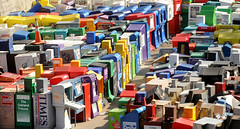
Makes me think of the old graveyard joke about people (and papers) dying to get in.
Also makes my stomach churn
Tuesday, February 24, 2009
What took ya so long?

Now this, I think, is nifty, also surprising because I would have thought a King, Douglass, Carver, Attucks, et al, would have made it on before, although the state-themed quarter thing hasn't been around all that long.
WASHINGTON (CNN) -- Jazz legend Duke Ellington is the first African-American to appear on an American coin, the U.S. Mint says in introducing the latest in its line of state-themed quarters.
The District of Columbia commemorative quarter showing Ellington playing the piano will be introduced by U.S. Mint Director Ed Moy at a news conference Tuesday at the Smithsonian's National Museum of American History.
Ellington won the honor by a vote of D.C. residents, beating out abolitionist Frederick Douglass and astronomer Benjamin Banneker.
Friday, January 23, 2009
... and David, we'll miss ya
Listening again to It's Mr. Fathead last night and this morning I was struck by two things. First, I just love hearing him play Hard Times. Second, he got impressive range out of his horn, which can sound like an alto one moment and a baritone the next and also features a lot of the kind of tenor sweetness that gives me goose bumps when I listen to Sonny Stitt. What a loss.
Thursday, January 22, 2009
So long Fathead...
Glad I took the opportunity to see David "Fathead" Newman when he was at the Jazz Kitchen in Indianapolis in recent years.
He was a guy, like Sonny Rollins, who seemed to get better with age. But you could always hear that Texas tenor sound (big as the open range, of course, like everything in Texas) in his playing.
While his new stuff was always good (I'm partial to Chillin' and Song for the New Man, both on High Note), my favorite David Newman CD buy remains the old 32 Jazz set It's Mr. Fathead, where you get four of his early LPs (including one with Ray Charles) for the price of one, sort of. Mr. Gentle, Mr. Cool, a set of all Ellington pieces from Kokopelli, also is another real good 'un.
He was a guy, like Sonny Rollins, who seemed to get better with age. But you could always hear that Texas tenor sound (big as the open range, of course, like everything in Texas) in his playing.
While his new stuff was always good (I'm partial to Chillin' and Song for the New Man, both on High Note), my favorite David Newman CD buy remains the old 32 Jazz set It's Mr. Fathead, where you get four of his early LPs (including one with Ray Charles) for the price of one, sort of. Mr. Gentle, Mr. Cool, a set of all Ellington pieces from Kokopelli, also is another real good 'un.
Sunday, January 18, 2009
Things I learned...
...that I wasn't looking out for.
Never thought about how much Bess, You Is My Woman relates to Rhapsody In Blue until I listened to Richard Twardzik render the former on Pacific Jazz Piano Trios, Mosaic. He's a big band on whatever he plays in any event. Stunning, classical rendition of Round Midnight, too, which says a bunch about Monk the composer. I'll Remember April is not like any version I've heard before, and that's a trick.
Never thought about how much Bess, You Is My Woman relates to Rhapsody In Blue until I listened to Richard Twardzik render the former on Pacific Jazz Piano Trios, Mosaic. He's a big band on whatever he plays in any event. Stunning, classical rendition of Round Midnight, too, which says a bunch about Monk the composer. I'll Remember April is not like any version I've heard before, and that's a trick.
Thursday, January 01, 2009
Top 10 reasons to buy Kind of Blue again...
The 50th anniversary edition, that is (so two reasons per decade).
10) So What.
9) Freddie Freeloader.
8) Blue in Green.
7) All Blues.
6) Flamenco Sketches.
5) What the hey, it might be the last version you can hold in your hand.
4) Cool blue LP in the box, even though you probably haven't had a turntable in years.
3) Nifty posters and 8x10s of Miles, Trane, Cannon and the rest of the guys.
2) The making-of DVD.
1) It's only maybe the greatest collection of American music ever.
10) So What.
9) Freddie Freeloader.
8) Blue in Green.
7) All Blues.
6) Flamenco Sketches.
5) What the hey, it might be the last version you can hold in your hand.
4) Cool blue LP in the box, even though you probably haven't had a turntable in years.
3) Nifty posters and 8x10s of Miles, Trane, Cannon and the rest of the guys.
2) The making-of DVD.
1) It's only maybe the greatest collection of American music ever.
Miles Davis, Ascenseur pour l'echafaud, Verve
One of Verve's recent Originals reissues, which I just bought for $11.99, which is a good thing since it lasts for just over 36 minutes, but it's worth it at that.
I don't know whether there's a more concentrated example of Miles working the mute than this French movie sound track he did, eventually issued as an LP. I'll import it into iTunes as a single, megamute track.
Plus you've got European jazz legends Wilen, Urtreger and Michelot in support, not to mention seminal bop drummer Kenny "Klook" Clarke. Michelot lays down an all-time bass solo on Visite du Vigile and Miles and Wilen are, like, Miles and Cannonesque on Au Bar du Petit Bac.
Oh, and it leads to Kind of Blue.
This plays behind the flick of my noir life.
I don't know whether there's a more concentrated example of Miles working the mute than this French movie sound track he did, eventually issued as an LP. I'll import it into iTunes as a single, megamute track.
Plus you've got European jazz legends Wilen, Urtreger and Michelot in support, not to mention seminal bop drummer Kenny "Klook" Clarke. Michelot lays down an all-time bass solo on Visite du Vigile and Miles and Wilen are, like, Miles and Cannonesque on Au Bar du Petit Bac.
Oh, and it leads to Kind of Blue.
This plays behind the flick of my noir life.
Tuesday, December 30, 2008
Gabriel's new trumpetmate
Forget (no, don't) Freddie Hubbard's own great sessions, Ready for Freddie, Breaking Point, Red Clay, Straight Life, First Light, et al; this list struck me in reading his L.A. Times obituary today:
"Seemingly the first choice for artists of every stripe, he was present on many of the most significant jazz albums of the '60s, among them Ornette Coleman's Free Jazz, John Coltrane's Ascension, Eric Dolphy's Out To Lunch, Oliver Nelson's Blues and the Abstract Truth, Wayne Shorter's Speak No Evil and Herbie Hancock's Maiden Voyage." And, I would add, Sonny Rollins' East Broadway Run Down (and Coltrane's Africa/Brass as well). Now that's a list, and it doesn't even include his stellar Jazz Messengers stuff, like Caravan.
I got to see Freddie Hubbard twice this year, first at Yoshi's in San Francisco in April for his 70th birthday celebration performance. Still working on overcoming a series of health problems, he was, frankly, awful on the horn(s). But with the good soul, and the sense of humor, he exhibited and the effort he exerted despite everything, you just had to pull for him. Plus, the band he had around him, which included Bobby Hutcherson, James Spaulding and George Cables, among others, was fabulous.
In August, I thought about heading home before his appearance at the Indy Jazz Fest. I stayed and was so glad (now, even more) that I did. He was never going to be the Freddie Hubbard of the '60s and '70s again, but he sounded a lot better and seemed to me to have figured out how to cope with his limitations, judiciously employ the chops he still had and maximize them in the context of the band. It was a memorable show. I'm sorry I won't see another one like it.
"Seemingly the first choice for artists of every stripe, he was present on many of the most significant jazz albums of the '60s, among them Ornette Coleman's Free Jazz, John Coltrane's Ascension, Eric Dolphy's Out To Lunch, Oliver Nelson's Blues and the Abstract Truth, Wayne Shorter's Speak No Evil and Herbie Hancock's Maiden Voyage." And, I would add, Sonny Rollins' East Broadway Run Down (and Coltrane's Africa/Brass as well). Now that's a list, and it doesn't even include his stellar Jazz Messengers stuff, like Caravan.
I got to see Freddie Hubbard twice this year, first at Yoshi's in San Francisco in April for his 70th birthday celebration performance. Still working on overcoming a series of health problems, he was, frankly, awful on the horn(s). But with the good soul, and the sense of humor, he exhibited and the effort he exerted despite everything, you just had to pull for him. Plus, the band he had around him, which included Bobby Hutcherson, James Spaulding and George Cables, among others, was fabulous.
In August, I thought about heading home before his appearance at the Indy Jazz Fest. I stayed and was so glad (now, even more) that I did. He was never going to be the Freddie Hubbard of the '60s and '70s again, but he sounded a lot better and seemed to me to have figured out how to cope with his limitations, judiciously employ the chops he still had and maximize them in the context of the band. It was a memorable show. I'm sorry I won't see another one like it.
Wednesday, December 24, 2008
Good enough to eat...
Herbie Hancock Maiden Voyage, Joe Henderson Page One, Lee Morgan the Sidewinder today.
I could probably live fulfilled on the classic Blue Notes.
But I did throw in Monk Underground and Mingus Black Saint and the Sinner Lady, the latter a classic, or classical, in any company.
I could probably live fulfilled on the classic Blue Notes.
But I did throw in Monk Underground and Mingus Black Saint and the Sinner Lady, the latter a classic, or classical, in any company.
Tuesday, December 23, 2008
Happy Holidays
The 2008 Xmas card from the great bassist, and artist extraordinaire, Henry Grimes, which appeared in my inbox yesterday.
Many thanks and happy holidays to Henry and Margaret, and the rest of you, too.

Many thanks and happy holidays to Henry and Margaret, and the rest of you, too.
Friday, October 31, 2008
How to have a good morning...
Chester Arthur Burnett, aka Howlin' Wolf, (Cause of it All) makes me want to get nasty.
Anthony Braxton (Mosaic box) gets my neurons firing like little arc welders.
Eddie Harris blowin' the Love Theme from the Sandpiper (The In Sound) makes me glad to be alive.
Anthony Braxton (Mosaic box) gets my neurons firing like little arc welders.
Eddie Harris blowin' the Love Theme from the Sandpiper (The In Sound) makes me glad to be alive.
Tuesday, October 21, 2008
Jolie Holland, The Living and the Dead, Anti
So this morning I'm reading Ted Gioia's excellent new book Delta Blues: The Life and Times if the Mississippi Masters Who Revolutionized American Music, in particular a discussion of the dark nature of some of Robert Johnson's most popular songs, which would seem to be oxymoronic. But I think people, myself included, are often attracted by raw emotion and tragedy in art, whether it is paintings, movies, plays or music (not to mention books, try Steinbeck's In Dubious Battle on for size.)
This occurred to me over breakfast and Jolie Holland's latest, The Living and the Dead, which is mostly every bit as dark as Hellhound On My Tail and might have made me think of Robert Johnson, or Son House and Skip James, even if I hadn't been reading Gioia's book when I first heard it. Holland's music isn't the blues, although it doesn't lack for blues elements, along with folk, pop, rock and a smattering of jazz.
But her lyrics are certainly emotive in the manner of the great blues songs and the way she uses vocal modulation reminds me of some of the tools employed by a James or a Johnson. (I've always loved her voice, which is kind of twangy, truth be told. Then again, Son House's was not exactly Ella Fitzgerald's, nor Louis Armstrong's for that matter. It's what he did with it that counted.)
Mexico City, and especially Corrido por Buddy, leave me feeling like I do when I walk out of the theater after seeing something like No Country for Old Men or finish a book like The Road (talk about dark, just check out Cormac McCarthy). Like I've been through an emotional wringer, sad, yet exhilarated, too.
This occurred to me over breakfast and Jolie Holland's latest, The Living and the Dead, which is mostly every bit as dark as Hellhound On My Tail and might have made me think of Robert Johnson, or Son House and Skip James, even if I hadn't been reading Gioia's book when I first heard it. Holland's music isn't the blues, although it doesn't lack for blues elements, along with folk, pop, rock and a smattering of jazz.
But her lyrics are certainly emotive in the manner of the great blues songs and the way she uses vocal modulation reminds me of some of the tools employed by a James or a Johnson. (I've always loved her voice, which is kind of twangy, truth be told. Then again, Son House's was not exactly Ella Fitzgerald's, nor Louis Armstrong's for that matter. It's what he did with it that counted.)
Mexico City, and especially Corrido por Buddy, leave me feeling like I do when I walk out of the theater after seeing something like No Country for Old Men or finish a book like The Road (talk about dark, just check out Cormac McCarthy). Like I've been through an emotional wringer, sad, yet exhilarated, too.
Sunday, October 19, 2008
Well dust my broom...
Woke up this morning, coffee maker wouldn't heat...
Woke up this morning, coffee maker wouldn't heat...
Woke up this morning, coffee maker wouldn't heat...
Thank the gods for my micrcrowave, and for Earl Grey hot tea.
Broken Mr. Coffee Blues.
Woke up this morning, coffee maker wouldn't heat...
Woke up this morning, coffee maker wouldn't heat...
Thank the gods for my micrcrowave, and for Earl Grey hot tea.
Broken Mr. Coffee Blues.
Thursday, October 16, 2008
Al Gallodoro, Out of Nowhere, Basta
With the Beau Hunks, a Dutch retro pre-swing pop jazz band in 1999. Chops like Pee Wee Russell on the clarinet and Benny Carter on the alto sax with the verve of a youngster like Anat Cohen, even though the Paul Whiteman, TV and other orchestra vet was well on at the time (he passed Oct. 4 at 95).
Great versions of Back Home Again in Indiana and Struttin' with Some Barbecue and a cool original, dedicated to his guitar-playing grandson, in Kevin's Tune. It may be rooted in before-Ellington jazz, but there's nothing "old" about it. Need more Al Gallodoro. Just sorry it took his death for me to find him.
Great versions of Back Home Again in Indiana and Struttin' with Some Barbecue and a cool original, dedicated to his guitar-playing grandson, in Kevin's Tune. It may be rooted in before-Ellington jazz, but there's nothing "old" about it. Need more Al Gallodoro. Just sorry it took his death for me to find him.
Tuesday, October 14, 2008
I am woman, hear me roar...
I find it ironic and really cool that the blues musician I am almost certain is the best interpreter today of thoroughly male-dominated traditional Delta blues, both singing and most certainly guitar playing, is a 59-year-old woman who is, frankly, hot, although I'd probably be in love with Rory Block even if she looked like Son House, the legend she pays tribute to on Blues Walkin' Like a Man, Stony Plain. She was just as lovely on The Lady and Mr. Johnson, Rykodisc. If she's going home on the morning train, or driving her Terraplane, I'm in for the ride.
What's next, Wynton Marsalis hiring a woman horn player for his Lincoln Center band?
Never mind.
What's next, Wynton Marsalis hiring a woman horn player for his Lincoln Center band?
Never mind.
Saturday, September 13, 2008
Jake Langley, Movin' & Groovin', Alma
Remember Wes Montgomery and Jimmy Smith on, say, Dynamic Duo? Well, this is right there. You can talk all you want about how they put a modernist touch on it, blah, blah, blah, but the fact is, it's just an old-fashioned organ, guitar, drums trio romp, and a butt-kicking one at that.
Joey DeFrancesco (and though the Jakester leads this session, this is, in fact, Joey D's working trio) plays the Hammond JS left him when he passed and I figure Jimmy must have been taking a break at Club Heaven and channeled some inspiration the way of this session. I don't think Langley was playing Wes Montgomery's old guitar, but he might as well have been. You walk away from Bobby Timmons Dis Here drenched in bluesy soul. They're flat-out symbiotic on Canadian Sunset. Great stuff.
Joey DeFrancesco (and though the Jakester leads this session, this is, in fact, Joey D's working trio) plays the Hammond JS left him when he passed and I figure Jimmy must have been taking a break at Club Heaven and channeled some inspiration the way of this session. I don't think Langley was playing Wes Montgomery's old guitar, but he might as well have been. You walk away from Bobby Timmons Dis Here drenched in bluesy soul. They're flat-out symbiotic on Canadian Sunset. Great stuff.
Friday, September 12, 2008
Happy birthday to me...
For which I bought The Complete Dean Benedetti Recordings of Charlie Parker from the wonderful folks at Mosaic, which Scott Yanow on allmusic refers to as "quite unlistenable." Now, I like Scott Yanow's AMG entries and books and find them to be, generally, useful guides. But here, he's plain wrong, especially if you've delved into the accessible Charlie Parker (Yardbird Suite: The Ultimate Collection and JSP's Charlie Parker: A Studio Chronicle come to mind) and want more, more, more.
The first more, more for me was The Complete Savoy Live Performances (mostly at the Royal Roost) and more recently The Complete Savoy and Dial Studio Recordings (which is basically what you get on the JSP set, plus all the alternate takes, which, as this is Charlie Parker, inevitably are different every take and instructive, if not scintillating, which they often are).
So comes the Benedetti recordings, by a guy who was actually an accomplished musician and musicologist, not a degenerate heroin dealer, as thoroughly incorrect legend has it, who put a recorder (tape and disk, not wire, again as legend has it) to Parker live at performances in California and New York, after Bird's stint in rehab in Camarillo and his return to New York, which is to say at the height of his powers.
Dean Benedetti, more or less, turned on the recorder when CP soloed and turned it off otherwise. Would I like to hear all of every set? Sure. Does it matter that I am listening as I type this to one Charlie Parker solo (more or less) after another? No. The music is incredible. I kept waking up last night with it playing in my head after listening to it before bedding down. That's powerful. The sound is fine, even really good, if you consider where it came from. The hair on my body stands on end sometimes listening to this stuff.
The first more, more for me was The Complete Savoy Live Performances (mostly at the Royal Roost) and more recently The Complete Savoy and Dial Studio Recordings (which is basically what you get on the JSP set, plus all the alternate takes, which, as this is Charlie Parker, inevitably are different every take and instructive, if not scintillating, which they often are).
So comes the Benedetti recordings, by a guy who was actually an accomplished musician and musicologist, not a degenerate heroin dealer, as thoroughly incorrect legend has it, who put a recorder (tape and disk, not wire, again as legend has it) to Parker live at performances in California and New York, after Bird's stint in rehab in Camarillo and his return to New York, which is to say at the height of his powers.
Dean Benedetti, more or less, turned on the recorder when CP soloed and turned it off otherwise. Would I like to hear all of every set? Sure. Does it matter that I am listening as I type this to one Charlie Parker solo (more or less) after another? No. The music is incredible. I kept waking up last night with it playing in my head after listening to it before bedding down. That's powerful. The sound is fine, even really good, if you consider where it came from. The hair on my body stands on end sometimes listening to this stuff.
Saturday, July 26, 2008
An observation...
2 CDs of Best of Miles Davis on the juke at ye olde Esquire Lounge in downstate Illinois. I slip in 3 bucks and spin up 8 tunes. As they play, I notice people moving their heads to the rythm, tapping feet, mouthing it. While talking about Dwight Yocham. Somehow, I don't think Dwight will translate as well 40 or 50 years from now.
-- From Mr. Greg's Sidekick II
-- From Mr. Greg's Sidekick II
Friday, July 25, 2008
Melvin Jackson, Funky Soul, Limelight/Dusty Groove
Exhibit A in the anti to the notion that those guys from the Art Ensemble of Chicago only went abstract because they couldn't play (semi anyway) straight. King Curtis would have been impressed by Roscoe Mitchell here and Lester Bowie sets the pace for about any rock, soul trumpet maven. Melvin anchors it all with his double bass fed through an electronicizing device to a point where it reminds me of Michael Henderson's effect on Miles Davis' electric bands, years before Miles Davis copped Henderson from Stevie Wonder. The title track is George Clinton funk-eee and the rendition of Eddie Harris' Cold Duck time is precious. But it's all good.
Thursday, July 10, 2008
Silence, David Murray and Mal Waldron, Justin Time
Gotta wonder if Mal Waldron recording Soul Eyes, his composition, one last time knew it was the last time, because he sure puts every bit of heart and soul into it.
And David Murray, on bass clarinet in this instance, is right there with him. Amazing affinity between the two on the whole CD, as a matter of fact.
Sitting here now, I can't bring up a better piano and reeds duet session, and I rate it as one of my favorite, in a long list of them, Murray disks of any sort.
What they do with the Miles Davis electric tune Jean-Pierre says a lot about their skill, and the elemental musicality of Miles' electric stuff as well.
-- From Mr. Greg's Sidekick II
Monday, June 16, 2008
Hey, it is Indiana...
Blue skies at the Indy Jazz Fest Sunday, too, until just prior to the end of Paquito D'Rivera's set, when a deluge accompanied by lightning rolled in; oh well, I wasn't staying for Fourplay anyway. D'Rivera, accompanied only by 20-year-old pianist Alex Brown, was really good, playing everything from Piazzola to Gillespie to his own tribute to the Dizzy one, A Night in Englewood. I enjoyed his clarinet as much as his saxophone, which he made sound amazingly like a bandoneon on the Piazolla piece.
I think a lot is going to be heard from Brown, by the way. He matched Paquito blow for blow from a creativity and chops perspective. Worries me that age and guile may not always, in fact, beat youth and speed.
Ramsey Lewis and his trio with first-call Chicago bassist Larry Gray were nifty as well. I like the way he mixed the Motownish, funky, soul-oriented stuff he became notable with, church music, the blues, Ellington and even classical in a wide-ranging, consistently catchy show.
The bonus for me was getting there early enough to hear the IUPUI Jazz Ensemble, which was great, and even better with guest artist Oliver Nelson, Jr., on flute and piccolo. Nature or nuture, the guy's a heck of player just like dad.
I think a lot is going to be heard from Brown, by the way. He matched Paquito blow for blow from a creativity and chops perspective. Worries me that age and guile may not always, in fact, beat youth and speed.
Ramsey Lewis and his trio with first-call Chicago bassist Larry Gray were nifty as well. I like the way he mixed the Motownish, funky, soul-oriented stuff he became notable with, church music, the blues, Ellington and even classical in a wide-ranging, consistently catchy show.
The bonus for me was getting there early enough to hear the IUPUI Jazz Ensemble, which was great, and even better with guest artist Oliver Nelson, Jr., on flute and piccolo. Nature or nuture, the guy's a heck of player just like dad.
Saturday, June 14, 2008
Blue skies...
Over the Indy Jazz Fest this afternoon. Freddie Hubbard was sounding better than when I heard him at Yoshi's in San Francisco in April. I think he's getting some of his stuff back, particularly on the flugelhorn. You sure couldn't beat the supporting cast he brought along, James Spaulding on alto and flute, Curtis Fuller on trombone, George Cables on piano and Joe Chambers drums. Every one a big hitter. Still, it was a younger guy who really stood out to me, Javon Jackson on tenor. Very creative blowing.
I really dug Jerry Gonzalez and the Fort Apache Band in the set prior. Amazing how he works the mute Miles style and yet doesn't come off as the least bit imitative. You just don't hear a lot about these guys outside of a small circle and they ought to be headliners. I love the way they put their own stamp on Monk's stuff. I'd like to hear them do a full show instead of one of those hour-long festival things.
Listening to their Moliendo Cafe now, which I bought at the fest. Nifty version of Stardust. Joe Ford rates right up there with James Spaulding in my book and Carter Jefferson on tenor is strong on this as well.
I really dug Jerry Gonzalez and the Fort Apache Band in the set prior. Amazing how he works the mute Miles style and yet doesn't come off as the least bit imitative. You just don't hear a lot about these guys outside of a small circle and they ought to be headliners. I love the way they put their own stamp on Monk's stuff. I'd like to hear them do a full show instead of one of those hour-long festival things.
Listening to their Moliendo Cafe now, which I bought at the fest. Nifty version of Stardust. Joe Ford rates right up there with James Spaulding in my book and Carter Jefferson on tenor is strong on this as well.
Saturday, June 07, 2008
His-tor-eee
Willie Pickens and six young dudes, marvy singer Saalik Ziyad leading them, making surprises at Fred Anderson's Velvet Lounge. Essence of AACM. Note to self, keep and eye out of saxophonist Fred Jackson and trombonist Norman Palm IV. These guys have some chops.
-- From Mr. Greg's Sidekick II
-- From Mr. Greg's Sidekick II
Guessing...
Wayne Shorter doesn't much need to record anymore, but wishing he would, at least live. His current quartet is a creativity machine.
-- From Mr. Greg's Sidekick II
-- From Mr. Greg's Sidekick II
Friday, June 06, 2008
Thinking ahead...
Retire to the beach?
Nah!
I think I'll retire to the South Loop, get up late every day.
And spend my evenings at the Velvet Lounge.
-- From Mr. Greg's Sidekick II
Nah!
I think I'll retire to the South Loop, get up late every day.
And spend my evenings at the Velvet Lounge.
-- From Mr. Greg's Sidekick II
Saturday, May 24, 2008
Superstar
In my almost empty co-op listening to Irvin Mayfield and Ellis Marsalis, good stuff for the end of a trail.
-- From Mr. Greg's Sidekick II
-- From Mr. Greg's Sidekick II
Friday, May 16, 2008
Irvin Mayfield, Love Songs, Ballads and Standards
With Ellis Marsalis. Hey, not a note out of the tradition, unless maybe it's Neal Caine slipping a few in on the bass, but it matters not a tad. So I have to listen to Ellis Marsalis play standards, kind of, with Irvin Mayfield, who's, like, channeling Louis Armstrong wherever he goes; what's the problem? Highlights: My One and Only Love and Yesterday. (They're doing "standards," I said, not chestnuts.) Mo' Betta Blues is worth the price of admission alone.
Friday, April 25, 2008
Slap me silly...
In a galaxy long, long ago and far, far away my man Rodd Zolkos introduced me to Tom Waits' Small Change and tonight I'm listening to it and I take a gander at the lineup and I notice Jim Hughart, bass, and that ain't so surprising, because TW used JH on bass regularly. But Shelley Manne on drums and Lou Tabackin on tenor? Not the least bit surprising that I've always loved this.
Nice little group...
Just happens to have Lester Young playing tenor, Walter Page and Jo Jones holding down the bass and drums spots, Mr. 5x5 Jimmy Rushing shouting (Evenin' slays me) and a guy name of Bill Basie in the piano chair. (He's playing organ on Goin' to Chicago and I'm giddy.) I hear no notes out of place anywhere and the acute sense of time is simply amazing.
New Classic Columbia, Okeh and Vocalion Lester Young with Count Basie (1936-40) set from my pals at Mosaic, which threatens to keep me up for like the next four hours anyway.
But I'll dream good.
New Classic Columbia, Okeh and Vocalion Lester Young with Count Basie (1936-40) set from my pals at Mosaic, which threatens to keep me up for like the next four hours anyway.
But I'll dream good.
Friday, April 11, 2008
Warm and dry at the Velvet Lounge
Kelan Phil Cohran plays
An electric kora, harp thing he made himself
And somewhere in the cosmos Sun Ra is smiling
-- From Mr. Greg's Sidekick II
An electric kora, harp thing he made himself
And somewhere in the cosmos Sun Ra is smiling
-- From Mr. Greg's Sidekick II
Sunday, April 06, 2008
Every town should have one...

I'll miss walking by this place on my way from motel to campus and
environs. I have to rate San Francisco as a pretty good jazz town.
-- From Mr. Greg's Sidekick II
Saturday, April 05, 2008
Sing-a-long for Fred
So I (along with the rest of the audience) got to sing happy birthday to Freddie Hubbard accompanied by Bobby Hutcherson. Now that's living. James Spaulding was great on alto and flute. They should have given some more solo space to Craig Handy on tenor. And drummer Lenny White III, who's off on tour with Chick Corea and Return to Forever this summer, was a beast.
Friday, April 04, 2008
Dinner at the Fillmore Street Cafe
Jazz legends on the walls
The house salad bops
Ready for Freddie
-- From Mr. Greg's Sidekick II
The house salad bops
Ready for Freddie
-- From Mr. Greg's Sidekick II
Barking dogs

public toilet when I got there.
On to the new Yoshi's and Freddie Hubbard's 70th birthday show.
-- From Mr. Greg's Sidekick II
Sunny Sonny
Sonny Rollins' concert at Berkeley last night was my seventh time seeing Mr. Rollins and, not surprisingly, I haven't heard the same thing yet. Musically, checks in a No. 2 on my memorable list. Orchestra Hall in Chicago a few years ago is No. 1 because of the amazing, expansive flights he went on, some of them lasting nearly half an hour. (The Olympia in Paris and Carnegie Hall for his 50th anniversary performing there last September are memorable for the music and, well, because it's Paris and Carnegie Hall).
Berkeley, I think, compares to the first time I saw him, in Ann Arbor, Mich. His solos weren't as long and he let his band carry more of the load. But when he played, it was plenty long, full of interesting ideas and joyous. He made me chuckle several times last night at the clever touches he threw down and I noticed that he smiled a lot, too. I think he was having fun.
Highlight: In a Sentimental Mood, both his own playing and his comping with percussionist Kimati Dinizulu, who's really become an integral part of what he does these days, as has guitarist Bobby Broom. At one point, it struck me what a masterful comp man he is, besides being the great soloist, and that makes this concert memorable as well.
Berkeley, I think, compares to the first time I saw him, in Ann Arbor, Mich. His solos weren't as long and he let his band carry more of the load. But when he played, it was plenty long, full of interesting ideas and joyous. He made me chuckle several times last night at the clever touches he threw down and I noticed that he smiled a lot, too. I think he was having fun.
Highlight: In a Sentimental Mood, both his own playing and his comping with percussionist Kimati Dinizulu, who's really become an integral part of what he does these days, as has guitarist Bobby Broom. At one point, it struck me what a masterful comp man he is, besides being the great soloist, and that makes this concert memorable as well.
Thursday, April 03, 2008
Goin' to church

Love the cross made of two soprano saxophones.
Sonny Rollins at Berkeley tonight, so it promises to be a day of
religious experiences.
-- From Mr. Greg's Sidekick II
Saturday, March 29, 2008
Great BJ
Never got to see Stitt and Ammons (or Stitt and Rollins, Rollins and Coltrane, Rollins and Hawkins for that matter, not even Zoot and Al) but I have to think Joshua Redman and Branford Marsalis locking horns, so to speak, was something like it. I'd have paid $25 for a recording of their interchanges on Blues Up and Down and Body and Soul had they been selling CDs in the lobby after (musicians in this digital age need to start doing that). Boss tenors (and sopranos, too, which they whipped out on Redman's Mantra #5). Will go down as one of my best memories from a jazz show.
Friday, March 28, 2008
Time for that BJ
Headed to Chicago's Orchestra Hall to hear the Joshua Redman Trio with Branford Marsalis tonight and been listening to their stuff all week.
Today it's Branford's Romare Bearden Revealed. I'm Slappin' Seventh Avenue brings to mind the word jaunty. Branford's soprano (he plays tenor, too) sounds a lot like a clarinet. Jungle Blues starts out making me think Ragtime and quickly morphs into a trad, Jelly Roll Morton-like New Orleans thing, albeit modernized, again with the clarinet-sounding soprano (tell me he's not channeling Sidney Bechet). Brothers Wynton and Delfeayo do some talking on the trumpet and 'bone.
The program is diverse, Seabreeze a Latinized slow dance number; Wynton's J Moood a blues-based advanced post bop piece in the manner of Miles Davis' second great quintet; B's Paris Blues with a Django feel and amusing solos and interplay between Branford and Doug Wamble, who goes it all alone in kind of a Piedmont style on Autumn Lamp. I think of Laughin' & Talkin' (with Higg) as abstract bebop. The duet between Branford and Harry Connnick Jr. (forget his singing, he's a boffo pianist) on James P. Johnson's Carolina Shout is a blisteringly fast minor classic.
It occurs to me that every time I put this on I find something else to enjoy in it.
Today it's Branford's Romare Bearden Revealed. I'm Slappin' Seventh Avenue brings to mind the word jaunty. Branford's soprano (he plays tenor, too) sounds a lot like a clarinet. Jungle Blues starts out making me think Ragtime and quickly morphs into a trad, Jelly Roll Morton-like New Orleans thing, albeit modernized, again with the clarinet-sounding soprano (tell me he's not channeling Sidney Bechet). Brothers Wynton and Delfeayo do some talking on the trumpet and 'bone.
The program is diverse, Seabreeze a Latinized slow dance number; Wynton's J Moood a blues-based advanced post bop piece in the manner of Miles Davis' second great quintet; B's Paris Blues with a Django feel and amusing solos and interplay between Branford and Doug Wamble, who goes it all alone in kind of a Piedmont style on Autumn Lamp. I think of Laughin' & Talkin' (with Higg) as abstract bebop. The duet between Branford and Harry Connnick Jr. (forget his singing, he's a boffo pianist) on James P. Johnson's Carolina Shout is a blisteringly fast minor classic.
It occurs to me that every time I put this on I find something else to enjoy in it.
Thursday, March 27, 2008
BJ week, day 4
Branford Marsalis, Random Abstract. Sophisticated, if not overly exciting blowing from a much younger Branford (this is from '88, 20 freaking years ago) who already was developing many of the distinctive touches he uses today, I think to greater effect. The guy who really keeps striking me throughout the session is pianist Kenny Kirkland.
Nice version of Monk's Crepuscule With Nellie, a song I have a thing for. Reminds me of T.M. and Rouse.
Joshua Redman, Wish. The young lion (this was issued in '93) in a strong hard bop session with older cats, and Ornette Coleman alums, Charlie Haden and Billy Higgins and Pat Metheny on guitar, who stands out, not that Redman doesn't play well, he does, but more like Wayne Shorter in the Jazz Messengers than O.C. The Deserving Many is sure a snappy tune. Maybe it's the guitar, but I hear regular Latin, Spanish influences on this. Nice jazz ballad made of Clapton's Tears in Heaven.
Nice version of Monk's Crepuscule With Nellie, a song I have a thing for. Reminds me of T.M. and Rouse.
Joshua Redman, Wish. The young lion (this was issued in '93) in a strong hard bop session with older cats, and Ornette Coleman alums, Charlie Haden and Billy Higgins and Pat Metheny on guitar, who stands out, not that Redman doesn't play well, he does, but more like Wayne Shorter in the Jazz Messengers than O.C. The Deserving Many is sure a snappy tune. Maybe it's the guitar, but I hear regular Latin, Spanish influences on this. Nice jazz ballad made of Clapton's Tears in Heaven.
Wednesday, March 26, 2008
BJ week, day 3
Joshua Redman Quartet Spirit of the Moment Live at the Village Vanguard. Less ethereal and more earthy, but also less individual, than his mature sound today. He makes me think of honkers like Arnett Cobb and Illinois Jacquet on Jig-A-Jug and Remember. (I wonder if the "Jug" is a reference to Gene Ammons?) The soprano piece Second Snow could be Coltrane, which is a compliment in terms of technical proficiency if not innovation. Dialogue is an abstract, free thing constructed around a marchy theme ala Albert Ayler. The standout is the stamp very much his own he puts on Sonny Rollins' St. Thomas. Reminds of Mr. Rollins having his way with something like, say, Autumn Nocturne. The melody is more an underlying framework for improvisation than recognizable on the surface for much of his run, yet it's all quite logical. Lot of S.R. on Roots and Herbs, his song or no.
Tuesday, March 25, 2008
BJ week continues
Today it's Branford Marsalis' Eternal. This time through I hear a lot of Coleman Hawkins- and Ben Webster-like interludes I didn't notice before (check out Dinner for One Please, James) and I admire the pulse Eric Revis sets down with his bass and the subtlety "Tain" Watts displays on a program all pretty much ballady tunes.
Monday, March 24, 2008
BJ week
Mind out of the gutter; that's B as in Branford Marsalis and J as in Joshua Redman, whom I'm catching at Orchestra Hall in Chicago Friday night.
Marsalis, Braggtown. Brings to mind another mature quartet fronted by one of the most powerfully inventive saxophonists of all time playing off a drummer with thunder, lightning and, yet, gentle rain as well in his sticks, a lyrical pianist and a bassist adept at holding it all together. Branford no longer sounds much like Coltrane, however. He makes me think more of Rollins and Dolphy with some Sanders and Coleman (Ornette and George for that matter) thrown in here, but it's an impression more than anything overt because his playing is all him now. Jack Baker, Blakzilla and Black Elk Speaks are noisy and pretty freely improvised romps, offset by quietly complex tunes like Hope, Fate and O Solitude almost classical in nature. His shift between soprano and tenor on the solos in the latter gives me goose bumps.
Redman, Elastic. His electric trio/quartet with Sam Yahel on B3, Rhodes and a host of other plugged-in keyboards and synths, which fits well with Redman's, as one review of him live I read lately put it, "silvery improvisational style, fluid eighth-note streaks and rangy altissimo runs." I've always been attracted by the way he works the high register and you get a lot of that on this, on soprano and alto (where he's got Charlie Parker speed) as well as tenor. Dig Molten Soul, Still Pushin' That Rock and Can a Good Thing Last Forever? Boogielastic shows off one of the cleanest sax sounds around. Ton of music in The Birthday Song. I enjoy his tendency to play more of the whole horn now, but this is an overall goodie with a lot of creativity and musicianship on display.
Marsalis, Braggtown. Brings to mind another mature quartet fronted by one of the most powerfully inventive saxophonists of all time playing off a drummer with thunder, lightning and, yet, gentle rain as well in his sticks, a lyrical pianist and a bassist adept at holding it all together. Branford no longer sounds much like Coltrane, however. He makes me think more of Rollins and Dolphy with some Sanders and Coleman (Ornette and George for that matter) thrown in here, but it's an impression more than anything overt because his playing is all him now. Jack Baker, Blakzilla and Black Elk Speaks are noisy and pretty freely improvised romps, offset by quietly complex tunes like Hope, Fate and O Solitude almost classical in nature. His shift between soprano and tenor on the solos in the latter gives me goose bumps.
Redman, Elastic. His electric trio/quartet with Sam Yahel on B3, Rhodes and a host of other plugged-in keyboards and synths, which fits well with Redman's, as one review of him live I read lately put it, "silvery improvisational style, fluid eighth-note streaks and rangy altissimo runs." I've always been attracted by the way he works the high register and you get a lot of that on this, on soprano and alto (where he's got Charlie Parker speed) as well as tenor. Dig Molten Soul, Still Pushin' That Rock and Can a Good Thing Last Forever? Boogielastic shows off one of the cleanest sax sounds around. Ton of music in The Birthday Song. I enjoy his tendency to play more of the whole horn now, but this is an overall goodie with a lot of creativity and musicianship on display.
Trane tome
Interesting story in my newspaper yesterday about a local guy's, and others', handiwork. Even at $150 this sounds like it's worth it.
I am working my way through Downbeat's Miles Davis Reader right now and I find it captivating to read what Miles was saying at the time about music so important to me today, and what other people were saying about Miles and his music. His Blindfold Test appearances are a hoot in particular.
The story, in part:
"CHAMPAIGN – For nearly seven years, Chris DeVito spent literally thousands of hours holed up in the University of Illinois newspaper and music libraries, researching jazz saxophonist John Coltrane.
"Using microfilm and other archives, he scoured hundreds of mainstream, black and underground newspapers and jazz magazines, looking for references, no matter how obscure, to Coltrane's gigs as a sideman or a band leader and to his life and his music.
"At the same time, Wolf Schmaler of Ottweiler, Germany, was doing similar research in Europe on the pioneering jazz musician's tours there. Their work plus more was compiled for "The John Coltrane Reference," an 821-page book recently published by Routledge Press. DeVito, of Rantoul, is lead author.
"The tome represents a massive amount of painstaking work by not only DeVito and Schmaler but also two other Coltrane experts, one in the United States and the other in Japan who focused on the discography. One, Yasuhiro Fujioka, uncovered rare recordings and met with the musician's son, Ravi Coltrane.
"The book, edited by jazz scholar/performer Lewis Porter, offers a detailed and expansive chronology of Coltrane's life and music from his birth in 1926 to his premature death in 1967. The discography updates two earlier ones that had been considered standards and had been compiled by Fujioka and co-author David Wild.
Among the many illustrations are vintage photographs, copies of more than 350 album covers, and newspaper reviews and interviews, some of which had never been reprinted before."
-- Melissa Merli, The News-Gazette, 3/23/08
I am working my way through Downbeat's Miles Davis Reader right now and I find it captivating to read what Miles was saying at the time about music so important to me today, and what other people were saying about Miles and his music. His Blindfold Test appearances are a hoot in particular.
The story, in part:
"CHAMPAIGN – For nearly seven years, Chris DeVito spent literally thousands of hours holed up in the University of Illinois newspaper and music libraries, researching jazz saxophonist John Coltrane.
"Using microfilm and other archives, he scoured hundreds of mainstream, black and underground newspapers and jazz magazines, looking for references, no matter how obscure, to Coltrane's gigs as a sideman or a band leader and to his life and his music.
"At the same time, Wolf Schmaler of Ottweiler, Germany, was doing similar research in Europe on the pioneering jazz musician's tours there. Their work plus more was compiled for "The John Coltrane Reference," an 821-page book recently published by Routledge Press. DeVito, of Rantoul, is lead author.
"The tome represents a massive amount of painstaking work by not only DeVito and Schmaler but also two other Coltrane experts, one in the United States and the other in Japan who focused on the discography. One, Yasuhiro Fujioka, uncovered rare recordings and met with the musician's son, Ravi Coltrane.
"The book, edited by jazz scholar/performer Lewis Porter, offers a detailed and expansive chronology of Coltrane's life and music from his birth in 1926 to his premature death in 1967. The discography updates two earlier ones that had been considered standards and had been compiled by Fujioka and co-author David Wild.
Among the many illustrations are vintage photographs, copies of more than 350 album covers, and newspaper reviews and interviews, some of which had never been reprinted before."
-- Melissa Merli, The News-Gazette, 3/23/08
Sunday, March 23, 2008
Sonny Rollins, Next Album
Been on a '60s and '70s Rollins kick recently, Next Album is Mr. Rollins with George Cables on electric piano and Bob Cranshaw hitting the electric bass pretty hard (albeit not with the overwhelming pulse you get from Miles' electric bassists) in a session leaning into the fusion wave of the time (1972) starting with Playin' in the Yard. For all of that it's pure Rollins (see The Everywhere Calypso), who sounded like himself even playing with the Stones, let alone his own kind-of rockish band.
Kenny G could learn something from his rare turn on the soprano in recrafting Poinciana. Skylark is classic Sonny having his way with a popular tune, no fusion about it (Cables and Cranshaw go acoustic).
A little gem I should spin up more often.
Kenny G could learn something from his rare turn on the soprano in recrafting Poinciana. Skylark is classic Sonny having his way with a popular tune, no fusion about it (Cables and Cranshaw go acoustic).
A little gem I should spin up more often.
Today's playlist
Wynton Marsalis, All Rise. Got to hear it live last year with the Chicago Symphony and Chorus and I have to say this is quite close to that performance, which was marvelous. Picked it up on a bargain table for $7.99, all the better. I am filing it under Classical, although there are some really jazzy bluesy interludes.
Coltrane, A Love Supreme. What the hey, it's Easter. Like I need an excuse to listen to one of the greatest pieces of music ever created.
Billy Mitchell, This is Billy Mitchell. Got to thinking about him the other day listening to Thad Jones' Detroit-New York Junction. Should have been a bigger deal, not a Coltrane or a Rollins maybe, but at least a Hank Mobley.
Wynton, Black Codes (From the Underground). Miles' second great quintet influenced and almost abstract in places (especially when Branford is saxing), which is different for Mr. Classicist. I like it when he stretches all that technical proficiency he has out.
Branford Marsalis, The Beautyful Ones Are Not Yet Born. Mostly a trio session he's still coming to grips with Coltrane and Rollins here but clearly on the way to the very personal sound he has today, which I think makes him the most interesting saxophonist in jazz who isn't Sonny Rollins, James Carter or Wayne Shorter.
Joshua Redman, Back East. I'm going to hear him at Orchestra Hall Friday night, with Branford as a special guest so I am listening to their stuff all week. Oddly, it will be the fourth time I've seen Dewey's boy even though he isn't someone I would generally go out of my way to catch (he's been in Champaign-Urbana three times). I think this disk shows some impressive artistic growth, however, perhaps no where more than on I'm an Old Cowhand and Wagon Wheels, nods to Mr. Rollins' famous trio date Way Out West that nonetheless aren't the least imitative. His Monkian The Surrey with the Fringe on Top is quite innovative, while Zarafah is like an East Indian blues and his rendition of Shorter's Indian Song (dueting with Joe Lovano) sounds Albert Ayler-tinged to me. He duets with Dewey on Coltrane's India and Dewey plays his last recorded date, the song GJ, written for his grandson, on the final track. Both pretty gripping. I have a feeling Friday's show will be memorable.
Wynton, Blue Interlude. Pure Ellingtonia, from a septet no less.
Coltrane, A Love Supreme. What the hey, it's Easter. Like I need an excuse to listen to one of the greatest pieces of music ever created.
Billy Mitchell, This is Billy Mitchell. Got to thinking about him the other day listening to Thad Jones' Detroit-New York Junction. Should have been a bigger deal, not a Coltrane or a Rollins maybe, but at least a Hank Mobley.
Wynton, Black Codes (From the Underground). Miles' second great quintet influenced and almost abstract in places (especially when Branford is saxing), which is different for Mr. Classicist. I like it when he stretches all that technical proficiency he has out.
Branford Marsalis, The Beautyful Ones Are Not Yet Born. Mostly a trio session he's still coming to grips with Coltrane and Rollins here but clearly on the way to the very personal sound he has today, which I think makes him the most interesting saxophonist in jazz who isn't Sonny Rollins, James Carter or Wayne Shorter.
Joshua Redman, Back East. I'm going to hear him at Orchestra Hall Friday night, with Branford as a special guest so I am listening to their stuff all week. Oddly, it will be the fourth time I've seen Dewey's boy even though he isn't someone I would generally go out of my way to catch (he's been in Champaign-Urbana three times). I think this disk shows some impressive artistic growth, however, perhaps no where more than on I'm an Old Cowhand and Wagon Wheels, nods to Mr. Rollins' famous trio date Way Out West that nonetheless aren't the least imitative. His Monkian The Surrey with the Fringe on Top is quite innovative, while Zarafah is like an East Indian blues and his rendition of Shorter's Indian Song (dueting with Joe Lovano) sounds Albert Ayler-tinged to me. He duets with Dewey on Coltrane's India and Dewey plays his last recorded date, the song GJ, written for his grandson, on the final track. Both pretty gripping. I have a feeling Friday's show will be memorable.
Wynton, Blue Interlude. Pure Ellingtonia, from a septet no less.
Friday, March 14, 2008
Velvet Lounging, how I love it
Lester Lashley's vibes are junky
The vibes he makes on them are golden
What"s that tell me/you
-- From Mr. Greg's Sidekick II
The vibes he makes on them are golden
What"s that tell me/you
-- From Mr. Greg's Sidekick II
Friday, February 29, 2008
Otis Taylor, Recapturing the Banjo, Telarc
Cahl, bless his heart, sent me this. Now, I like Otis Taylor anyway, because he's one of a few modern blues guys whose CDs I cue up and never am quite sure what's going to hit my ears next, which is to say he advances the art in a jazz-like way that isn't always the case with the blues today.
But this is even a step beyond that involving, as it does integrally, the banjo, an instrument I basically loathe as a device employed mostly by peckerwoods.
Taylor, a stellar cast including my men Corey Harris, Guy Davis and Don Vappie, whom I saw playing in Orchestra Hall in Chicago last fall, recapture the banjo, an African-American instrument at its roots, not only for the blues, but I'd say folk, jazz, rock and more (and just see Live Your Life for all of them).
Check out Hey Joe for a serious rock-blues employment of the banjo. Who knew?
I've sung Little Liza Jane since I was a kid, but I will sing it far more cooly now that Davis has showed me how.
Five Hundred Roses is what you might get if John Lee Hooker had been a banjo player.
The banjo wasn't always, clearly, the purview of Grand Ole Opry white boys, as Vappie et al make clear on the trad New Orleans tune Les Ognons and, ditto, Alvin Youngblood Hart on Deep Blue Sea.
Still the extensibility happens mostly in the tunes penned by Taylor, of which there are plenty.
This is not your father's, assuming he was an inbred mofo, Dueling Banjos.
But this is even a step beyond that involving, as it does integrally, the banjo, an instrument I basically loathe as a device employed mostly by peckerwoods.
Taylor, a stellar cast including my men Corey Harris, Guy Davis and Don Vappie, whom I saw playing in Orchestra Hall in Chicago last fall, recapture the banjo, an African-American instrument at its roots, not only for the blues, but I'd say folk, jazz, rock and more (and just see Live Your Life for all of them).
Check out Hey Joe for a serious rock-blues employment of the banjo. Who knew?
I've sung Little Liza Jane since I was a kid, but I will sing it far more cooly now that Davis has showed me how.
Five Hundred Roses is what you might get if John Lee Hooker had been a banjo player.
The banjo wasn't always, clearly, the purview of Grand Ole Opry white boys, as Vappie et al make clear on the trad New Orleans tune Les Ognons and, ditto, Alvin Youngblood Hart on Deep Blue Sea.
Still the extensibility happens mostly in the tunes penned by Taylor, of which there are plenty.
This is not your father's, assuming he was an inbred mofo, Dueling Banjos.
Thursday, February 28, 2008
This is your brain on jazz...
Interesting study scanning the brains of jazz musicians with functional Magnetic Resonance Imaging as they improvise (on a keyboard in this case).
The crux: performance-monitoring regions of their brains shut down and various areas associated with dreaming, with all of the senses and with regulating emotions kick in, in addition to an area involved in organizing self-initiated thoughts and behaviors.
In other words, they stop thinking about what they're doing on a conscious level and just let it come to them, which sounds a lot like Mr. Sonny Rollins describing what happens to him in concert, or Michael Jordan in one of those stretches where he'd hit every shot he tossed up for that matter.
The crux: performance-monitoring regions of their brains shut down and various areas associated with dreaming, with all of the senses and with regulating emotions kick in, in addition to an area involved in organizing self-initiated thoughts and behaviors.
In other words, they stop thinking about what they're doing on a conscious level and just let it come to them, which sounds a lot like Mr. Sonny Rollins describing what happens to him in concert, or Michael Jordan in one of those stretches where he'd hit every shot he tossed up for that matter.
Saturday, February 23, 2008
Thanks, Teo
So sad to read that Teo Macero died. He produced a ton of stunning
sessions by jazz artists from Monk to Wallace Roney.
sessions by jazz artists from Monk to Wallace Roney.
I owe him big for some of my favorite Miles Davis electric music, which
is some of my favorite music period, including In a Silent Way, which I
think is Miles' masterpiece. Not to mention Sketches of Spain.
I won't say Miles couldn't have done it without Teo, but he would have
had to find (and later did) someone to take Teo's place and the stuff
might not have been as uniformly interesting and evolutionary (and
later wasn't}.
I hope they're working somewhere tonight.
Teo was a pretty good bop sax player, too, which people tend to forget.
Friday, January 25, 2008
Criss craft
What I like about Sonny Criss is that he works that alto with the freedom Charlie Parker fought for but with his own sound entirely.
Good stuff: I'll Catch the Sun! Absolutely benefits from the sympathetic piano playing of Hampton Hawes (read his autobiography, Raise Up Off Me, which Cahl turned me on to). These guys should have played together all the time. Their version of I Thought About You is stunning. Monty Budwig on bass is sympathetic as well. S.C. has all the panache of Bird and Benny Carter on California Screamin' and his version of Cry Me a River is blues city. Check out the title track for a guy every bit of Bird, in his own way.
Sonny's Dream. S.C. in a tenet with Teddy Edwards on tenor (great solo on The Black Apostles), Conti Candoli on trumpet, Tommy Flanagan on piano (as righteous here as Hawes) and Ray Draper on tuba, among others. But Criss is the centerpiece, whether wailtastic on Sonny's Dream or on the semi-classical Ballad for Samuel. I read that Horace Tapscott laid all this out. He ruled.
Good stuff: I'll Catch the Sun! Absolutely benefits from the sympathetic piano playing of Hampton Hawes (read his autobiography, Raise Up Off Me, which Cahl turned me on to). These guys should have played together all the time. Their version of I Thought About You is stunning. Monty Budwig on bass is sympathetic as well. S.C. has all the panache of Bird and Benny Carter on California Screamin' and his version of Cry Me a River is blues city. Check out the title track for a guy every bit of Bird, in his own way.
Sonny's Dream. S.C. in a tenet with Teddy Edwards on tenor (great solo on The Black Apostles), Conti Candoli on trumpet, Tommy Flanagan on piano (as righteous here as Hawes) and Ray Draper on tuba, among others. But Criss is the centerpiece, whether wailtastic on Sonny's Dream or on the semi-classical Ballad for Samuel. I read that Horace Tapscott laid all this out. He ruled.
Somewhere, Big Ben is smiling
I have to think Mr. Ben Webster, maybe the ultimate ballad player on the tenor, would greatly appreciate Saxually Romantic by J.J. Jones, whose tone is as thick as peanut butter (smooth, no nuts) and as sweet as honey. Wonderful version of Stardust followed by a standout rendition of She's Out of My Life. Even his fast-paced take of Fly Me to the Moon is soul drenched.
He doesn't play My Funny Valentine anything like Chet Baker or Miles, who clearly played it to kick Chet's ass, but he spins it just as emotively. And his funktastic roll through Summertime is such that I'm willing to forget I've heard, what, a million versions of it. He makes well-trod Misty similarly interesting.
By the way, I think this stuff would absolutely promote getting laid.
A gem.
He doesn't play My Funny Valentine anything like Chet Baker or Miles, who clearly played it to kick Chet's ass, but he spins it just as emotively. And his funktastic roll through Summertime is such that I'm willing to forget I've heard, what, a million versions of it. He makes well-trod Misty similarly interesting.
By the way, I think this stuff would absolutely promote getting laid.
A gem.
Saturday, January 19, 2008
Thoughts on Holy Ghost (not that one)
day old donuts
I didn't eat them coming home from Chicago last night
Albert Ayler makes them taste better
-- From Mr. Greg's Sidekick II
I didn't eat them coming home from Chicago last night
Albert Ayler makes them taste better
-- From Mr. Greg's Sidekick II
Wednesday, December 26, 2007
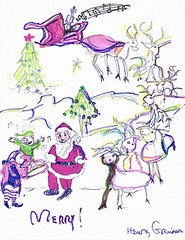
Season's greetings
Another holiday e-card from the mind and fingers of the great bassist Henry Grimes, whose talents extend beyond the bandstand. Check out last year's as well.
Sunday, December 23, 2007
Smooth, as in good Scotch
On a Dave Brubeck jag today after buying Indian Summer on severe sale this morning (which, if Dave Brubeck never records again, is a wonderful solo capstone to his career) and it occurs too me that it's a shame smooth as in jazz has come to mean pap from, say, Kenny G, best consumed, if consumed at all, on an elevator.
Brubeck's Quartet through Brubeck & Rushing (a super outing with the blues shouting Mr. Five by Five), Jazz at the College of Pacific and Jazz at Oberlin defines "smooth" jazz in the good sense, rendered with nary a jagged edge but still adventurous, creative and full of surprises. They still take risks, they're just good enough to walk the tightrope without falling, and they can swing like mad, kind of like a smaller version of Duke Ellington's orchestra. (And outside of Johnny Hodges and Charlie Parker, I don't know an altoist with a more distinctive sound than Paul Desmond. I'd throw Benny Carter in there, too, although I think his sound got a little less distinctive over the years from all the people who appropriated it.)
Proof that "smooth" jazz doesn't have to be boring.
Will end the session with the classic Time Out, of course.
Brubeck's Quartet through Brubeck & Rushing (a super outing with the blues shouting Mr. Five by Five), Jazz at the College of Pacific and Jazz at Oberlin defines "smooth" jazz in the good sense, rendered with nary a jagged edge but still adventurous, creative and full of surprises. They still take risks, they're just good enough to walk the tightrope without falling, and they can swing like mad, kind of like a smaller version of Duke Ellington's orchestra. (And outside of Johnny Hodges and Charlie Parker, I don't know an altoist with a more distinctive sound than Paul Desmond. I'd throw Benny Carter in there, too, although I think his sound got a little less distinctive over the years from all the people who appropriated it.)
Proof that "smooth" jazz doesn't have to be boring.
Will end the session with the classic Time Out, of course.
Saturday, December 15, 2007
Stop that
Geez, I just had like a heart palpitation listening to Billy Preston on the third disk of The Complete On the Corner Sessions, which I am rationing slowly so as to savor, same thing I do when I buy maple sugar candy at Xmas.
Incredibly exciting music with, amazingly, not the least bit of dated feeling to it.
Then I'm sitting here and suddenly realizing I am frigging mesmerized by The Hen.
No wonder this stuff upset people when it came out. It's radical, man.
And I love it.
Incredibly exciting music with, amazingly, not the least bit of dated feeling to it.
Then I'm sitting here and suddenly realizing I am frigging mesmerized by The Hen.
No wonder this stuff upset people when it came out. It's radical, man.
And I love it.
Corey Harris, Zion Crossroads, Telarc
On second pass I hear a nifty melding of blues-inflected rock with Marleyesque reggae (In the Morning) and lyrics sometimes belted out in a way a blues shouter like Jimmy Rushing could appreciate (Fire Go Come). I also like the way the horn and organ, which are pretty jazzy at times, flesh out the music without getting in the way (Cleanliness, among other places).
His synthesis of blues, rock and reggae, even a little country, on Plantation Town is particularly impressive.
His synthesis of blues, rock and reggae, even a little country, on Plantation Town is particularly impressive.
Friday, December 14, 2007
Corey Harris, Between Midnight and Day, ALCD
I know two MacArthur "genius grant" winners and they are fascinating dudes, but I doubt either one could fit right in with Robert Johnson, Bukka White and Tampa Red. This guy pulls it off. The title track, for example, slides between covers of tunes by Blind Boy Fuller and White like it was right at home, in the Delta.
I thought his most recent thing, Zion Crossroads, was shades of Bob Marley (although none of the tunes were Marley's and almost all of the music was of his own manufacture) and yet in doing all this, his musical voice is unique, which tells me that genius money was well spent. I'm interested to see what's next.
I thought his most recent thing, Zion Crossroads, was shades of Bob Marley (although none of the tunes were Marley's and almost all of the music was of his own manufacture) and yet in doing all this, his musical voice is unique, which tells me that genius money was well spent. I'm interested to see what's next.
Christian Scott, Anthem, Concord
So before fusion, I think the last great Miles Davis quintet (Miles, Shorter, Hancock, Carter, Williams) was pretty much the pinnacle of mostly acoustic jazz and this, electronics here and there notwithstanding, is in the vein. Diverse, complex, extremely technically proficient music with a drummer, Marcus Gilmore, as a linchpin.
My reservation: it's generally downbeat mood music (The Uprising, more or less, excepted). OK, it's about the aftermath of Katrina, but there must be something lively to touch on musically there. Kind of thing I'll play on a rainy day and dig as appropriate moodwise, but maybe not when the sun is shining.
My reservation: it's generally downbeat mood music (The Uprising, more or less, excepted). OK, it's about the aftermath of Katrina, but there must be something lively to touch on musically there. Kind of thing I'll play on a rainy day and dig as appropriate moodwise, but maybe not when the sun is shining.
Saturday, December 01, 2007
I love her anyway...
In person, Anat Cohen is as tall as, or taller, than me and her fingers
are mondo long. But I still lust after every note from her clarinet. And
her saxes.
-- From Mr. Greg's Sidekick II
are mondo long. But I still lust after every note from her clarinet. And
her saxes.
-- From Mr. Greg's Sidekick II
Friday, November 16, 2007
That special kind of place...
...as my friend Rodd Zolkos says of the Churchill Arms in London, where
nothing bad can happen and, I add, I am sure to be content.
nothing bad can happen and, I add, I am sure to be content.
The kind of place I think about when I am having a root canal.
The Velvet Lounge in Chicago. Especially when saxophones are wailing,
two of them, both tenors no less (Eliel Sherman Storey and Paul Pakisa Fenner, although the former does alto and soprano as well). Drummer Su Ra Ramses' E.S.P. Project, which belongs to the Chicago AACM lineage and is well worth catching.
The Old Style is cold, too.
-- From Mr. Greg's Sidekick II
Monday, November 12, 2007
Lanny Morgan, Pacific Standard, Contemporary
Coleman Hawkins ruined Body and Soul for everyone else if you ask me. I mean, what are you going to do for an encore after he takes possession of the song in 1939?
Likewise, Charlie Parker and the alto saxophone in general. Sonny Stitt, about as good a player as there ever has been, quit playing it for a long time (switched to tenor) largely to get out of Parker's shadow.
Benny Carter didn't, however, I have to think because he was such a great arranger and composer as well as a sax player that he felt secure enough as a musician to keep doing what he did. This must be the case with Lanny Morgan as well, who has pieces of Parker and Carter (listen to Broadway) in his own alto sound, which I think of, as I listen to this disk, as pristine.
He gets at least a slice of Body and Soul back from Hawk on a really nice rendition and I think his version of I'll Remember April is groovy. Nifty Latiny, bluesy, uptempo version of Spring Can Really Hang You Up the Most. Yardbird would surely have dug it.
Likewise, Charlie Parker and the alto saxophone in general. Sonny Stitt, about as good a player as there ever has been, quit playing it for a long time (switched to tenor) largely to get out of Parker's shadow.
Benny Carter didn't, however, I have to think because he was such a great arranger and composer as well as a sax player that he felt secure enough as a musician to keep doing what he did. This must be the case with Lanny Morgan as well, who has pieces of Parker and Carter (listen to Broadway) in his own alto sound, which I think of, as I listen to this disk, as pristine.
He gets at least a slice of Body and Soul back from Hawk on a really nice rendition and I think his version of I'll Remember April is groovy. Nifty Latiny, bluesy, uptempo version of Spring Can Really Hang You Up the Most. Yardbird would surely have dug it.
Friday, October 19, 2007
Fred Anderson, Milwaukee Tapes Vol. 1, Atavistic
Opens with an Albert Ayler screech followed by an Archie Shepp foray into the blues and a lengthy trip, with lots of diversions, along whatever melody was in his his head, reminiscent of Sonny Rollins’ playing, before it becomes a breathless run of musical invention.
Breathless for me listening that is. Fred Anderson never loses his breath as far as I can tell.
He's a national not just a Chicago treasure in my opinion, and is still wonderful today. But he was certainly at his best when this (excellent quality) tape of a live performance in Milwaukee was made in 1980.
Hamid Drake is strong as well, not a surprise. It's hard for me to think of a more sympathetic tenor and drums pair. Maybe Mr. Rollins and Max Roach or Coltrane and Elvin Jones, the latter probably being the better comparison because of Drake's prominence here, basically as a another front-line player rather than a sideman, which was often the case with Jones.
This is a quartet date with Billy Brimfield on trumpet and bassist Larry Hayrod and when Brimfield solos, as on Black Woman and Bombay (Children of Cambodia), it reminds me of seeing Anderson last year at the Velvet Lounge in Chicago, Anderson's place, with Roy Campbell (and Henry Grimes), one of my favorite live jazz experiences. Bombay is great ensemble improvising all around.
Second volume of the Milwaukee tapes coming and I'm buying.
Breathless for me listening that is. Fred Anderson never loses his breath as far as I can tell.
He's a national not just a Chicago treasure in my opinion, and is still wonderful today. But he was certainly at his best when this (excellent quality) tape of a live performance in Milwaukee was made in 1980.
Hamid Drake is strong as well, not a surprise. It's hard for me to think of a more sympathetic tenor and drums pair. Maybe Mr. Rollins and Max Roach or Coltrane and Elvin Jones, the latter probably being the better comparison because of Drake's prominence here, basically as a another front-line player rather than a sideman, which was often the case with Jones.
This is a quartet date with Billy Brimfield on trumpet and bassist Larry Hayrod and when Brimfield solos, as on Black Woman and Bombay (Children of Cambodia), it reminds me of seeing Anderson last year at the Velvet Lounge in Chicago, Anderson's place, with Roy Campbell (and Henry Grimes), one of my favorite live jazz experiences. Bombay is great ensemble improvising all around.
Second volume of the Milwaukee tapes coming and I'm buying.
Wednesday, October 17, 2007
More "Baby Face" Willette
Baby Face does some screaming on Behind the 8 Ball/Mo-Rock, which I assume was a nod to the "New Thing" stuff going on at the time (it makes me think of Linda Sharrock's wailing on husband Sonny's Black Woman, which caused me to trade that CD). Baby Face would have been better off leaving it out. Thankfully, it doesn't last long or appear often.
On some cuts, like Unseen and Unknown, he travels along the edge of the outside a lot like Larry Young on Unity or Lawrence of Newark (my favorite) and that works much better. Just another reason I'm thinking Baby Face was a heck of a multifaceted player who didn't get recorded enough.
On some cuts, like Unseen and Unknown, he travels along the edge of the outside a lot like Larry Young on Unity or Lawrence of Newark (my favorite) and that works much better. Just another reason I'm thinking Baby Face was a heck of a multifaceted player who didn't get recorded enough.
Tuesday, October 16, 2007
"Baby Face" Willette, Behind the 8 Ball, Groove Hut
Also includes Mo-Rock, both as I understand it with his regular Chicago trio mates (Ben White guitar and Jerold Donavon or Eugene Bass drums, White in particular worth a listen). This and the recent Blue Note reissue Face to Face make three-quarters of Roosevelt "Baby Face" Willette's four recordings as a leader available again and I think that's a good thing.
On the funk-eee end of things, he reminds me of the great Jimmy Smith, but he has more of a church organ tinge than J.S., kind of like Freddie Roach, but not as overt as Roach. I appreciate the color it adds and the subtlety with which he adds it.
This one leans more to funk and soul than Face to Face, which is more jazzy and bluesy and displays the church influence a bit more prominently, but they're both good. Jimmy Smith certainly would have appreciated Roll 'Em Pete. Bantu Penda makes me think of Benny Golson's composing for some reason.
On the funk-eee end of things, he reminds me of the great Jimmy Smith, but he has more of a church organ tinge than J.S., kind of like Freddie Roach, but not as overt as Roach. I appreciate the color it adds and the subtlety with which he adds it.
This one leans more to funk and soul than Face to Face, which is more jazzy and bluesy and displays the church influence a bit more prominently, but they're both good. Jimmy Smith certainly would have appreciated Roll 'Em Pete. Bantu Penda makes me think of Benny Golson's composing for some reason.
Monday, October 15, 2007
Peter Brötzmann Octet, The Complete Machine Gun Sessions, Atavistic
Listening to this is akin to being in the middle of a really powerful Midwest summer storm with jagged dangerous-looking streaks of lightning flashing and booming thunder crashing like a giant's bass drum, literally illuminating and shaking my apartment and sending every dog within a mile under the bed for cover.
Like the force of nature, the music is awe inspiring and unsettling at the same time. You don't dance to it or tap your foot, but it makes my hair stand on end.
I also think of it as a very accomplished and logical extension of late Coltrane, his larger band works like Ascension, for instance. If Albert Ayler had ever found enough like-minded and like-skilled players for a group as large as an octet it might have sounded this way as well.
In short Brötzmann, Evan Parker, Peter Kowald, Sven-Ake Johansson, et al created a near-perfect work of free jazz in 1968 that sounds fresh, and unrelentingly cool, to me almost 40 years later. What a wonderful reissue.
Like the force of nature, the music is awe inspiring and unsettling at the same time. You don't dance to it or tap your foot, but it makes my hair stand on end.
I also think of it as a very accomplished and logical extension of late Coltrane, his larger band works like Ascension, for instance. If Albert Ayler had ever found enough like-minded and like-skilled players for a group as large as an octet it might have sounded this way as well.
In short Brötzmann, Evan Parker, Peter Kowald, Sven-Ake Johansson, et al created a near-perfect work of free jazz in 1968 that sounds fresh, and unrelentingly cool, to me almost 40 years later. What a wonderful reissue.
Saturday, October 13, 2007
So cool...
In the last month I've been to the Austin City Limits festival, seen Sonny Rollins at Carnegie Hall (which was marvelous), done Mark Turner at the Village Vanguard, Marcus Strickland at the Zinc Bar and James Carter with a symphony orchestra and Jaleel Shaw with Roy Haynes. Wonderful saxophonists (and I live for wonderful saxophonists) all. But I ain't listened to anything better than Willie Akins doing Straight No Chaser at Spruill's Cocktail Lounge in St. Louis. Guy has one CD. Get if you can find it. But if you ever pass through St. Louis at the right time, see him live.
-- From Mr. Greg's Sidekick II
-- From Mr. Greg's Sidekick II
Miles high

local landmark. The music notes are a nice touch.
Slipping over to St. Louis tonight to catch saxman Willie Akins, one of
those local legends, like Fred Hess, Ernie Krivda or Bootsie Barnes not
too well known beyond home, but who should be.
-- From Mr. Greg's Sidekick II
Friday, October 12, 2007
Joshua Redman, Wish, Warner Brothers
Listened to this on the way to East St. Louis this morning and kept
thinking, geez, that's good guitar, bass and drums.
thinking, geez, that's good guitar, bass and drums.
Duh, as I found out when I pit stopped at a rest area and took a look:
Pat Metheny, Charlie Haden and Billy Higgins.
Redman sounds good as well, but very Sonny Rollins like. This is a nifty
disk on its own, but interesting to contrast with his stuff today as
well. He really has grown as a player and I now hear all Joshua Redman
even when he's playing some Rollins material, as on his recent, very
good, trio CD Back East.
I still think that, like Sonny Rollins, he's most impressive live.
-- From Mr. Greg's Sidekick II
Thursday, October 11, 2007
Chris Potter 10, Song for Anyone, Sunnyside
To me there are two kinds of horn "with strings" sessions, those where the strings are in the way and those where the strings are complimentary. I've always thought the strings on Charlie Parker with Strings added to what he was doing with his sax, for instance, although history tells us a lot of jazz snobs disagreed at the time it came out and, I'm sure, some still do.
Chris Potter 10, Song(s) for Anyone is a "with strings" session I got all the way through the first time and barely remembered hearing the strings. That's how well the compositions, all Potter's, and the group improvisation work, integrate to generate the sound he’s after. I think Against the Wind is a particularly good example of this. Likewise Closer to the Sun.
His saxophone stands out on the cuts, too, (with Coltrane-like power on the latter) and on the disk in general, which is a good thing. It occurred to me listening that he has to be one of the best of the younger veteran tenorists (also soprano on this) going today, in a league with, if different from, Branford Marsalis or Joe Lovano. (He's the equal of a Marsalis or the late Michael Brecker on his CD Gratitude as well.) I’ve got to think Sonny Rollins would dig All By All, a bluesy ballad with a western tinge that sounds like it could have come off Rollins’ Way Out West.
I noticed the strings more the second time through, but I was listening for them in checking my first impression. They’re definitely part of the mix in music that made me think of it as sweeping, soaring, towering, epic, jaunty, free, sophisticated and a logical extension of Miles Davis’ last great acoustic quintet, among other things, as it progressed. But the strings are never obtrusive. Stellar 21st Century jazz.
(I’m calling it a strings session. It’s not billed that way. But when a session includes violin, viola, cello, bass and guitar, I’d say that’s that pretty stringy. More than a horn with strings thing, however, because his tenet includes, besides drums and percussion, a clarinet, flute and bassoon. Michael Rabinowitz on the latter is just a natural jazz guy, classical instrument or not.)
Chris Potter 10, Song(s) for Anyone is a "with strings" session I got all the way through the first time and barely remembered hearing the strings. That's how well the compositions, all Potter's, and the group improvisation work, integrate to generate the sound he’s after. I think Against the Wind is a particularly good example of this. Likewise Closer to the Sun.
His saxophone stands out on the cuts, too, (with Coltrane-like power on the latter) and on the disk in general, which is a good thing. It occurred to me listening that he has to be one of the best of the younger veteran tenorists (also soprano on this) going today, in a league with, if different from, Branford Marsalis or Joe Lovano. (He's the equal of a Marsalis or the late Michael Brecker on his CD Gratitude as well.) I’ve got to think Sonny Rollins would dig All By All, a bluesy ballad with a western tinge that sounds like it could have come off Rollins’ Way Out West.
I noticed the strings more the second time through, but I was listening for them in checking my first impression. They’re definitely part of the mix in music that made me think of it as sweeping, soaring, towering, epic, jaunty, free, sophisticated and a logical extension of Miles Davis’ last great acoustic quintet, among other things, as it progressed. But the strings are never obtrusive. Stellar 21st Century jazz.
(I’m calling it a strings session. It’s not billed that way. But when a session includes violin, viola, cello, bass and guitar, I’d say that’s that pretty stringy. More than a horn with strings thing, however, because his tenet includes, besides drums and percussion, a clarinet, flute and bassoon. Michael Rabinowitz on the latter is just a natural jazz guy, classical instrument or not.)
Wednesday, October 10, 2007
So big...
The other night I saw James Carter play a saxophone concerto, written for him by composer Roberto Sierra, with the local symphony, which was cool (and pretty jazzy). After, somebody I was talking to about it pointed me to this clip.
Chasin' the Gypsy is the prime CD on which to hear J.C. wrestle this beast.
Saturday, October 06, 2007
Miles Davis: Live at Philharmonic Hall, Columbia
This one is from the On the Corner period. With the Cellar Doors Sessions box from the Jack Johnson period, I make it exhibit one against the notion that Miles and his guys had a hard time doing what was heavily post-produced in the studio for the albums live. In fact, the live stuff in many cases is even more coherent and the musicianship is generally outstanding. Perfect, no, but that's what happens when you're taking risks and taking risks is what jazz is about.
Also strikes me that this is jazz, like 30 years after the heyday of swing, whose beat must have compelled people to get their feet moving, as in dancing. Funk-eee. Great driving, as in an automobile, music as well. A powerful pulse (from Michael Henderson's bass) also makes it great driving music musically.
That said, there are sections more in an electric free jazz or electronica or trance vein. In other words, Miles was pushing the envelope ... again.
Also strikes me that this is jazz, like 30 years after the heyday of swing, whose beat must have compelled people to get their feet moving, as in dancing. Funk-eee. Great driving, as in an automobile, music as well. A powerful pulse (from Michael Henderson's bass) also makes it great driving music musically.
That said, there are sections more in an electric free jazz or electronica or trance vein. In other words, Miles was pushing the envelope ... again.
Tuesday, October 02, 2007
Bruce Springsteen, Magic, Columbia
It's 1978 and we are riding in a red Triumph Spitfire, which breaks down a lot, but is great on a summer, or nice fall, day with the top down and Born to Run or Darkness on the Edge of Town blasting out of the speakers and our best years are ahead of us and we can do and be anything and we're probably bullet proof, too, and chicks dig us, the important chicks anyway, and there will be a party tonight and we feel great and life is so so good.
Kind of nifty all the places a good disk can take you. Magic, like in time machine.
(Favorite tracks: I'll Work for Your Love, Long Walk Home and secret track 12. It's all good.)
Kind of nifty all the places a good disk can take you. Magic, like in time machine.
(Favorite tracks: I'll Work for Your Love, Long Walk Home and secret track 12. It's all good.)
Sunday, September 30, 2007
Andrew Hill, Dance With Death, Blue Note
Hill's playing on this one illustrates my thought that he was the next logical progression in the line running from Monk to Herbie Nichols.
Charles Tolliver gets in some strong Woody Shaw-like licks and tenorist Joe Farrell plays with the verve and sophistication that Joe Henderson was about this time (1968). Tolliver and Farrell are strong in ensemble as well, which struck me in particular on Black Sabbath and Dance With Death, but is true pretty much throughout.
You could also class this as the Jazz Messengers taken out closer to the edge of the avant-garde, although not over it.
Density, in an ideas and stuff happening sense, is the word that comes to mind whenever I am listening to Andrew Hill, especially his '60s Blue Note sessions.
Charles Tolliver gets in some strong Woody Shaw-like licks and tenorist Joe Farrell plays with the verve and sophistication that Joe Henderson was about this time (1968). Tolliver and Farrell are strong in ensemble as well, which struck me in particular on Black Sabbath and Dance With Death, but is true pretty much throughout.
You could also class this as the Jazz Messengers taken out closer to the edge of the avant-garde, although not over it.
Density, in an ideas and stuff happening sense, is the word that comes to mind whenever I am listening to Andrew Hill, especially his '60s Blue Note sessions.
Monday, September 24, 2007
Miles Davis at Carnegie Hall (1961), Columbia
I wanted this when I saw the album cover in the museum at Carnegie while there to see Sonny Rollins' 50th anniversary concert, but they didn't have it in the museum store last week. (Snapped it up after I flipped across it at B&N today.)
This is the acoustic playing by Miles Davis most reliant on power versus subtlety, at least that I can recall sitting here now; he blows like he would later in his electric bands, where he's strongest in a trumpeting sense over the course of his career, I think.
On Teo, he lets loose in a way that says he could have been Dizzy, or Maynard Ferguson, if that had been his thing.
I think he pulls Hank Mobley along with him (for instance on Walkin') as well and Mobley's playing is another thing in this set's favor. Nice addition to the Blackhawk sessions in the coverage I have of a Davis quintet that, along with the George Coleman group, doesn't get the attention deserved because of their transitional nature between the two landmark quintets with Coltrane-Garland-Chambers-Jones and Shorter-Hancock-Carter-Williams.
Miles pretty much has to play strong to stand out on three numbers with the Gil Evans Orchestra performed in the same concert at Carnegie. Maybe that carried over into the quintet pieces. He's even loud, fast and aggressive with the mute in place.
Crosses my mind that this, in fact, is a neat snapshot of his band in transition and his own playing, too, a movement toward the sound, less pretty but even more interesting, he ultimately will have in the second great quintet.
This is the acoustic playing by Miles Davis most reliant on power versus subtlety, at least that I can recall sitting here now; he blows like he would later in his electric bands, where he's strongest in a trumpeting sense over the course of his career, I think.
On Teo, he lets loose in a way that says he could have been Dizzy, or Maynard Ferguson, if that had been his thing.
I think he pulls Hank Mobley along with him (for instance on Walkin') as well and Mobley's playing is another thing in this set's favor. Nice addition to the Blackhawk sessions in the coverage I have of a Davis quintet that, along with the George Coleman group, doesn't get the attention deserved because of their transitional nature between the two landmark quintets with Coltrane-Garland-Chambers-Jones and Shorter-Hancock-Carter-Williams.
Miles pretty much has to play strong to stand out on three numbers with the Gil Evans Orchestra performed in the same concert at Carnegie. Maybe that carried over into the quintet pieces. He's even loud, fast and aggressive with the mute in place.
Crosses my mind that this, in fact, is a neat snapshot of his band in transition and his own playing, too, a movement toward the sound, less pretty but even more interesting, he ultimately will have in the second great quintet.
Saturday, September 22, 2007
From East St. Louis...

this on my way to do some interviews this morning. It marks Miles' old
neighborhood.
From Austin (ACL festival) to New York (Sonny Rollins in Carnegie Hall,
not to mention Kurt Rosenwinkel-Mark Turner at the Village Vanguard and
Marcus Strickland at the Zinc Bar) to East St. Louis (work) in a week.
I need a nap.
-- From Mr. Greg's Sidekick II
Thursday, September 13, 2007
Dan Willis, Velvet Gentleman, Omnitone
So if Dan Willis was inspired to make the (outstanding) music on Velvet Gentleman by the compositions of Erik Satie and principles of quantum physics, and I think it's also rooted (maybe heavily) in the electric music of Miles Davis, and I know Miles was familiar with Satie, does that also mean he was quantum physics conversant?
Maybe he was, although he might not (probably wouldn't) have couched it that way.
He was, in a sense, musically an example of superposition and entanglement, for instance, his music often in multiple states at once (bop and cool, cool and hard bop, hard bop and modal, modal and free, modal free electrically charged abstraction and all of the above mixed with rock, funk and proto hip hop) and the various elements of his musical development are at a base level linked over space and time.
Side note: While thinking about this I happened to read a Jazz Improv interview with saxophonist Sue Terry, who talks about composing in a quantum fashion (in "particles," that is phrases, which she doesn't necessarily arrive at or assemble in a linear fashion but rather which come together kind of organically starting, perhaps, at the end, or even in the middle in a process that, in essence, leaps back and forth in time).
Maybe he was, although he might not (probably wouldn't) have couched it that way.
He was, in a sense, musically an example of superposition and entanglement, for instance, his music often in multiple states at once (bop and cool, cool and hard bop, hard bop and modal, modal and free, modal free electrically charged abstraction and all of the above mixed with rock, funk and proto hip hop) and the various elements of his musical development are at a base level linked over space and time.
Side note: While thinking about this I happened to read a Jazz Improv interview with saxophonist Sue Terry, who talks about composing in a quantum fashion (in "particles," that is phrases, which she doesn't necessarily arrive at or assemble in a linear fashion but rather which come together kind of organically starting, perhaps, at the end, or even in the middle in a process that, in essence, leaps back and forth in time).
Sunday, September 09, 2007
Ike Quebec, Bossa Nova Soul Samba, Blue Note
Pay particular attention to the sound behind Ike's tenor (one of my favorite things). First tune, I picked up the jewel case to see who the organist was back there. There was none, but Kenny Burrell and Wendell Marshall on bass, Willie Bobo on drums and Garvin Masseaux on chekere (hollow gourd shakers) are so in sync they sound like one player and his instrument. Masterfully rendered, peaceful, slow-danceable music. (More graphically, some of it just drips sex.) They even make a bossa of Dvorak piece.
Tuesday, August 28, 2007
Logan Richardson, Cerebral Flow, Fresh Sound New Talent
Altoist (and soprano) the Dewars, Cahl and I caught a couple years ago in Kansas City with Joe Chambers opens with a high register piece that makes me think of Branford Marsalis, Greg Osby (who wrote the brief liner notes) and Jackie McLean.
That's by way of saying what he does here fits the title track. It's thoughtful, intricate music generally paced as neither ballad nor burner, more in the nature of a steadily flowing musical idea stream. Probably overstating a bit, there are variations in the pace, just not in typical ways. Animated Concept of Being may be slower, but it strikes me as a lament rather than being ballady. I don't hear any I've Got Rhythm changes in Release, a faster piece, either.
I think I'd like to hear him reach down into the horn more, but this is a good modern session skirting the border of, and sometimes sticking a toe over, the avant-garde. The instrumentation, sax, vibes, guitar, bass and drums gives it a rockish pulse that contributes to the not-your-father's jazz feeling. Nice Mike Pinto vibes solo on Free the Blues and on In the Wall. I like guitarist Mike Moreno as well. Kind of thing that will make me scoff at the next jazz obituary I read.
That's by way of saying what he does here fits the title track. It's thoughtful, intricate music generally paced as neither ballad nor burner, more in the nature of a steadily flowing musical idea stream. Probably overstating a bit, there are variations in the pace, just not in typical ways. Animated Concept of Being may be slower, but it strikes me as a lament rather than being ballady. I don't hear any I've Got Rhythm changes in Release, a faster piece, either.
I think I'd like to hear him reach down into the horn more, but this is a good modern session skirting the border of, and sometimes sticking a toe over, the avant-garde. The instrumentation, sax, vibes, guitar, bass and drums gives it a rockish pulse that contributes to the not-your-father's jazz feeling. Nice Mike Pinto vibes solo on Free the Blues and on In the Wall. I like guitarist Mike Moreno as well. Kind of thing that will make me scoff at the next jazz obituary I read.
Subscribe to:
Posts (Atom)